Quick Answer
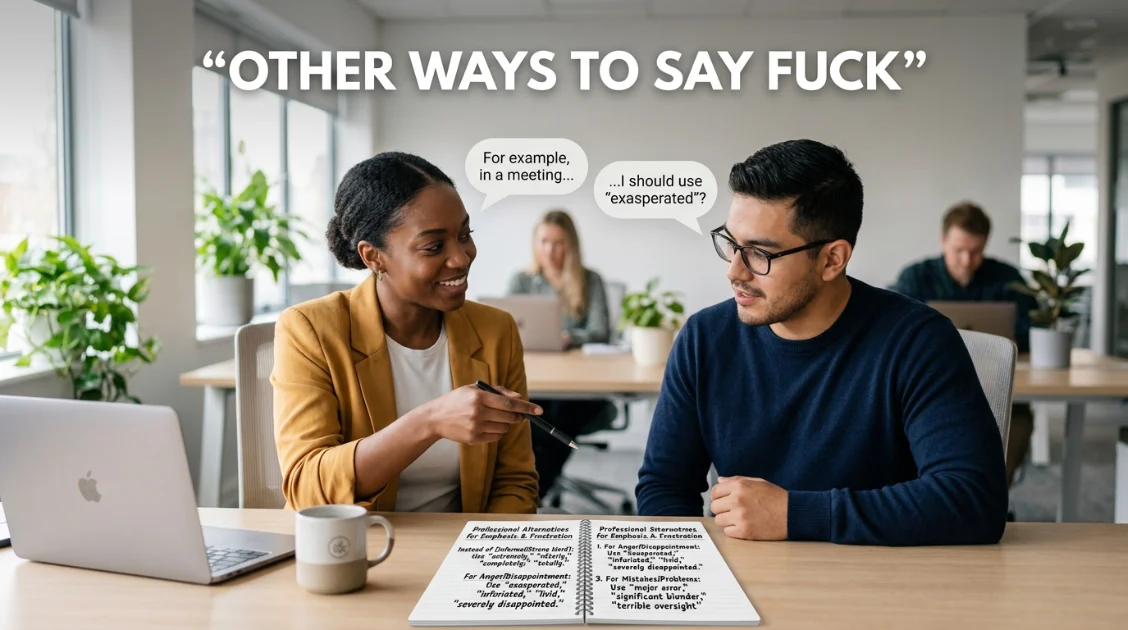
There are many ways to replace fuck depending on your meaning, tone, and audience. Common alternatives include damn, swear, mess up, have sex, annoy, heck, curse, and screw up. Choose carefully because the original word is highly informal and often offensive.
Knowing other ways to say fuck can help English learners communicate the intended meaning without sounding unnecessarily rude or inappropriate. The word can express anger, frustration, surprise, emphasis, sexual activity, or failure, so its meaning depends heavily on context and tone.
Learning alternatives to fuck gives you more control over your English in conversations, workplaces, writing, and social situations. Some expressions are mild, while others remain informal or offensive. Understanding these differences can improve fluency just as learning how to express excitement in English helps you choose words that match your emotions. This guide explains 30 alternatives with meanings, examples, tone information, and practical usage advice so you can communicate confidently while choosing language appropriate for your audience.
Quick Categories
Formal alternatives to “fuck”
- Have sexual intercourse
- Have sexual relations
- Make a serious mistake
- Cause a problem
Pro Tip: In formal or professional communication, describe the exact meaning rather than replacing the word with another offensive expression.
Casual alternatives
- Screw up
- Mess up
- Damn
- Heck
Pro Tip: Casual alternatives work well with friends, but always consider whether the listener is comfortable with informal language.
Professional alternatives
- Make a mistake
- Handle poorly
- Cause difficulties
- Create a problem
Pro Tip: Professional English should focus on the situation and meaning instead of emotional profanity.
Informal expressions
- Screw
- Crap
- Damn it
- What the heck
Pro Tip: These informal expressions in English are generally milder than the original word, but some can still sound inappropriate in formal settings.
“Fluent English is not about using stronger words. It is about choosing the right words for the situation.”
Common Mistakes
1. Using “fuck” in professional emails
Mistake: “This project is fucking difficult.”
Better: “This project is extremely challenging.”
Why: Profanity can make professional communication sound aggressive or careless.
2. Assuming every meaning has the same replacement
Mistake: Replacing every use of “fuck” with “screw.”
Better: Identify whether the word expresses anger, sex, failure, or emphasis first.
Why: The correct alternative depends on the intended meaning.
3. Using “have sex” when discussing frustration
Mistake: “Have sex! I forgot my keys.”
Better: “Damn it! I forgot my keys.”
Why: “Have sex” only works when the intended meaning is sexual activity.
4. Using “screw up” for every situation
Mistake: “He screwed up the client” when you mean he offended the client.
Better: “He upset the client.”
Why: “Screw up” generally means making a mistake or handling something badly.
5. Using mild expressions without understanding tone
Mistake: “What the heck!” in a highly formal presentation.
Better: “That is surprising.”
Why: Even mild exclamations may not fit every professional context.
What Does “Fuck” Mean?
Fuck is a highly informal and often offensive English word with several meanings. Depending on context, it can refer to sexual activity, express anger or frustration, describe making a mistake, or add strong emphasis.
Because the word has several meanings, grammar and context are especially important.
Example: “I fucked up the report.”
Here, fucked up means made a serious mistake, not the sexual meaning of the word.
When to Use “Fuck”
The word can appear in:
- Very informal conversations: Usually among people who are comfortable with strong language.
- Emotional speech: It may express anger, frustration, shock, or excitement.
- Entertainment: Movies, music, comedy, and informal online communication may use it.
- Sexual contexts: It can be used as a vulgar term for sexual intercourse.
- Strong emphasis: Speakers sometimes use it to intensify another word or statement.
Spoken vs. Written: It is more common in informal spoken English, although it also appears in informal online writing.
Formal vs. Informal: It is strongly informal and can be offensive. Avoid it in professional documents, academic writing, formal emails, and most workplace situations.
Is It Professional or Polite to Say “Fuck”?
Polite? ❌ No
Professional? ❌ No
The word is widely recognized as profanity. Even when speakers use it casually, it can sound disrespectful, aggressive, or inappropriate depending on the audience.
Business style example: Instead of saying, “This situation is fucked up,” say, “This situation is extremely difficult.”
“The safest professional replacement is usually a precise description of what actually happened.”
Pros and Cons of Using “Fuck”
Pros
- Simple and expressive: It can communicate strong emotion quickly.
- Common usage: Most native English speakers understand it.
- Strong emphasis: It can intensify anger, surprise, or frustration.
- Flexible meaning: Context can give the word several different meanings.
Cons
- Too informal for work: It can damage professional credibility.
- Potentially offensive: Some listeners strongly dislike profanity.
- Limited professional value: It rarely improves formal communication.
- Not suitable for formal writing: Academic and business contexts generally require more appropriate vocabulary.
Other Ways to Say “Fuck” With Examples
These alternatives will help you sound more fluent, confident, and natural in different situations.
Use them according to tone, context, and audience to communicate the intended meaning without unnecessary profanity.
1. Phrase: Damn
Meaning: An expression of anger, frustration, or surprise.
Explanation: “Damn” is considerably milder than the original word and is common in informal speech.
Example Sentence: “Damn, I forgot to send the email.”
Best Use: Casual frustration
Worst Use: Formal meetings
Tone: Informal, emotional, mild
Context Variability: Casual: “Damn, that was close.” Professional: “That is unfortunate.” Spoken: “Damn, I forgot.”
2. Phrase: Heck
Meaning: A mild substitute for a stronger exclamation.
Explanation: “Heck” is often used to soften expressions involving anger, surprise, or confusion.
Example Sentence: “What the heck is going on?”
Best Use: Casual speech
Worst Use: Formal reports
Tone: Mild, casual, friendly
Context Variability: Casual: “What the heck?” Professional: “What is happening?” Spoken: “What the heck is going on?”
3. Phrase: Screw Up
Meaning: To make a mistake or handle something badly.
Explanation: This is a common informal alternative when the original word means making a serious mistake.
Example Sentence: “I screwed up the presentation.”
Best Use: Casual mistakes
Worst Use: Formal reports
Tone: Informal, direct, conversational
Context Variability: Casual: “I screwed up.” Professional: “I made a mistake.” Spoken: “I really screwed up.”
4. Phrase: Mess Up
Meaning: To make a mistake or cause something to go wrong.
Explanation: “Mess up” is milder and more socially acceptable than stronger profanity.
Example Sentence: “I messed up the schedule.”
Best Use: Everyday speech
Worst Use: Legal documents
Tone: Casual, mild, friendly
Context Variability: Casual: “I messed up.” Professional: “I made an error.” Spoken: “I messed up the timing.”
5. Phrase: Make a Mistake
Meaning: To do something incorrectly.
Explanation: This is one of the safest professional alternatives when the original word means making an error.
Example Sentence: “Everyone makes a mistake sometimes.”
Best Use: Professional communication
Worst Use: Emotional outburst
Tone: Neutral, professional, polite
Context Variability: Casual: “I messed up.” Professional: “I made a mistake.” Spoken: “I made a mistake.”
6. Phrase: Handle Poorly
Meaning: To deal with a situation ineffectively.
Explanation: This phrase is useful when someone has managed a situation badly.
Example Sentence: “The complaint was handled poorly.”
Best Use: Workplace feedback
Worst Use: Casual jokes
Tone: Formal, objective, professional
Context Variability: Casual: “He messed that up.” Professional: “The situation was handled poorly.” Spoken: “They handled it poorly.”
7. Phrase: Cause a Problem
Meaning: To create difficulty or trouble.
Explanation: This phrase works when the original word refers to creating a negative situation.
Example Sentence: “The error caused a problem for the team.”
Best Use: Professional English
Worst Use: Emotional speech
Tone: Neutral, professional, clear
Context Variability: Casual: “That caused trouble.” Professional: “That caused a problem.” Spoken: “It caused a problem.”
8. Phrase: Screw
Meaning: An informal word that can replace the original in some expressions.
Explanation: “Screw” is often used to express frustration or describe making a mistake, but context matters.
Example Sentence: “Screw this, I am going home.”
Best Use: Informal speech
Worst Use: Workplace communication
Tone: Informal, emotional, direct
Context Variability: Casual: “Screw this.” Professional: “I would prefer to stop.” Spoken: “Screw it.”
9. Phrase: Screw It
Meaning: An informal expression showing that someone has stopped caring about a situation.
Explanation: It can express frustration, resignation, or a decision to proceed despite a problem.
Example Sentence: “Screw it, I will try again.”
Best Use: Casual conversations
Worst Use: Formal settings
Tone: Informal, frustrated, decisive
Context Variability: Casual: “Screw it.” Professional: “I will proceed anyway.” Spoken: “Screw it, let’s go.”
10. Phrase: Screw This
Meaning: An expression of frustration or rejection.
Explanation: It communicates that someone strongly dislikes or wants to abandon a situation.
Example Sentence: “Screw this, I am leaving.”
Best Use: Informal speech
Worst Use: Professional meetings
Tone: Strong, informal, frustrated
Context Variability: Casual: “Screw this.” Professional: “I cannot continue with this approach.” Spoken: “Screw this, I am done.”
11. Phrase: Crap
Meaning: A mild informal expression for something unpleasant, poor, or frustrating.
Explanation: It is often used as a softer exclamation.
Example Sentence: “Crap, I left my phone at home.”
Best Use: Casual frustration
Worst Use: Academic writing
Tone: Informal, mild, emotional
Context Variability: Casual: “Crap, I forgot.” Professional: “I made an oversight.” Spoken: “Crap, not again.”
12. Phrase: Damn It
Meaning: An expression of frustration or annoyance.
Explanation: This is a familiar informal expression that is much less offensive than stronger profanity.
Example Sentence: “Damn it, I missed the train.”
Best Use: Casual frustration
Worst Use: Formal presentations
Tone: Emotional, informal, direct
Context Variability: Casual: “Damn it!” Professional: “That is frustrating.” Spoken: “Damn it, I missed it.”
13. Phrase: What the Heck
Meaning: A mild expression of surprise, confusion, or frustration.
Explanation: It is a softened version of stronger expressions.
Example Sentence: “What the heck happened here?”
Best Use: Casual questions
Worst Use: Formal reports
Tone: Mild, casual, expressive
Context Variability: Casual: “What the heck?” Professional: “What happened here?” Spoken: “What the heck happened?”
14. Phrase: Have Sex
Meaning: To engage in sexual activity.
Explanation: This is a neutral phrase when the original word is being used with its sexual meaning.
Example Sentence: “The characters decide to have sex.”
Best Use: Neutral discussions
Worst Use: Casual joking
Tone: Neutral, direct, respectful
Context Variability: Casual: “They had sex.” Professional: “They engaged in sexual activity.” Spoken: “They decided to have sex.”
15. Phrase: Have Sexual Intercourse
Meaning: To engage in sexual intercourse.
Explanation: This is a formal and clinical expression appropriate for serious or educational contexts.
Example Sentence: “The report explains the risks of having sexual intercourse without protection.”
Best Use: Medical education
Worst Use: Casual conversation
Tone: Formal, clinical, precise
Context Variability: Casual: “They had sex.” Professional: “They had sexual intercourse.” Spoken: “Sexual intercourse is discussed in the lesson.”
16. Phrase: Have Sexual Relations
Meaning: To engage in sexual activity with another person.
Explanation: This phrase is formal and can sound less direct than casual terminology.
Example Sentence: “The couple had sexual relations.”
Best Use: Formal writing
Worst Use: Casual jokes
Tone: Formal, neutral, discreet
Context Variability: Casual: “They had sex.” Professional: “They had sexual relations.” Spoken: “They were in a relationship and had sexual relations.”
17. Phrase: Make a Mess
Meaning: To create disorder or cause something to become disorganized.
Explanation: This phrase can replace profanity when someone has caused a physical or organizational mess.
Example Sentence: “I made a mess of the kitchen.”
Best Use: Everyday situations
Worst Use: Technical reports
Tone: Casual, mild, conversational
Context Variability: Casual: “I made a mess.” Professional: “The area became disorganized.” Spoken: “I made a mess of everything.”
18. Phrase: Ruin
Meaning: To damage something or make it unsuccessful.
Explanation: “Ruin” is a strong but neutral verb that works well when something has been seriously damaged.
Example Sentence: “The mistake ruined the entire plan.”
Best Use: General writing
Worst Use: Mild situations
Tone: Direct, neutral, strong
Context Variability: Casual: “You ruined it.” Professional: “The error negatively affected the plan.” Spoken: “That ruined everything.”
19. Phrase: Mess Things Up
Meaning: To cause problems or make a situation worse.
Explanation: This informal phrase is useful when describing poor decisions or mistakes.
Example Sentence: “One small error can mess things up.”
Best Use: Casual conversations
Worst Use: Formal reports
Tone: Informal, conversational, mild
Context Variability: Casual: “I messed things up.” Professional: “I caused an error.” Spoken: “I really messed things up.”
20. Phrase: Go Wrong
Meaning: To develop into an unsuccessful or problematic situation.
Explanation: This is a neutral alternative when something has failed or produced an unwanted result.
Example Sentence: “Something went wrong during the presentation.”
Best Use: Professional speech
Worst Use: Strong emotional expression
Tone: Neutral, professional, clear
Context Variability: Casual: “Something went wrong.” Professional: “There was an issue.” Spoken: “Something went wrong.”
21. Phrase: Fail
Meaning: To be unsuccessful in achieving an intended result.
Explanation: “Fail” is direct and appropriate when discussing an unsuccessful attempt.
Example Sentence: “The system failed during testing.”
Best Use: Professional contexts
Worst Use: Friendly encouragement
Tone: Direct, neutral, professional
Context Variability: Casual: “It failed.” Professional: “The system failed.” Spoken: “The attempt failed.”
22. Phrase: Screw Someone Over
Meaning: To treat someone unfairly or cause them serious difficulty.
Explanation: This is an informal phrase that can replace profanity when discussing unfair treatment.
Example Sentence: “I feel like the company screwed me over.”
Best Use: Informal complaints
Worst Use: Business letters
Tone: Informal, emotional, negative
Context Variability: Casual: “They screwed me over.” Professional: “I believe I was treated unfairly.” Spoken: “I feel like they screwed me over.”
23. Phrase: Treat Unfairly
Meaning: To behave toward someone in an unjust way.
Explanation: This is the professional alternative to stronger informal language about unfair treatment.
Example Sentence: “I believe the employee was treated unfairly.”
Best Use: Professional complaints
Worst Use: Casual joking
Tone: Formal, objective, professional
Context Variability: Casual: “They treated me badly.” Professional: “I was treated unfairly.” Spoken: “I believe I was treated unfairly.”
24. Phrase: Annoy
Meaning: To make someone feel irritated or bothered.
Explanation: This can replace the original word when it is used to express strong annoyance toward someone.
Example Sentence: “His constant interruptions really annoy me.”
Best Use: Everyday speech
Worst Use: Strong anger
Tone: Neutral, direct, mild
Context Variability: Casual: “You annoy me.” Professional: “The interruptions are disruptive.” Spoken: “That really annoys me.”
25. Phrase: Irritate
Meaning: To make someone feel annoyed or uncomfortable.
Explanation: “Irritate” is a more neutral and professional choice than profanity.
Example Sentence: “The repeated delays are beginning to irritate the team.”
Best Use: Professional communication
Worst Use: Friendly banter
Tone: Neutral, formal, controlled
Context Variability: Casual: “That irritates me.” Professional: “The delays are irritating.” Spoken: “It really irritates me.”
26. Phrase: Frustrate
Meaning: To make someone feel upset because progress is difficult.
Explanation: This is an excellent professional alternative for expressing strong annoyance.
Example Sentence: “The repeated technical problems are frustrating.”
Best Use: Workplace communication
Worst Use: Lighthearted situations
Tone: Professional, emotional, controlled
Context Variability: Casual: “This is frustrating.” Professional: “The delays are frustrating.” Spoken: “This really frustrates me.”
27. Phrase: Get Angry
Meaning: To become angry or upset.
Explanation: This neutral phrase can replace profanity when the main purpose is to describe an emotional reaction.
Example Sentence: “Try not to get angry about the mistake.”
Best Use: Everyday communication
Worst Use: Technical description
Tone: Neutral, clear, simple
Context Variability: Casual: “I got angry.” Professional: “I became frustrated.” Spoken: “I got really angry.”
28. Phrase: Lose Your Temper
Meaning: To suddenly become very angry.
Explanation: This idiomatic expression is useful when describing an intense emotional reaction.
Example Sentence: “He lost his temper during the meeting.”
Best Use: Describing behavior
Worst Use: Mild annoyance
Tone: Neutral, expressive, idiomatic
Context Variability: Casual: “He lost his temper.” Professional: “He reacted angrily.” Spoken: “She lost her temper.”
29. Phrase: Be Extremely Frustrated
Meaning: To feel a very strong level of frustration.
Explanation: This phrase communicates intensity without using profanity.
Example Sentence: “I was extremely frustrated by the repeated delays.”
Best Use: Professional English
Worst Use: Casual joking
Tone: Formal, controlled, clear
Context Variability: Casual: “I was really frustrated.” Professional: “I was extremely frustrated.” Spoken: “I was extremely frustrated.”
30. Phrase: Be Completely Fed Up
Meaning: To be extremely annoyed or tired of a situation.
Explanation: This idiomatic expression is informal but much less offensive than profanity.
Example Sentence: “I am completely fed up with these repeated delays.”
Best Use: Strong frustration
Worst Use: Formal reports
Tone: Informal, expressive, frustrated
Context Variability: Casual: “I am fed up.” Professional: “I am dissatisfied with the situation.” Spoken: “I am completely fed up.”
“Strong emotions can be communicated clearly without relying on profanity.”
Mini Quiz / Self Check
1. Which phrase is most suitable for a professional email?
A. Fuck this problem
B. Screw this
C. I am extremely frustrated
D. What the heck
Answer: C. I am extremely frustrated
2. Which phrase can mean “make a serious mistake”?
A. Have sex
B. Screw up
C. Get angry
D. Irritate
Answer: B. Screw up
3. Which phrase is a neutral alternative when discussing sexual activity?
A. Have sexual intercourse
B. Damn it
C. Mess up
D. Screw this
Answer: A. Have sexual intercourse
4. Which expression is most informal?
A. Treat unfairly
B. Cause a problem
C. The original profanity
D. Make a mistake
Answer: C. The original profanity
Comparison Table: Top Alternatives
| Phrase | Tone | Best Use |
|---|---|---|
| Make a mistake | Professional, neutral | Workplace communication |
| Screw up | Informal, conversational | Casual mistakes |
| Mess up | Casual, mild | Everyday speech |
| Damn | Informal, emotional | Casual frustration |
| Heck | Mild, friendly | Casual reactions |
| Frustrate | Professional, controlled | Workplace communication |
| Irritate | Neutral, formal | Professional discussion |
| Have sex | Neutral, direct | General discussion |
| Have sexual intercourse | Formal, clinical | Educational writing |
| Lose your temper | Neutral, expressive | Describing anger |
FAQs
What are the best other ways to say fuck?
The best alternative depends on the meaning. Damn, screw up, mess up, make a mistake, frustrate, and have sex can work in different contexts.
What is a polite way to say fuck?
For emotional situations, I am frustrated, that is unfortunate, or what happened? can replace profanity with more polite language.
What is the professional alternative to fuck?
There is no single professional replacement because the word has multiple meanings. Use precise phrases such as make a mistake, cause a problem, frustrate, or have sexual intercourse, depending on context.
Is “screw” a polite alternative to fuck?
“Screw” is generally milder, but it remains informal. It is not always appropriate in professional or formal communication.
What does “fuck up” mean?
“Fuck up” usually means to make a serious mistake or cause something to go wrong. A professional alternative is make a mistake or handle something poorly.
Conclusion
Learning other ways to say fuck gives you greater control over tone, meaning, and audience. Because the word can communicate several different ideas, choosing an accurate alternative is more effective than simply replacing it with another informal expression.
Practice these professional reaction phrases and everyday alternatives in realistic sentences. With regular practice, you can recognize when informal language is appropriate and when a neutral or professional expression will communicate your message more effectively.
Discover More Post:
- Other Ways to Say Diarrhea | Polite, Professional & Clear …
- 30+ Other Ways to Say Good to Hear | Natural, Professional …
- Other Ways to Say It Means a Lot | Meaningful Expressions …

Logan Hayes is a content writer at Replynst.com. He specializes in turning complex topics into simple, engaging and useful articles. His work combines careful research, clear writing to create content readers can trust.