Quick Answer:
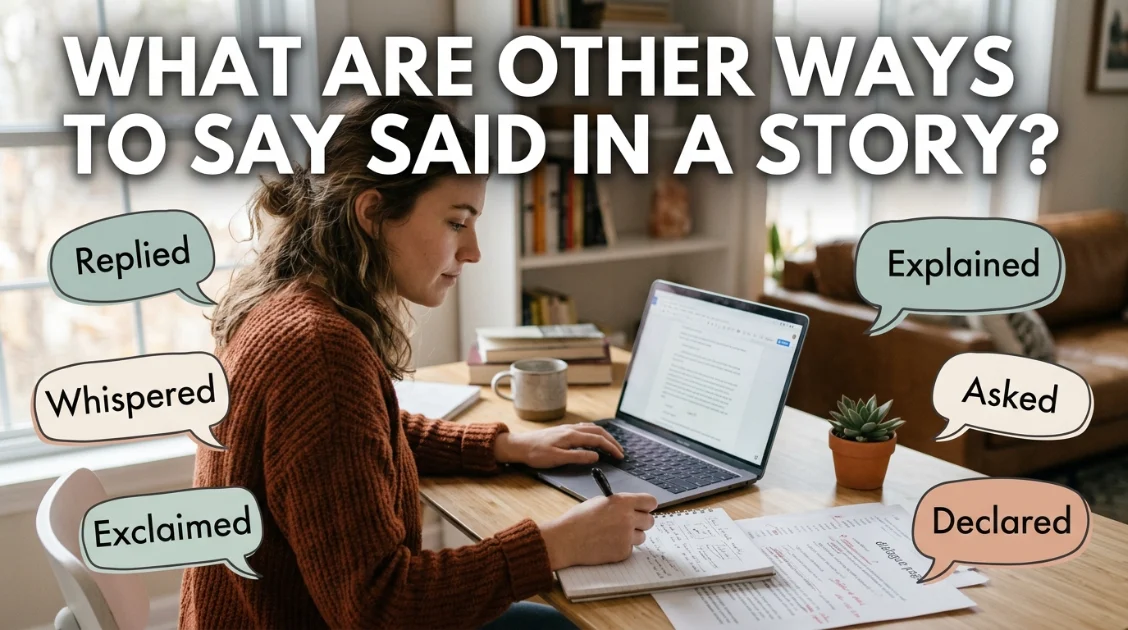
There are many effective alternatives to said in a story, including replied, whispered, exclaimed, explained, shouted, murmured, stated, asked, responded, and remarked. Choosing the right dialogue verb can make your storytelling more vivid, natural, and engaging.
When writing stories, repeating the word said can make dialogue feel predictable, especially when several characters speak in the same scene. Learning what are other ways to say said in a story can help writers create clearer dialogue, show emotion, and make conversations more engaging without adding unnecessary description.
Strong dialogue verbs help readers understand how a character speaks and reacts. Words such as whispered, replied, exclaimed, murmured, and argued can add context while keeping sentences natural. Whether you are writing fiction, essays, short stories, or creative assignments, choosing the right alternative improves your vocabulary and storytelling style. Just as learners study professional reaction phrases or ways to express excitement in English, understanding dialogue vocabulary helps you communicate character emotions more effectively and confidently.
Quick Categories
Formal alternatives to “said”
- Stated
- Declared
- Explained
- Remarked
Pro Tip: Use formal dialogue verbs when the character is making an important statement or when the story has a serious tone.
Casual alternatives
- Replied
- Answered
- Mentioned
- Added
Pro Tip: Simple dialogue verbs often sound more natural in everyday conversations between characters.
Professional alternatives
- Explained
- Noted
- Responded
- Confirmed
Pro Tip: Professional dialogue benefits from precise verbs that communicate the speaker’s purpose without exaggerating emotion.
Informal expressions
- Whispered
- Murmured
- Muttered
- Blurted
Pro Tip: Use informal and emotional dialogue verbs when the character’s voice, mood, or reaction is important to the scene.
“A strong dialogue verb does more than replace ‘said’. It helps readers hear the character’s voice.”
Common Mistakes
1. Replacing “said” in every sentence
Mistake: “I am tired,” she complained. “I am hungry,” she groaned. “I want to leave,” she sighed.
Better: “I am tired,” she said. “I am hungry,” she added.
Why: Using dramatic verbs repeatedly can make dialogue feel forced.
2. Using an incorrect dialogue verb
Mistake: “I love this book,” she whispered loudly.
Better: “I love this book,” she exclaimed.
Why: The dialogue verb should match the volume and emotion of the character.
3. Choosing complicated words unnecessarily
Mistake: “I agree,” he articulated.
Better: “I agree,” he said.
Why: Simple dialogue is often more natural than using an unusual synonym simply to avoid repetition.
4. Using emotional verbs without emotional context
Mistake: “The meeting starts at nine,” he screamed.
Better: “The meeting starts at nine,” he stated.
Why: “Screamed” suggests strong emotion and loud volume, which may not fit the sentence.
5. Adding too many dialogue tags
Mistake: “Where are you going?” she asked nervously.
Better: “Where are you going?” She watched him leave.
Why: Actions can sometimes communicate emotion more naturally than repeated dialogue tags.
What Does “Said” Mean in a Story?
Said is a common dialogue tag used to identify the person speaking. It tells the reader who said the words without necessarily describing emotion, volume, or attitude.
The word is a past-tense form of say and is usually followed by the speaker’s name or pronoun.
Example: “I will see you tomorrow,” James said.
In storytelling, said is often considered a neutral dialogue tag because it identifies the speaker without strongly directing the reader’s interpretation.
When to Use “Said” in a Story
You can use said in several common storytelling situations:
- Simple dialogue: When the character is making a straightforward statement.
- Fast conversations: When dialogue needs to move quickly.
- Neutral scenes: When no special emotion needs to be emphasized.
- Long conversations: When repeated dramatic verbs would become distracting.
- Fiction writing: When clarity is more important than descriptive wording.
Spoken vs. Written: “Said” is especially common in written dialogue because it clearly identifies the speaker.
Formal vs. Informal: It is neutral and can work in both formal and informal storytelling.
Is “Said” Professional or Effective in Story Writing?
Natural? Yes
Professional? Yes
Effective? Yes, when used appropriately
“Said” is not a weak word simply because it is common. Professional writers often use it because readers can process it quickly without being distracted.
Story-writing example: “I don’t think we should go,” Maria said.
However, alternatives can be useful when the writer needs to communicate emotion, volume, hesitation, or attitude.
Pros and Cons of Using “Said”
Pros
- Simple and natural: Readers understand it immediately.
- Neutral tone: It does not force an emotion onto the dialogue.
- Common usage: It is widely accepted in fiction and creative writing.
- Easy to understand: It keeps attention on the actual dialogue.
Cons
- Can become repetitive: Frequent repetition may feel noticeable.
- Limited emotional detail: It does not show how something was said.
- Less descriptive: It may not communicate volume or attitude.
- Not always enough: Emotional scenes may benefit from more specific verbs.
“You do not need to eliminate ‘said’. You need to know when another verb adds useful information.”
Other Ways to Say “Said” in a Story With Examples
These alternatives will help you write more fluent, vivid, and natural dialogue.
Use each phrase according to the character’s emotion, volume, intention, and the overall context of the story.
1. Phrase: Replied
Meaning: Responded to something another person said.
Explanation: “Replied” is a natural alternative when a character answers another speaker.
Example Sentence: “Of course I’ll help,” she replied.
Best Use: Direct responses
Worst Use: First statements
Tone: Neutral, natural, conversational
Context Variability: Casual: “Sure,” he replied. Professional: “I understand,” she replied. Spoken: “Yes, that’s correct,” he replied.
2. Phrase: Responded
Meaning: Gave an answer or reaction.
Explanation: “Responded” works well when emphasizing a character’s reaction to another statement.
Example Sentence: “I already know,” Daniel responded.
Best Use: Dialogue reactions
Worst Use: Emotional scenes
Tone: Neutral, formal, clear
Context Variability: Casual: “Okay,” she responded. Professional: “I understand,” he responded. Spoken: “That makes sense,” she responded.
3. Phrase: Answered
Meaning: Gave a response to a question.
Explanation: Use “answered” when the character is directly responding to a question.
Example Sentence: “The library is across the street,” she answered.
Best Use: Questions
Worst Use: Statements
Tone: Neutral, direct, clear
Context Variability: Casual: “At home,” he answered. Professional: “The deadline is Friday,” she answered. Spoken: “Yes,” he answered.
4. Phrase: Explained
Meaning: Gave information to make something clear.
Explanation: “Explained” is useful when a character provides details or clarification.
Example Sentence: “The train leaves at six,” she explained.
Best Use: Giving details
Worst Use: Simple reactions
Tone: Informative, neutral, professional
Context Variability: Casual: “That’s why I left,” she explained. Professional: “The process takes two days,” he explained. Spoken: “Let me explain,” she said.
5. Phrase: Whispered
Meaning: Spoke very quietly.
Explanation: “Whispered” immediately tells readers that the character is speaking in a very low voice.
Example Sentence: “Don’t wake him,” she whispered.
Best Use: Quiet scenes
Worst Use: Loud scenes
Tone: Quiet, secretive, gentle
Context Variability: Casual: “Come here,” she whispered. Professional: “Keep this confidential,” he whispered. Spoken: “Be quiet,” she whispered.
6. Phrase: Murmured
Meaning: Spoke quietly and sometimes unclearly.
Explanation: “Murmured” can suggest softness, uncertainty, tiredness, or low volume.
Example Sentence: “I don’t know,” he murmured.
Best Use: Quiet dialogue
Worst Use: Loud arguments
Tone: Soft, subdued, thoughtful
Context Variability: Casual: “Maybe tomorrow,” she murmured. Professional: “I am not sure,” he murmured. Spoken: “I suppose so,” she murmured.
7. Phrase: Muttered
Meaning: Spoke quietly in an annoyed or dissatisfied way.
Explanation: “Muttered” often suggests that the character is unhappy or speaking under their breath.
Example Sentence: “This is ridiculous,” he muttered.
Best Use: Frustrated dialogue
Worst Use: Happy greetings
Tone: Irritated, quiet, informal
Context Variability: Casual: “Not again,” he muttered. Professional: “This is inconvenient,” she muttered. Spoken: “I can’t believe this,” he muttered.
8. Phrase: Exclaimed
Meaning: Spoke suddenly with strong emotion.
Explanation: Use “exclaimed” when the character expresses excitement, surprise, anger, or another strong reaction.
Example Sentence: “We actually won!” she exclaimed.
Best Use: Strong reactions
Worst Use: Neutral statements
Tone: Excited, emotional, energetic
Context Variability: Casual: “That’s amazing!” she exclaimed. Professional: “We reached our target!” he exclaimed. Spoken: “You came!” she exclaimed.
9. Phrase: Shouted
Meaning: Spoke very loudly.
Explanation: “Shouted” clearly communicates high volume and is useful during arguments or urgent situations.
Example Sentence: “Stop!” he shouted.
Best Use: Urgent scenes
Worst Use: Quiet settings
Tone: Loud, urgent, forceful
Context Variability: Casual: “Wait for me!” she shouted. Professional: “Everyone, leave the building!” he shouted. Spoken: “Look out!” she shouted.
10. Phrase: Screamed
Meaning: Spoke or cried out in an extremely loud voice.
Explanation: “Screamed” suggests very strong emotion such as fear, anger, or excitement.
Example Sentence: “Get away from me!” she screamed.
Best Use: Extreme emotion
Worst Use: Calm dialogue
Tone: Intense, emotional, dramatic
Context Variability: Casual: “I won!” she screamed. Professional: “Call security!” he screamed. Spoken: “Help!” she screamed.
11. Phrase: Declared
Meaning: Stated something confidently or publicly.
Explanation: “Declared” works well when a character makes a strong or important statement.
Example Sentence: “I will never give up,” she declared.
Best Use: Strong statements
Worst Use: Small talk
Tone: Confident, strong, formal
Context Variability: Casual: “I’m staying,” he declared. Professional: “The project is complete,” she declared. Spoken: “This is my decision,” he declared.
12. Phrase: Stated
Meaning: Expressed something clearly and directly.
Explanation: “Stated” is more formal than “said” and suits serious or factual dialogue.
Example Sentence: “The evidence is clear,” the lawyer stated.
Best Use: Formal dialogue
Worst Use: Emotional scenes
Tone: Formal, direct, factual
Context Variability: Casual: “That’s my opinion,” he stated. Professional: “The report is complete,” she stated. Spoken: “That is correct,” he stated.
13. Phrase: Remarked
Meaning: Made a comment or observation.
Explanation: “Remarked” is useful when a character casually comments on something.
Example Sentence: “It’s unusually quiet today,” she remarked.
Best Use: Observations
Worst Use: Urgent commands
Tone: Casual, thoughtful, neutral
Context Variability: Casual: “That’s interesting,” he remarked. Professional: “The results are surprising,” she remarked. Spoken: “It looks different,” he remarked.
14. Phrase: Mentioned
Meaning: Referred to something briefly.
Explanation: “Mentioned” works when a character brings up information without emphasizing it.
Example Sentence: “Sarah is joining us later,” he mentioned.
Best Use: Brief information
Worst Use: Emotional speeches
Tone: Casual, neutral, understated
Context Variability: Casual: “I saw him yesterday,” she mentioned. Professional: “The manager mentioned the deadline,” he said. Spoken: “I mentioned that earlier,” she said.
15. Phrase: Added
Meaning: Said something extra after a previous statement.
Explanation: “Added” helps connect two related pieces of dialogue.
Example Sentence: “We should leave now,” he added.
Best Use: Continued dialogue
Worst Use: First statements
Tone: Natural, neutral, conversational
Context Variability: Casual: “And bring your coat,” she added. Professional: “The meeting starts at nine,” he added. Spoken: “One more thing,” she added.
16. Phrase: Asked
Meaning: Spoke in order to request information.
Explanation: “Asked” is the natural dialogue tag for questions.
Example Sentence: “Where are you going?” she asked.
Best Use: Questions
Worst Use: Statements
Tone: Neutral, natural, clear
Context Variability: Casual: “Are you coming?” he asked. Professional: “Could you clarify that?” she asked. Spoken: “What happened?” he asked.
17. Phrase: Suggested
Meaning: Offered an idea or possible action.
Explanation: “Suggested” shows that the character is proposing something rather than simply stating it.
Example Sentence: “Why don’t we leave early?” she suggested.
Best Use: Ideas
Worst Use: Emotional reactions
Tone: Helpful, thoughtful, neutral
Context Variability: Casual: “Let’s walk,” he suggested. Professional: “We could revise the plan,” she suggested. Spoken: “Maybe we should wait,” he suggested.
18. Phrase: Argued
Meaning: Presented a reason in disagreement with someone.
Explanation: “Argued” is useful when a character strongly defends an opinion.
Example Sentence: “That was not my responsibility,” he argued.
Best Use: Disagreements
Worst Use: Friendly greetings
Tone: Assertive, tense, forceful
Context Variability: Casual: “I never said that,” she argued. Professional: “The figures do not support that conclusion,” he argued. Spoken: “You’re wrong,” she argued.
19. Phrase: Complained
Meaning: Expressed dissatisfaction or annoyance.
Explanation: “Complained” shows that the character is unhappy about a situation.
Example Sentence: “We’ve been waiting for hours,” he complained.
Best Use: Dissatisfaction
Worst Use: Celebrations
Tone: Negative, frustrated, direct
Context Variability: Casual: “It’s too cold,” she complained. Professional: “The schedule is unrealistic,” he complained. Spoken: “This isn’t fair,” she complained.
20. Phrase: Admitted
Meaning: Accepted or acknowledged something, often reluctantly.
Explanation: “Admitted” adds meaning when a character reveals something they previously avoided acknowledging.
Example Sentence: “I was wrong,” he admitted.
Best Use: Confessions
Worst Use: Routine statements
Tone: Honest, reflective, serious
Context Variability: Casual: “I ate the last cookie,” she admitted. Professional: “We made an error,” he admitted. Spoken: “I forgot,” she admitted.
21. Phrase: Confessed
Meaning: Revealed something personal or previously hidden.
Explanation: “Confessed” is stronger than “admitted” and often suggests secrecy.
Example Sentence: “I was afraid,” she confessed.
Best Use: Personal revelations
Worst Use: Simple facts
Tone: Emotional, honest, serious
Context Variability: Casual: “I broke it,” he confessed. Professional: “I made the mistake,” she confessed. Spoken: “I never told you the truth,” he confessed.
22. Phrase: Promised
Meaning: Gave an assurance that something would happen.
Explanation: “Promised” shows that the character is making a commitment.
Example Sentence: “I will come back,” he promised.
Best Use: Commitments
Worst Use: Questions
Tone: Reassuring, sincere, confident
Context Variability: Casual: “I’ll call you,” she promised. Professional: “We will deliver it tomorrow,” he promised. Spoken: “I won’t forget,” she promised.
23. Phrase: Warned
Meaning: Told someone about a possible danger or problem.
Explanation: “Warned” adds urgency and shows that the character wants someone to be careful.
Example Sentence: “Don’t touch that,” he warned.
Best Use: Danger scenes
Worst Use: Friendly greetings
Tone: Serious, urgent, cautious
Context Variability: Casual: “Be careful,” she warned. Professional: “The deadline is approaching,” he warned. Spoken: “Watch out,” she warned.
24. Phrase: Encouraged
Meaning: Gave someone confidence or motivation.
Explanation: “Encouraged” works when a character supports another person.
Example Sentence: “You can do this,” she encouraged.
Best Use: Supportive dialogue
Worst Use: Arguments
Tone: Positive, supportive, warm
Context Variability: Casual: “Keep going,” he encouraged. Professional: “You have the skills for this,” she encouraged. Spoken: “Don’t give up,” he encouraged.
25. Phrase: Urged
Meaning: Strongly encouraged someone to do something.
Explanation: “Urged” suggests more force or urgency than “encouraged.”
Example Sentence: “You need to leave now,” she urged.
Best Use: Urgent advice
Worst Use: Casual observations
Tone: Urgent, persuasive, serious
Context Variability: Casual: “Come with us,” he urged. Professional: “We should act immediately,” she urged. Spoken: “Please listen,” he urged.
26. Phrase: Observed
Meaning: Made a thoughtful comment about something.
Explanation: “Observed” works well when a character notices or analyzes something.
Example Sentence: “The room looks different,” she observed.
Best Use: Thoughtful comments
Worst Use: Emotional shouting
Tone: Thoughtful, formal, analytical
Context Variability: Casual: “It’s getting dark,” he observed. Professional: “The results have changed,” she observed. Spoken: “Something feels unusual,” he observed.
27. Phrase: Announced
Meaning: Told people important information publicly.
Explanation: “Announced” is appropriate when a character communicates news or information to a group.
Example Sentence: “The winner will be announced tomorrow,” she announced.
Best Use: Public information
Worst Use: Private dialogue
Tone: Formal, confident, official
Context Variability: Casual: “We’re leaving tomorrow,” he announced. Professional: “The meeting is canceled,” she announced. Spoken: “Dinner is ready,” he announced.
28. Phrase: Retorted
Meaning: Gave a quick and often sharp reply.
Explanation: “Retorted” is useful during arguments or tense exchanges.
Example Sentence: “I don’t need your help,” she retorted.
Best Use: Arguments
Worst Use: Friendly conversations
Tone: Sharp, defensive, tense
Context Variability: Casual: “Mind your business,” he retorted. Professional: “That is not what I said,” she retorted. Spoken: “I can handle it,” he retorted.
29. Phrase: Interrupted
Meaning: Spoke before another person had finished.
Explanation: “Interrupted” describes dialogue that breaks into another speaker’s turn.
Example Sentence: “But that’s not what happened,” she interrupted.
Best Use: Fast dialogue
Worst Use: Calm monologues
Tone: Direct, urgent, disruptive
Context Variability: Casual: “Wait, I know,” he interrupted. Professional: “May I clarify something?” she interrupted. Spoken: “Hold on,” he interrupted.
30. Phrase: Insisted
Meaning: Said something firmly and refused to change position.
Explanation: “Insisted” shows determination, persistence, or strong belief.
Example Sentence: “I know what I saw,” he insisted.
Best Use: Strong opinions
Worst Use: Casual greetings
Tone: Firm, determined, forceful
Context Variability: Casual: “I’m coming with you,” she insisted. Professional: “The figures are accurate,” he insisted. Spoken: “I am telling the truth,” he insisted.
“Choose a dialogue verb for meaning, not simply for variety.”
Mini Quiz / Self-Check
1. Which alternative is best when a character speaks very quietly?
A. Shouted
B. Whispered
C. Declared
D. Announced
Answer: B. Whispered
2. Which word best fits a character who gives a strong warning?
A. Remarked
B. Mentioned
C. Warned
D. Added
Answer: C. Warned
3. Which dialogue tag is best for a direct question?
A. Asked
B. Declared
C. Promised
D. Stated
Answer: A. Asked
4. Which word suggests that a character firmly maintains an opinion?
A. Murmured
B. Mentioned
C. Insisted
D. Whispered
Answer: C. Insisted
Comparison Table: Top Alternatives
| Phrase | Tone | Best Use |
|---|---|---|
| Replied | Neutral, natural | Direct responses |
| Responded | Formal, clear | Reactions |
| Answered | Neutral, direct | Questions |
| Explained | Informative, professional | Clarification |
| Whispered | Quiet, gentle | Secretive scenes |
| Exclaimed | Excited, emotional | Strong reactions |
| Shouted | Loud, urgent | Arguments |
| Declared | Strong, confident | Important statements |
| Remarked | Casual, thoughtful | Observations |
| Insisted | Firm, determined | Strong opinions |
FAQs
What are other ways to say said in a story?
Common alternatives include replied, answered, whispered, exclaimed, explained, stated, remarked, declared, murmured, and insisted.
What is a better word than “said” in a story?
There is no single best replacement. Choose a word based on the character’s emotion, volume, intention, and the situation.
Should writers avoid using “said” in stories?
No. “Said” is a useful neutral dialogue tag. The goal is to avoid unnecessary repetition, not to remove the word completely.
What are emotional alternatives to “said”?
Words such as exclaimed, screamed, shouted, cried, muttered, and retorted can communicate stronger emotions or reactions.
What is the best alternative to “said” for a question?
Asked is usually the most natural choice when a character directly asks a question.
Conclusion
Learning what are other ways to say said in a story can make your writing more varied, expressive, and engaging. Words such as replied, whispered, exclaimed, explained, argued, and insisted can provide useful information about how a character communicates.
However, strong storytelling is not about replacing every “said” with a complicated verb. Use alternatives when they add meaning, and keep “said” when a neutral dialogue tag works best. With regular practice, you can develop stronger dialogue, improve your vocabulary, and write stories that feel natural and engaging.
Discover More Post:
- How to Say Yes in Other Ways | 30+ Fresh Replies That …
- 30+ Meaningful Alternatives to Honor a Loved One in 2026
- 30+ Other Ways to Say One-Stop Shop | Better Words for …

Emma Richardson is a professional content writer at Replynst.com. She creates clear, engaging and well-researched content designed to answer readers’ questions while following modern SEO best practices. Her focus is on helpful, reader-friendly articles that deliver genuine value.