Quick Answer:
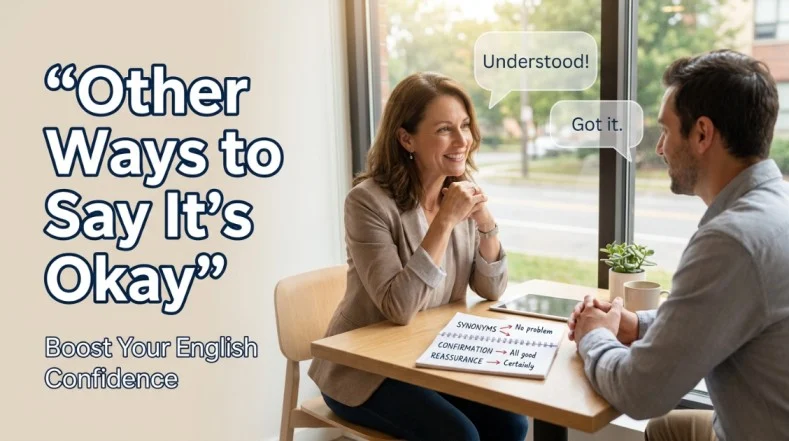
The best alternatives to “it’s okay” include no problem, that’s fine, don’t worry about it, I understand, and everything is fine. The best choice depends on whether you want to sound casual, polite, reassuring, professional, or friendly.
Knowing other ways to say it’s okay can make your English sound more natural, flexible, and confident. Although “it’s okay” is common, repeating the same phrase can make conversations feel limited. Different situations often need different expressions, especially when you are reassuring someone, accepting an apology, or showing that something is not a problem.
Learning alternatives to it’s okay also helps you communicate with the right tone. You might say “no problem” to a friend, “that’s perfectly fine” in a professional conversation, or “I understand” when someone explains a mistake. Just as you learn to express excitement in English, learning professional reaction phrases gives you more control over everyday communication.
Quick Categories
Formal alternatives to “it’s okay”
- That is perfectly acceptable
- That is quite all right
- There is no issue
- That is understandable
Pro Tip: Use formal alternatives when writing emails, responding to clients, or handling sensitive professional situations.
Casual alternatives
- No problem
- That’s fine
- Don’t worry about it
- No worries
Pro Tip: Casual phrases work best with friends, family, classmates, and people you know well.
Professional alternatives
- I understand
- That works for me
- That is not a problem
- That is completely fine
Pro Tip: In professional communication, choose calm and respectful wording instead of expressions that may sound too relaxed.
Informal expressions
- All good
- You’re good
- It’s all right
- No big deal
Pro Tip: Informal expressions in English are useful in relaxed conversations, but they may sound too casual in formal writing.
“Fluent English is not about knowing one phrase. It is about knowing when to choose the right one.”
Common Mistakes
1. Using “it’s okay” for every situation
Mistake: “It’s okay” after every apology, request, and problem.
Better: Choose a phrase that matches the situation, such as “I understand” or “No problem.”
Why: Repeating one expression can make your English sound less flexible.
2. Confusing “it’s okay” with “I agree”
Mistake: “You want to cancel the meeting? It’s okay.”
Better: “That works for me.”
Why: “It’s okay” can mean acceptance, but it does not always clearly show agreement.
3. Using “no worries” in formal emails
Mistake: “No worries about the delay.”
Better: “Thank you for letting me know. That is completely fine.”
Why: “No worries” is friendly but may sound too casual in formal business communication.
4. Saying “you’re good” to someone you do not know well
Mistake: “You’re good” when responding to a professional apology.
Better: “I understand. There is no problem.”
Why: “You’re good” is informal and can sound overly familiar.
5. Using “no big deal” for a serious problem
Mistake: “Your project was seriously damaged? No big deal.”
Better: “I understand. Let’s see how we can resolve this.”
Why: “No big deal” can sound dismissive when someone is dealing with a serious issue.
What Does “It’s Okay” Mean?
“It’s okay” is a common English expression used to show acceptance, reassurance, agreement, or the idea that something is not a problem.
The expression can have different meanings depending on context and tone. It may reassure someone after an apology or describe a situation as acceptable.
Example: “It’s okay. You don’t need to apologize.”
Grammatically, “it’s” is a contraction of “it is.”
When to Use “It’s Okay”
You can use “it’s okay” in many everyday situations:
- Accepting an apology: “It’s okay. I understand.”
- Reassuring someone: “It’s okay. Everything will work out.”
- Accepting a situation: “It’s okay if you cannot come.”
- Showing agreement: “It’s okay with me.”
- Describing something as acceptable: “The result is okay.”
Spoken vs. Written: It is natural in both, although alternatives can make formal writing more precise.
Formal vs. Informal: The phrase is neutral, but the meaning depends heavily on tone and context.
Is It Professional or Polite to Say “It’s Okay”?
Polite? ✔️ Yes
Professional? ✔️ Sometimes
“It’s okay” is generally polite and acceptable, but professional situations often benefit from more specific wording.
For example, instead of simply saying “It’s okay” after a client apologizes, you could say:
Business-style example: “Thank you for letting me know. That is completely fine.”
This sounds reassuring while maintaining a professional tone.
Pros and Cons of Using “It’s Okay”
Pros
- Simple and natural: Almost everyone understands it.
- Friendly tone: It can make conversations feel relaxed.
- Common usage: Native speakers use it frequently.
- Easy to understand: The basic meaning is clear in most situations.
Cons
- Can sound vague: The listener may not know exactly what you mean.
- Overused: Repeating it can limit your vocabulary.
- Limited emotional range: It may not clearly show empathy or agreement.
- Not always suitable for formal writing: More precise phrases can sound stronger professionally.
“A small change in wording can turn a basic response into a warm, professional one.”
Other Ways to Say “It’s Okay” With Examples
These alternatives will help you sound more fluent, confident, and natural in different situations.
Use them according to tone, context, and audience to express reassurance, acceptance, understanding, or approval.
1. Phrase: No Problem
Meaning: The situation does not cause difficulty or concern.
Explanation: This is one of the most common alternatives when accepting an apology or request.
Example Sentence: “No problem. You can send the report tomorrow.”
Best Use: Casual conversations
Worst Use: Formal reports
Tone: Friendly, relaxed, reassuring
Context Variability: Casual: “No problem.” Professional: “No problem at all.” Spoken: “No problem, I understand.”
2. Phrase: That’s Fine
Meaning: Something is acceptable.
Explanation: This simple phrase works well when accepting a situation or decision.
Example Sentence: “That’s fine. We can meet next week instead.”
Best Use: Everyday communication
Worst Use: Serious disputes
Tone: Neutral, polite, calm
Context Variability: Casual: “That’s fine with me.” Professional: “That’s fine. Thank you.” Spoken: “That’s fine.”
3. Phrase: Don’t Worry About It
Meaning: There is no need to feel concerned.
Explanation: Use this phrase to reassure someone after a small mistake or problem.
Example Sentence: “Don’t worry about it. Everyone makes mistakes.”
Best Use: Reassuring friends
Worst Use: Formal complaints
Tone: Friendly, reassuring, casual
Context Variability: Casual: “Don’t worry about it.” Professional: “Please do not worry about the delay.” Spoken: “Don’t worry about it.”
4. Phrase: No Worries
Meaning: There is no problem or concern.
Explanation: This is a friendly informal expression commonly used after an apology or request.
Example Sentence: “No worries. Thanks for letting me know.”
Best Use: Casual speech
Worst Use: Formal letters
Tone: Relaxed, friendly, informal
Context Variability: Casual: “No worries.” Professional: “That is not a problem.” Spoken: “No worries at all.”
5. Phrase: I Understand
Meaning: You recognize and accept someone’s situation or explanation.
Explanation: This phrase is especially useful when someone explains a mistake or difficulty.
Example Sentence: “I understand. These things happen sometimes.”
Best Use: Sensitive situations
Worst Use: Simple approval
Tone: Empathetic, calm, professional
Context Variability: Casual: “I understand.” Professional: “I completely understand.” Spoken: “I understand your situation.”
6. Phrase: That’s Completely Fine
Meaning: Something is fully acceptable.
Explanation: This is a polite and professional way to reassure someone.
Example Sentence: “That’s completely fine. We can reschedule the appointment.”
Best Use: Professional communication
Worst Use: Very casual jokes
Tone: Polite, reassuring, professional
Context Variability: Casual: “That’s fine.” Professional: “That’s completely fine.” Spoken: “That’s completely fine with me.”
7. Phrase: That’s All Right
Meaning: Something is acceptable or not a problem.
Explanation: This is a natural alternative that can sound slightly more traditional than “that’s fine.”
Example Sentence: “That’s all right. You can take your time.”
Best Use: Polite conversations
Worst Use: Technical writing
Tone: Polite, calm, friendly
Context Variability: Casual: “That’s all right.” Professional: “That’s quite all right.” Spoken: “That’s all right.”
8. Phrase: It’s All Good
Meaning: Everything is fine.
Explanation: This informal expression is often used to reassure someone after a small problem.
Example Sentence: “It’s all good. We still have plenty of time.”
Best Use: Casual speech
Worst Use: Formal emails
Tone: Relaxed, friendly, informal
Context Variability: Casual: “It’s all good.” Professional: “Everything is fine.” Spoken: “It’s all good.”
9. Phrase: Everything Is Fine
Meaning: There is no serious problem.
Explanation: This phrase directly reassures someone that the situation is under control.
Example Sentence: “Everything is fine, so there is no need to worry.”
Best Use: Reassurance
Worst Use: Minor approval
Tone: Calm, reassuring, neutral
Context Variability: Casual: “Everything’s fine.” Professional: “Everything is fine.” Spoken: “Everything is fine now.”
10. Phrase: There’s No Problem
Meaning: Something does not cause difficulty.
Explanation: This is a clear alternative when you want to reassure someone or accept a request.
Example Sentence: “There’s no problem. We can make the change.”
Best Use: Professional speech
Worst Use: Emotional support
Tone: Clear, polite, professional
Context Variability: Casual: “There’s no problem.” Professional: “There is no problem with the request.” Spoken: “There’s no problem.”
11. Phrase: That Works for Me
Meaning: You agree with a plan or suggestion.
Explanation: Use this when “it’s okay” means that you accept a proposed arrangement.
Example Sentence: “Friday afternoon? That works for me.”
Best Use: Plans and schedules
Worst Use: Apologies
Tone: Friendly, confident, practical
Context Variability: Casual: “That works for me.” Professional: “Friday works well for me.” Spoken: “That works for me.”
12. Phrase: I Don’t Mind
Meaning: You have no objection to something.
Explanation: This phrase shows that a choice or action does not bother you.
Example Sentence: “I don’t mind if we start a little later.”
Best Use: Personal preferences
Worst Use: Strong agreement
Tone: Neutral, relaxed, accepting
Context Variability: Casual: “I don’t mind.” Professional: “I have no objection.” Spoken: “I don’t mind at all.”
13. Phrase: That Is Acceptable
Meaning: Something meets an acceptable standard.
Explanation: This formal phrase works well when discussing decisions, results, or requirements.
Example Sentence: “The revised proposal is acceptable to our team.”
Best Use: Formal communication
Worst Use: Friendly chats
Tone: Formal, precise, professional
Context Variability: Casual: “That’s fine.” Professional: “That is acceptable.” Spoken: “That is acceptable to us.”
14. Phrase: That Is Perfectly Acceptable
Meaning: Something is completely acceptable.
Explanation: This phrase provides stronger reassurance than simply saying “that is acceptable.”
Example Sentence: “A short delay is perfectly acceptable under these circumstances.”
Best Use: Professional writing
Worst Use: Casual jokes
Tone: Formal, reassuring, confident
Context Variability: Casual: “That’s completely fine.” Professional: “That is perfectly acceptable.” Spoken: “That is perfectly acceptable.”
15. Phrase: There Is No Need to Worry
Meaning: Someone does not need to feel concerned.
Explanation: This phrase focuses on reassurance rather than acceptance.
Example Sentence: “There is no need to worry. We have resolved the issue.”
Best Use: Reassurance
Worst Use: Simple agreement
Tone: Calm, reassuring, supportive
Context Variability: Casual: “Don’t worry.” Professional: “There is no need to worry.” Spoken: “There’s no need to worry.”
16. Phrase: I’m Fine With That
Meaning: You accept or agree with something.
Explanation: This phrase is useful when someone asks for your opinion or permission.
Example Sentence: “I’m fine with that if everyone else agrees.”
Best Use: Giving approval
Worst Use: Formal reports
Tone: Casual, neutral, cooperative
Context Variability: Casual: “I’m fine with that.” Professional: “I am comfortable with that arrangement.” Spoken: “I’m fine with that.”
17. Phrase: That Is Quite All Right
Meaning: Something is completely acceptable.
Explanation: This polite expression is suitable for formal or respectful conversations.
Example Sentence: “That is quite all right. Thank you for explaining.”
Best Use: Polite responses
Worst Use: Casual slang
Tone: Polite, formal, reassuring
Context Variability: Casual: “That’s all right.” Professional: “That is quite all right.” Spoken: “That is quite all right.”
18. Phrase: I Have No Problem With That
Meaning: You do not object to something.
Explanation: This phrase clearly communicates acceptance.
Example Sentence: “I have no problem with that arrangement.”
Best Use: Expressing agreement
Worst Use: Emotional reassurance
Tone: Direct, neutral, confident
Context Variability: Casual: “No problem with that.” Professional: “I have no problem with the proposal.” Spoken: “I have no problem with that.”
19. Phrase: That’s Not an Issue
Meaning: Something will not cause a problem.
Explanation: This is a useful professional phrase for responding to requests or concerns.
Example Sentence: “That’s not an issue. We can update the document.”
Best Use: Workplace communication
Worst Use: Personal apologies
Tone: Professional, calm, clear
Context Variability: Casual: “No problem.” Professional: “That’s not an issue.” Spoken: “That’s not an issue at all.”
20. Phrase: No Big Deal
Meaning: Something is not very important or serious.
Explanation: This informal phrase is useful for minimizing a small mistake or inconvenience.
Example Sentence: “No big deal. We can fix it.”
Best Use: Casual conversations
Worst Use: Serious problems
Tone: Informal, relaxed, friendly
Context Variability: Casual: “No big deal.” Professional: “It is not a major concern.” Spoken: “No big deal.”
21. Phrase: You’re Good
Meaning: You do not need to worry or apologize.
Explanation: This informal phrase is commonly used to reassure someone after a minor mistake.
Example Sentence: “You’re good. You didn’t cause any problems.”
Best Use: Friendly speech
Worst Use: Formal emails
Tone: Informal, friendly, relaxed
Context Variability: Casual: “You’re good.” Professional: “There is no problem.” Spoken: “You’re good.”
22. Phrase: Nothing to Worry About
Meaning: There is no reason for concern.
Explanation: This phrase reassures someone that a situation is under control.
Example Sentence: “There’s nothing to worry about. We have a backup plan.”
Best Use: Reassurance
Worst Use: Formal reports
Tone: Reassuring, friendly, calm
Context Variability: Casual: “Nothing to worry about.” Professional: “There is no cause for concern.” Spoken: “There’s nothing to worry about.”
23. Phrase: It’s Not a Problem
Meaning: Something does not cause difficulty or inconvenience.
Explanation: This is a direct and useful alternative in both personal and professional conversations.
Example Sentence: “It’s not a problem. I can help you with that.”
Best Use: Everyday communication
Worst Use: Serious complaints
Tone: Neutral, polite, reassuring
Context Variability: Casual: “It’s not a problem.” Professional: “It is not a problem at all.” Spoken: “It’s not a problem.”
24. Phrase: That’s Okay With Me
Meaning: You agree with or accept something.
Explanation: This phrase clearly shows personal approval.
Example Sentence: “If you prefer to meet online, that’s okay with me.”
Best Use: Personal agreement
Worst Use: Formal reports
Tone: Friendly, neutral, accepting
Context Variability: Casual: “That’s okay with me.” Professional: “That arrangement works for me.” Spoken: “That’s okay with me.”
25. Phrase: I Can Accept That
Meaning: You are willing to accept a situation or decision.
Explanation: This phrase is useful when discussing choices, compromises, or conditions.
Example Sentence: “I can accept that as a reasonable solution.”
Best Use: Negotiations
Worst Use: Casual apologies
Tone: Direct, mature, professional
Context Variability: Casual: “I can live with that.” Professional: “I can accept that proposal.” Spoken: “I can accept that.”
26. Phrase: That’s Understandable
Meaning: A situation or reaction makes sense.
Explanation: Use this phrase when you want to show empathy rather than simply approve something.
Example Sentence: “That’s understandable. You had several deadlines to meet.”
Best Use: Showing empathy
Worst Use: Simple scheduling
Tone: Empathetic, polite, supportive
Context Variability: Casual: “I understand.” Professional: “That is understandable.” Spoken: “That’s understandable.”
27. Phrase: I Appreciate Your Explanation
Meaning: You recognize and value someone’s explanation.
Explanation: This is a professional way to respond when someone explains a mistake or difficult situation.
Example Sentence: “I appreciate your explanation, and I understand the circumstances.”
Best Use: Professional situations
Worst Use: Casual chats
Tone: Professional, respectful, diplomatic
Context Variability: Casual: “Thanks for explaining.” Professional: “I appreciate your explanation.” Spoken: “I appreciate you explaining that.”
28. Phrase: That Is Not a Concern
Meaning: Something does not cause worry or difficulty.
Explanation: This formal phrase is useful when responding to a concern in professional communication.
Example Sentence: “The minor delay is not a concern for our team.”
Best Use: Business communication
Worst Use: Friendly conversations
Tone: Formal, calm, professional
Context Variability: Casual: “No problem.” Professional: “That is not a concern.” Spoken: “That is not a concern for us.”
29. Phrase: Everything Is Under Control
Meaning: The situation is being managed successfully.
Explanation: This phrase reassures someone that there is no need for further concern.
Example Sentence: “Everything is under control, and the team is handling the issue.”
Best Use: Reassuring others
Worst Use: Simple approval
Tone: Confident, reassuring, professional
Context Variability: Casual: “Everything’s under control.” Professional: “The situation is under control.” Spoken: “Everything is under control.”
30. Phrase: I’m Happy to Accommodate
Meaning: You are willing to adjust or help with someone’s request.
Explanation: This is a polished professional alternative when “it’s okay” means you are willing to accept a change.
Example Sentence: “I’m happy to accommodate your request and move the meeting.”
Best Use: Professional communication
Worst Use: Casual apologies
Tone: Professional, helpful, accommodating
Context Variability: Casual: “Sure, that’s fine.” Professional: “I’m happy to accommodate your request.” Spoken: “I’m happy to accommodate that.”
“Choose ‘I understand’ for empathy, ‘that works for me’ for agreement, and ‘no problem’ for simple reassurance.”
Mini Quiz / Self-Check
1. Which phrase is best for a formal workplace email?
A. No big deal
B. You’re good
C. That is perfectly acceptable
D. It’s all good
Answer: C. That is perfectly acceptable
2. Which phrase best shows agreement with a proposed plan?
A. That works for me
B. Don’t worry about it
C. Nothing to worry about
D. I understand
Answer: A. That works for me
3. Which phrase is most informal?
A. That is acceptable
B. I understand
C. You’re good
D. That is not a concern
Answer: C. You’re good
4. Someone apologizes for a small mistake. Which response sounds natural?
A. That is perfectly acceptable under the circumstances.
B. No problem.
C. I can accept your behavioral situation.
D. That is not a concern of the organization.
Answer: B. No problem.
Comparison Table: Top Alternatives
| Phrase | Tone | Best Use |
|---|---|---|
| No problem | Friendly, neutral | Everyday conversations |
| That’s fine | Neutral, polite | General communication |
| I understand | Empathetic, professional | Sensitive situations |
| That works for me | Confident, practical | Plans and schedules |
| No worries | Friendly, informal | Casual conversations |
| That’s completely fine | Polite, professional | Workplace communication |
| There’s no problem | Clear, reassuring | Professional speech |
| That’s understandable | Empathetic, calm | Explanations |
| That’s not an issue | Professional, calm | Workplace situations |
| That is perfectly acceptable | Formal, precise | Business writing |
FAQs
What are the best other ways to say it’s okay?
Some of the best alternatives are no problem, that’s fine, I understand, that works for me, and that’s completely fine.
What is a polite way to say it’s okay?
You can say that’s completely fine, that’s all right, I understand, or that is perfectly acceptable, depending on the situation.
What is a professional way to say it’s okay?
For professional communication, try that is acceptable, that’s not an issue, I understand, or that is not a concern.
What can I say instead of “it’s okay” after an apology?
Natural choices include no problem, don’t worry about it, I understand, and that’s completely fine.
Is “no worries” professional?
“No worries” is friendly and natural, but it is generally more casual than professional. In formal communication, that’s completely fine or there is no problem may be better.
Conclusion
Learning other ways to say it’s okay gives you more control over your English. Instead of relying on one common expression, you can choose phrases that show agreement, empathy, reassurance, acceptance, or professionalism.
Practice these alternatives in real conversations and written messages. Pay attention to your audience and situation, because the right phrase can make your English sound more natural, confident, and respectful.
Read More Related Articles:
- You’re Welcome Other Ways to Say | 30+ Polished …
- Other Ways to Say Please | Make Every Request Sound More …
- Other Ways to Say Diarrhea | Polite, Professional & Clear …

Emma Richardson is a professional content writer at Replynst.com. She creates clear, engaging and well-researched content designed to answer readers’ questions while following modern SEO best practices. Her focus is on helpful, reader-friendly articles that deliver genuine value.