Quick Answer:
The best alternatives to looking forward to hearing from you include I await your response, I look forward to your reply, and I hope to hear from you soon. The right phrase depends on your relationship with the reader and how formal your message needs to be.
Learning other ways to say looking forward to hearing from you can make your emails sound more natural and professional. This common closing shows that you expect a reply and feel positive about continuing the conversation.
You can use alternatives to looking forward to hearing from you when writing to a client, applying for a job, or sending a friendly message. Learning these phrases helps you choose the right tone, avoid repetition, and express excitement in English. A strong email ending should sound polite, confident, and suited to the situation.
Quick Categories
Formal alternatives to “looking forward to hearing from you”
- I await your response.
- I look forward to your reply.
- I would appreciate your response.
- I hope to hear from you at your earliest convenience.
Pro Tip: Use formal alternatives when writing to clients, hiring managers, or people you do not know well.
Casual alternatives
- Hope to hear from you soon.
- I look forward to hearing from you.
- Let me know what you think.
- I hope we can talk soon.
Pro Tip: Casual phrases work best when you already have a friendly relationship with the reader.
Professional alternatives
- I look forward to your feedback.
- I would welcome your thoughts.
- I look forward to discussing this further.
- Please let me know your thoughts.
Pro Tip: Choose a phrase that matches the action you want from the reader, such as feedback, approval, or a meeting.
Informal expressions
- Talk soon.
- Hope to hear from you.
- Let me know.
- I’ll be in touch.
Pro Tip: Informal expressions in English are useful for friends, familiar colleagues, and relaxed conversations.
“A professional email ending should make the next step clear, not just sound polite.”
Common Mistakes
1. Using “looking forward to hear from you”
Mistake: “I am looking forward to hear from you.”
Correct: “I am looking forward to hearing from you.”
Why: The phrase look forward to is followed by a noun or an -ing form.
2. Using “I look forward to hearing from you” in every email
Mistake: “I look forward to hearing from you” after every message.
Better: “Please let me know your thoughts.”
Why: Different endings make your writing more natural and specific.
3. Using “I await your response” in a friendly message
Mistake: “I await your response, Sarah.”
Better: “Hope to hear from you soon, Sarah.”
Why: “I await your response” can sound formal or stiff in a casual conversation.
4. Using “at your earliest convenience” for urgent requests
Mistake: “Please reply at your earliest convenience” when you need an answer today.
Better: “Could you please reply by the end of today?”
Why: The phrase does not clearly communicate a deadline.
5. Ending an email without a clear next step
Mistake: “Thanks for your time. Best regards.”
Better: “Thanks for your time. Please let me know if you have any questions.”
Why: A clear closing helps the reader understand what you expect next.
What Does “Looking Forward to Hearing From You” Mean?
Looking forward to hearing from you means that you feel positive about receiving a reply from someone.
The phrase uses look forward to + noun or -ing form. Here, hearing means receiving a message or response, not necessarily speaking on the phone.
Example: “I look forward to hearing from you soon.”
When to Use “Looking Forward to Hearing From You”
You can use this phrase in several common situations:
- Job applications: When closing an email to a hiring manager.
- Business emails: When expecting a client’s response.
- Customer service: When inviting a customer to reply.
- Networking: When hoping to continue a professional conversation.
- Friendly messages: When you want to sound warm and positive.
Spoken vs. Written: The phrase is more common in written English, especially at the end of emails.
Formal vs. Informal: It is polite and professional, but it can also work in friendly messages.
Is It Professional or Polite to Say “Looking Forward to Hearing From You”?
Polite? ✔️ Yes
Professional? ✔️ Yes
This phrase is one of the most common professional email closings. It sounds positive, respectful, and confident without being too demanding.
Business-style example: “Thank you for your time. I look forward to hearing from you.”
For a more direct ending, you can use I look forward to your reply or Please let me know your thoughts.
Pros and Cons of Using “Looking Forward to Hearing From You”
Pros
- Simple and natural: Easy to understand and use.
- Friendly tone: Shows that you welcome a response.
- Common usage: Familiar in professional emails.
- Easy to understand: Clearly communicates that you expect a reply.
Cons
- Too informal for work: This is usually not a problem, but some situations need more formal wording.
- Overused: Repeating it can make emails sound less varied.
- Limited emotional range: It does not show urgency or a specific next step.
- Not suitable for formal writing: Some formal letters may need a more traditional closing.
“The best email closing is clear, polite, and matched to the reader.”
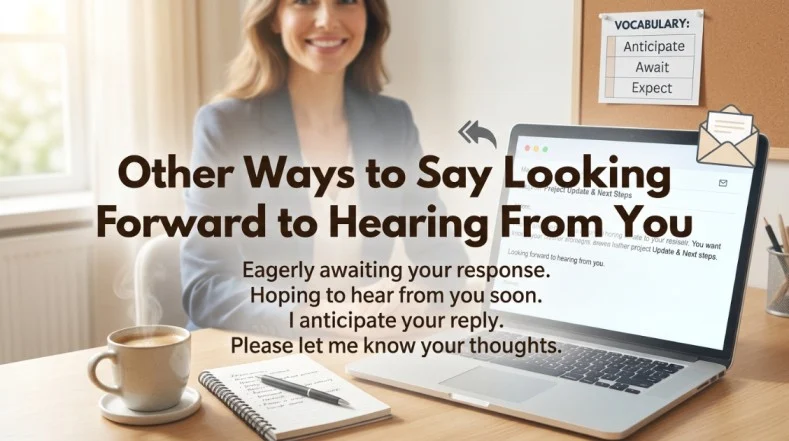
Other Ways to Say “Looking Forward to Hearing From You” With Examples
These alternatives will help you sound more fluent, confident, and natural in different situations.
Use them according to tone, context, and audience to express excitement, appreciation, or approval.
1. Phrase: I Look Forward to Your Reply
Meaning: I am expecting and welcome your response.
Explanation: This is a clear and professional alternative that works well in most business emails.
Example Sentence: “Thank you for your message. I look forward to your reply.”
Best Use: Professional emails
Worst Use: Casual jokes
Tone: Professional, polite, confident
Context Variability: Casual: “I look forward to your reply.” Professional: “I look forward to your reply regarding the proposal.” Spoken: “I look forward to your reply.”
2. Phrase: I Await Your Response
Meaning: I am waiting for your answer.
Explanation: This formal phrase is useful when you expect a response to a request or question.
Example Sentence: “I await your response regarding the application.”
Best Use: Formal correspondence
Worst Use: Friendly chat
Tone: Formal, direct, respectful
Context Variability: Casual: “I hope to hear from you.” Professional: “I await your response.” Spoken: “I await your response.”
3. Phrase: I Hope to Hear From You Soon
Meaning: I hope you will contact me soon.
Explanation: This is a polite and friendly alternative that works in both professional and personal messages.
Example Sentence: “Thank you for your time. I hope to hear from you soon.”
Best Use: General emails
Worst Use: Urgent demands
Tone: Friendly, polite, positive
Context Variability: Casual: “Hope to hear from you soon.” Professional: “I hope to hear from you soon regarding the position.” Spoken: “I hope to hear from you soon.”
4. Phrase: Please Let Me Know Your Thoughts
Meaning: Please share your opinion or feedback.
Explanation: This phrase is useful when you want a response about an idea, proposal, or decision.
Example Sentence: “Please let me know your thoughts on the revised plan.”
Best Use: Feedback requests
Worst Use: Simple greetings
Tone: Professional, polite, clear
Context Variability: Casual: “Let me know what you think.” Professional: “Please let me know your thoughts.” Spoken: “Please let me know your thoughts.”
5. Phrase: I Look Forward to Your Feedback
Meaning: I am eager to receive your comments or suggestions.
Explanation: This is a professional alternative when you specifically want feedback.
Example Sentence: “I look forward to your feedback on the report.”
Best Use: Work communication
Worst Use: Personal messages
Tone: Professional, positive, confident
Context Variability: Casual: “I would love your feedback.” Professional: “I look forward to your feedback.” Spoken: “I look forward to your feedback.”
6. Phrase: I Would Welcome Your Thoughts
Meaning: I would be happy to hear your opinion.
Explanation: This phrase sounds polite and open, making it useful when inviting discussion.
Example Sentence: “I would welcome your thoughts on this proposal.”
Best Use: Professional discussion
Worst Use: Urgent requests
Tone: Polite, formal, open
Context Variability: Casual: “I would love to hear your thoughts.” Professional: “I would welcome your thoughts.” Spoken: “I would welcome your thoughts.”
7. Phrase: I Look Forward to Discussing This Further
Meaning: I am eager to continue the conversation.
Explanation: This phrase is ideal when you want to arrange another discussion or meeting.
Example Sentence: “I look forward to discussing this further with you.”
Best Use: Business meetings
Worst Use: Simple replies
Tone: Professional, positive, confident
Context Variability: Casual: “I hope we can talk more about this.” Professional: “I look forward to discussing this further.” Spoken: “I look forward to discussing this further.”
8. Phrase: I Hope We Can Connect Soon
Meaning: I hope we can communicate or meet soon.
Explanation: This friendly phrase is common in networking and professional introductions.
Example Sentence: “It was great meeting you. I hope we can connect soon.”
Best Use: Networking messages
Worst Use: Formal complaints
Tone: Friendly, professional, warm
Context Variability: Casual: “Hope we can catch up soon.” Professional: “I hope we can connect soon.” Spoken: “I hope we can connect soon.”
9. Phrase: I Look Forward to Speaking With You
Meaning: I am eager to have a conversation with you.
Explanation: This phrase is useful when you expect a phone call, interview, or meeting.
Example Sentence: “I look forward to speaking with you about the position.”
Best Use: Interviews
Worst Use: Written feedback
Tone: Professional, polite, positive
Context Variability: Casual: “I hope we can talk soon.” Professional: “I look forward to speaking with you.” Spoken: “I look forward to speaking with you.”
10. Phrase: I Look Forward to Our Conversation
Meaning: I am eager to talk with you.
Explanation: This phrase sounds warm and professional when a conversation has already been planned.
Example Sentence: “I look forward to our conversation tomorrow.”
Best Use: Scheduled calls
Worst Use: Uncertain plans
Tone: Professional, warm, confident
Context Variability: Casual: “Looking forward to our chat.” Professional: “I look forward to our conversation.” Spoken: “I look forward to our conversation.”
11. Phrase: I Look Forward to Working With You
Meaning: I am excited about working together.
Explanation: This phrase is useful when starting a new professional relationship.
Example Sentence: “Thank you for the opportunity. I look forward to working with you.”
Best Use: New partnerships
Worst Use: Personal emails
Tone: Professional, positive, confident
Context Variability: Casual: “I am excited to work with you.” Professional: “I look forward to working with you.” Spoken: “I look forward to working with you.”
12. Phrase: I Look Forward to Your Confirmation
Meaning: I am waiting for you to confirm something.
Explanation: This phrase is useful when you need confirmation of a booking, meeting, or decision.
Example Sentence: “I look forward to your confirmation of the meeting time.”
Best Use: Business arrangements
Worst Use: General greetings
Tone: Formal, polite, direct
Context Variability: Casual: “Please confirm when you can.” Professional: “I look forward to your confirmation.” Spoken: “I look forward to your confirmation.”
13. Phrase: I Would Appreciate Your Response
Meaning: I would be grateful if you replied.
Explanation: This phrase is polite and useful when requesting an answer.
Example Sentence: “I would appreciate your response by Friday.”
Best Use: Formal requests
Worst Use: Friendly chat
Tone: Formal, polite, respectful
Context Variability: Casual: “Please get back to me.” Professional: “I would appreciate your response.” Spoken: “I would appreciate your response.”
14. Phrase: Please Get Back to Me
Meaning: Please reply to me.
Explanation: This is a common and direct phrase that works in both casual and professional English.
Example Sentence: “Please get back to me when you have a chance.”
Best Use: General communication
Worst Use: Formal letters
Tone: Direct, neutral, polite
Context Variability: Casual: “Get back to me soon.” Professional: “Please get back to me when you have a chance.” Spoken: “Please get back to me.”
15. Phrase: I Hope to Receive Your Response Soon
Meaning: I hope you will reply soon.
Explanation: This is a polite and slightly formal alternative for emails and letters.
Example Sentence: “I hope to receive your response soon regarding the request.”
Best Use: Formal emails
Worst Use: Casual messages
Tone: Formal, polite, patient
Context Variability: Casual: “Hope to hear from you soon.” Professional: “I hope to receive your response soon.” Spoken: “I hope to receive your response soon.”
16. Phrase: I Would Be Grateful for Your Reply
Meaning: I would appreciate receiving your response.
Explanation: This phrase is formal and respectful, especially when making a request.
Example Sentence: “I would be grateful for your reply at your earliest convenience.”
Best Use: Formal requests
Worst Use: Casual chat
Tone: Formal, respectful, polite
Context Variability: Casual: “I would really appreciate a reply.” Professional: “I would be grateful for your reply.” Spoken: “I would be grateful for your reply.”
17. Phrase: I Look Forward to Your Thoughts
Meaning: I am eager to hear your opinion.
Explanation: This is a professional phrase that invites the reader to share ideas or feedback.
Example Sentence: “I look forward to your thoughts on the proposed changes.”
Best Use: Business emails
Worst Use: Urgent demands
Tone: Professional, open, positive
Context Variability: Casual: “I would love your thoughts.” Professional: “I look forward to your thoughts.” Spoken: “I look forward to your thoughts.”
18. Phrase: I Hope to Hear Your Views
Meaning: I hope you will share your opinions.
Explanation: This phrase is useful when inviting someone to discuss an idea or issue.
Example Sentence: “I hope to hear your views on the new policy.”
Best Use: Professional discussions
Worst Use: Simple requests
Tone: Formal, polite, open
Context Variability: Casual: “I would love to hear your views.” Professional: “I hope to hear your views.” Spoken: “I hope to hear your views.”
19. Phrase: I Look Forward to Your Decision
Meaning: I am waiting for you to decide.
Explanation: This phrase is useful when a response involves approval or a final decision.
Example Sentence: “I look forward to your decision regarding the proposal.”
Best Use: Business decisions
Worst Use: Casual conversations
Tone: Formal, direct, professional
Context Variability: Casual: “Let me know what you decide.” Professional: “I look forward to your decision.” Spoken: “I look forward to your decision.”
20. Phrase: I Hope We Can Speak Soon
Meaning: I hope we can have a conversation soon.
Explanation: This is a friendly alternative that works well when you want to continue a discussion.
Example Sentence: “I hope we can speak soon about the project.”
Best Use: Friendly emails
Worst Use: Formal complaints
Tone: Friendly, polite, warm
Context Variability: Casual: “Hope we can talk soon.” Professional: “I hope we can speak soon.” Spoken: “I hope we can speak soon.”
21. Phrase: I Look Forward to Staying in Touch
Meaning: I hope we continue communicating.
Explanation: This phrase is useful after meeting someone or finishing a conversation.
Example Sentence: “It was a pleasure meeting you. I look forward to staying in touch.”
Best Use: Networking
Worst Use: Urgent requests
Tone: Friendly, professional, warm
Context Variability: Casual: “Hope we stay in touch.” Professional: “I look forward to staying in touch.” Spoken: “I look forward to staying in touch.”
22. Phrase: I Hope to Continue Our Conversation
Meaning: I hope we can keep discussing the topic.
Explanation: This phrase is useful when you want to continue a professional or personal discussion.
Example Sentence: “I hope to continue our conversation about the project soon.”
Best Use: Follow-up emails
Worst Use: Simple replies
Tone: Polite, professional, positive
Context Variability: Casual: “Hope we can keep talking.” Professional: “I hope to continue our conversation.” Spoken: “I hope to continue our conversation.”
23. Phrase: I Look Forward to Your Update
Meaning: I am waiting for new information from you.
Explanation: This phrase is useful when expecting progress, news, or a status report.
Example Sentence: “I look forward to your update on the project.”
Best Use: Work communication
Worst Use: Personal messages
Tone: Professional, direct, polite
Context Variability: Casual: “Let me know how it goes.” Professional: “I look forward to your update.” Spoken: “I look forward to your update.”
24. Phrase: I Hope to Receive Your Feedback
Meaning: I hope you will share your comments or suggestions.
Explanation: This is a polite alternative when you want someone to review your work.
Example Sentence: “I hope to receive your feedback on the draft.”
Best Use: Review requests
Worst Use: Casual chat
Tone: Professional, polite, open
Context Variability: Casual: “I would love your feedback.” Professional: “I hope to receive your feedback.” Spoken: “I hope to receive your feedback.”
25. Phrase: I Look Forward to Hearing Your Thoughts
Meaning: I am eager to hear your opinion.
Explanation: This phrase is slightly warmer than “I look forward to your thoughts.”
Example Sentence: “I look forward to hearing your thoughts on the new design.”
Best Use: Creative discussions
Worst Use: Formal complaints
Tone: Warm, professional, positive
Context Variability: Casual: “I would love to hear what you think.” Professional: “I look forward to hearing your thoughts.” Spoken: “I look forward to hearing your thoughts.”
26. Phrase: I Hope to Hear Back From You
Meaning: I hope you will reply to me.
Explanation: This is a natural and common alternative for both casual and professional messages.
Example Sentence: “I hope to hear back from you soon.”
Best Use: General emails
Worst Use: Formal letters
Tone: Friendly, polite, neutral
Context Variability: Casual: “Hope to hear back from you.” Professional: “I hope to hear back from you soon.” Spoken: “I hope to hear back from you.”
27. Phrase: I Would Love to Hear From You
Meaning: I would be happy to receive your message.
Explanation: This phrase sounds warm and friendly, making it useful for personal or relaxed professional messages.
Example Sentence: “I would love to hear from you when you have time.”
Best Use: Friendly communication
Worst Use: Formal requests
Tone: Warm, friendly, positive
Context Variability: Casual: “I would love to hear from you.” Professional: “I would welcome your response.” Spoken: “I would love to hear from you.”
28. Phrase: I Hope We Can Catch Up Soon
Meaning: I hope we can talk and share updates soon.
Explanation: This is a friendly expression that works best with people you already know.
Example Sentence: “It was great hearing from you. I hope we can catch up soon.”
Best Use: Personal messages
Worst Use: Formal emails
Tone: Friendly, informal, warm
Context Variability: Casual: “Hope we can catch up soon.” Professional: “I hope we can reconnect soon.” Spoken: “I hope we can catch up soon.”
29. Phrase: Talk Soon
Meaning: I expect or hope we will speak again soon.
Explanation: This short closing is common in casual messages and friendly emails.
Example Sentence: “Thanks for your help. Talk soon!”
Best Use: Casual messages
Worst Use: Formal letters
Tone: Informal, friendly, warm
Context Variability: Casual: “Talk soon.” Professional: “I look forward to speaking with you.” Spoken: “Talk soon.”
30. Phrase: Please Keep Me Posted
Meaning: Please continue to give me updates.
Explanation: This phrase is useful when you want someone to share new information as it becomes available.
Example Sentence: “Please keep me posted on the progress of the project.”
Best Use: Work communication
Worst Use: Formal complaints
Tone: Professional, friendly, direct
Context Variability: Casual: “Keep me updated.” Professional: “Please keep me posted.” Spoken: “Please keep me posted.”
“A strong closing does more than end an email. It guides the next step.”
Mini Quiz / Self-Check
1. Which phrase is most suitable for a formal business email?
A. Talk soon
B. I await your response
C. Catch you later
D. Hope we can chat
Answer: B. I await your response
2. Which sentence is grammatically correct?
A. I look forward to hear from you.
B. I look forward to hearing from you.
C. I look forward hearing from you.
D. I look forward to heard from you.
Answer: B. I look forward to hearing from you.
3. Which phrase is best when you want feedback on a report?
A. Talk soon
B. I look forward to your feedback
C. I hope we can catch up soon
D. I’ll be in touch
Answer: B. I look forward to your feedback
4. Which phrase is most suitable for a friendly message?
A. I await your response
B. I would be grateful for your reply
C. Hope to hear from you soon
D. I look forward to your decision
Answer: C. Hope to hear from you soon
Comparison Table: Top Alternatives
| Phrase | Tone | Best Use |
|---|---|---|
| I look forward to your reply | Professional, polite | Business emails |
| I await your response | Formal, direct | Formal correspondence |
| I hope to hear from you soon | Friendly, polite | General emails |
| Please let me know your thoughts | Professional, clear | Feedback requests |
| I look forward to your feedback | Professional, positive | Work communication |
| I would welcome your thoughts | Formal, open | Professional discussions |
| I look forward to discussing this further | Professional, confident | Business meetings |
| I hope we can connect soon | Friendly, warm | Networking |
| I look forward to speaking with you | Professional, polite | Interviews |
| Talk soon | Informal, friendly | Casual messages |
FAQs
What are the best other ways to say looking forward to hearing from you?
The best alternatives include I look forward to your reply, I await your response, I hope to hear from you soon, and Please let me know your thoughts.
What is a professional way to say looking forward to hearing from you?
You can say I look forward to your reply, I await your response, or I look forward to your feedback.
Is “looking forward to hearing from you” formal or informal?
It is polite and professional, but it can also be used in friendly messages. The tone depends on the rest of the email.
What is a casual alternative to looking forward to hearing from you?
Hope to hear from you soon, Talk soon, and I hope we can connect soon are natural casual alternatives.
Is “I look forward to hear from you” correct?
No. The correct phrase is I look forward to hearing from you because look forward to is followed by a noun or an -ing form.
Conclusion
Learning other ways to say looking forward to hearing from you helps you write emails that sound natural, polite, and professional. From I await your response to Talk soon, each phrase has a different tone and purpose.
Practice these alternatives in short messages and professional emails. The more you notice context and tone, the easier it becomes to choose the right closing for every situation.
Read More Related Articles:
- You’re Welcome Other Ways to Say | 30+ Polished …
- Other Ways to Say Please | Make Every Request Sound More …
- Other Ways to Say Diarrhea | Polite, Professional & Clear …

Ethan Parker is a professional content writer at Replynst.com. He creates clear, engaging and well-researched articles focused on providing useful information, answering readers’ questions.