Quick Answer:
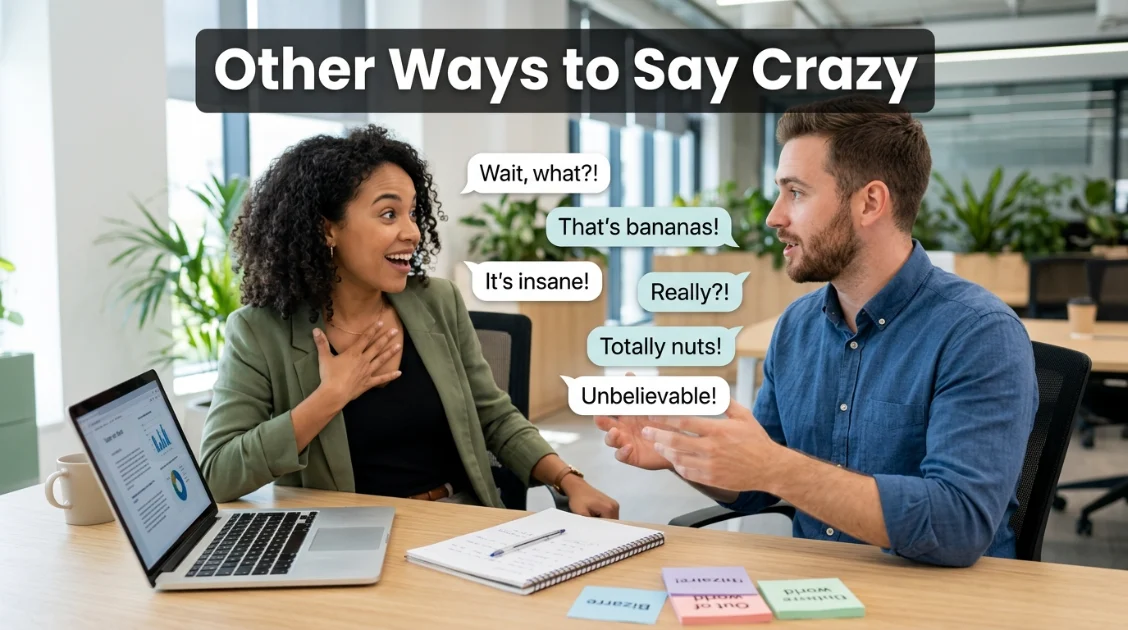
The best alternatives to crazy include unusual, irrational, wild, unreasonable, eccentric, bizarre, and out of control. The right choice depends on whether you are describing a person, idea, situation, behavior, or surprising event.
Knowing other ways to say crazy can help you communicate more accurately and avoid language that may sound rude or judgmental. Although “crazy” is common in everyday English, its meaning changes depending on context. It can describe something surprising, unusual, irrational, exciting, extreme, or even mentally unstable.
Learning alternatives to crazy gives English learners more precise vocabulary for conversations, writing, and professional communication. Instead of repeatedly using one informal word, you can choose expressions that match your intended meaning and audience. These alternatives can make your English sound more natural, thoughtful, and confident. Whether you want to describe an unbelievable situation, explain unusual behavior, or express excitement in English, selecting the right phrase helps you communicate your message clearly while respecting the context.
Quick Categories
Formal alternatives to “crazy”
- Irrational
- Unreasonable
- Illogical
- Unorthodox
Pro Tip: Use precise words such as “irrational” or “illogical” when discussing decisions, arguments, or ideas in formal settings.
Casual alternatives
- Wild
- Unbelievable
- Ridiculous
- Insane
Pro Tip: Casual expressions work well with friends, but consider your audience before using words that may sound judgmental.
Professional alternatives
- Unusual
- Unconventional
- Extreme
- Highly unexpected
Pro Tip: In professional communication, describe the specific behavior or situation instead of labeling a person.
Informal expressions
- Out of control
- All over the place
- Over the top
- Way out there
Pro Tip: Informal expressions in English are useful in relaxed conversations, but avoid them in formal reports and workplace documents.
“Better vocabulary gives you more control over meaning, tone, and professionalism.”
Common Mistakes
1. Calling a person “crazy” without considering the context
Mistake: “My manager is crazy.”
Better: “My manager’s behavior was unpredictable.”
Why: Calling someone crazy can sound insulting or judgmental.
2. Using “crazy” when you mean “exciting”
Mistake: “The concert was crazy.”
Better: “The concert was incredible.”
Why: “Crazy” may be understood differently depending on the listener.
3. Using “insane” in formal writing
Mistake: “The company made an insane decision.”
Better: “The company made an unreasonable decision.”
Why: “Insane” is generally informal and can sound unnecessarily strong.
4. Using “irrational” for something merely unusual
Mistake: “Her new idea is irrational.”
Better: “Her new idea is unconventional.”
Why: Irrational means lacking logical reasoning, while unconventional means different from what is usual.
5. Using “ridiculous” when you mean surprising
Mistake: “The price was ridiculous” when you simply mean unexpectedly high.
Better: “The price was surprisingly high.”
Why: “Ridiculous” can communicate criticism rather than simple surprise.
What Does “Crazy” Mean?
Crazy is an informal adjective with several meanings. It can describe something extremely unusual, unreasonable, exciting, chaotic, or difficult to believe. When applied to a person, it can also be offensive because it may imply mental instability.
The word is usually used as an adjective.
Example: “That was a crazy idea, but it actually worked.”
When to Use “Crazy”
You can use crazy in several contexts:
- Casual conversations: To describe surprising or unusual events.
- Informal storytelling: To emphasize that something was extreme.
- Entertainment: To describe an exciting or unexpected experience.
- Personal opinions: To express strong reactions.
- Written communication: Mainly in informal messages, blogs, and social posts.
Spoken vs. Written: “Crazy” is more common in spoken and informal written English.
Formal vs. Informal: It is primarily informal and should be replaced with a more precise term in professional or academic writing.
Is It Professional or Polite to Say “Crazy”?
Polite? ✔️ Sometimes
Professional? ❌ No (in most cases)
The word is not always offensive, but calling a person “crazy” can sound disrespectful. In professional English, choose a specific description such as unreasonable, unpredictable, unusual, or unconventional.
Business-style example: “The proposal is unconventional, but it deserves further consideration.”
When describing a situation rather than a person, “crazy” can sometimes be acceptable in informal workplace conversation, but more precise wording is usually better.
Pros and Cons of Using “Crazy”
Pros
- Simple and natural: English speakers commonly use it in casual conversation.
- Friendly tone: It can sound playful when used about situations.
- Common usage: Most learners encounter it frequently.
- Easy to understand: Its general meaning is familiar to many English speakers.
Cons
- Too informal for work: Professional writing usually requires more precise vocabulary.
- Overused: Repeating “crazy” can make your language less descriptive.
- Limited emotional range: It can mean several different things without specifying the exact meaning.
- Not suitable for formal writing: Academic and professional contexts often need clearer alternatives.
“Choose a word that explains exactly what you mean instead of relying on one broad expression.”
Other Ways to Say “Crazy” With Examples
These alternatives will help you sound more fluent, confident, and natural in different situations.
Use them according to tone, context, and audience to describe unusual ideas, surprising events, extreme situations, or unexpected behavior.
1. Phrase: Unusual
Meaning: Different from what is normal or expected.
Explanation: This is a neutral alternative that works well when you want to avoid sounding judgmental.
Example Sentence: “She has an unusual approach to solving problems.”
Best Use: Professional descriptions
Worst Use: Strong criticism
Tone: Neutral, polite, professional
Context Variability: Casual: “That is unusual.” Professional: “The approach is unusual.” Spoken: “That was an unusual situation.”
2. Phrase: Irrational
Meaning: Not based on logic or reasonable thinking.
Explanation: Use this word when someone’s decision, argument, or reaction lacks logical reasoning.
Example Sentence: “His reaction seemed completely irrational.”
Best Use: Logical criticism
Worst Use: Friendly compliments
Tone: Formal, critical, precise
Context Variability: Casual: “That reaction was irrational.” Professional: “The decision appears irrational.” Spoken: “That seems irrational.”
3. Phrase: Unreasonable
Meaning: Not sensible, fair, or practical.
Explanation: This is a professional alternative when criticizing a demand, decision, or expectation.
Example Sentence: “The deadline seems unreasonable given the amount of work involved.”
Best Use: Workplace discussions
Worst Use: Describing excitement
Tone: Professional, direct, neutral
Context Variability: Casual: “That request is unreasonable.” Professional: “The deadline is unreasonable.” Spoken: “That seems unreasonable.”
4. Phrase: Illogical
Meaning: Not following clear or sensible reasoning.
Explanation: This word is useful when an argument, conclusion, or decision does not make sense logically.
Example Sentence: “That conclusion is illogical because it ignores the available evidence.”
Best Use: Academic discussions
Worst Use: Casual excitement
Tone: Formal, analytical, precise
Context Variability: Casual: “That sounds illogical.” Professional: “The conclusion is illogical.” Spoken: “That argument seems illogical.”
5. Phrase: Unconventional
Meaning: Different from traditional or commonly accepted methods.
Explanation: This is a useful positive or neutral alternative when something is unusual but not necessarily bad.
Example Sentence: “She uses an unconventional method to manage her team.”
Best Use: Professional contexts
Worst Use: Severe criticism
Tone: Professional, neutral, positive
Context Variability: Casual: “That is unconventional.” Professional: “The strategy is unconventional.” Spoken: “It is an unconventional approach.”
6. Phrase: Eccentric
Meaning: Unusual in behavior, appearance, or personality.
Explanation: This word often describes a person whose behavior or style differs noticeably from social norms.
Example Sentence: “The artist was known for his eccentric personality.”
Best Use: Personality descriptions
Worst Use: Formal criticism
Tone: Descriptive, unusual, neutral
Context Variability: Casual: “He is a little eccentric.” Professional: “The designer has an eccentric style.” Spoken: “She can be quite eccentric.”
7. Phrase: Bizarre
Meaning: Very strange or unusual.
Explanation: Use this word when something seems unusually strange or difficult to understand.
Example Sentence: “We experienced a bizarre situation at the airport.”
Best Use: Strange situations
Worst Use: Sensitive discussions
Tone: Strong, descriptive, informal
Context Variability: Casual: “That was bizarre.” Professional: “The circumstances were unusual.” Spoken: “That was a bizarre experience.”
8. Phrase: Wild
Meaning: Extremely unusual, exciting, uncontrolled, or surprising.
Explanation: This flexible word is common in casual English when reacting strongly to an event.
Example Sentence: “That was a wild night.”
Best Use: Casual reactions
Worst Use: Formal reports
Tone: Informal, energetic, expressive
Context Variability: Casual: “That is wild.” Professional: “The situation was highly unusual.” Spoken: “That was a wild experience.”
9. Phrase: Unbelievable
Meaning: Extremely surprising or difficult to believe.
Explanation: This phrase is useful when “crazy” means surprisingly impressive or shocking.
Example Sentence: “The amount of support we received was unbelievable.”
Best Use: Strong reactions
Worst Use: Technical writing
Tone: Emotional, positive, informal
Context Variability: Casual: “That is unbelievable.” Professional: “The response was remarkable.” Spoken: “That was unbelievable.”
10. Phrase: Extreme
Meaning: Far beyond what is normal or moderate.
Explanation: This is a useful neutral word when describing unusually high levels, behavior, or situations.
Example Sentence: “The company faced extreme pressure during the launch.”
Best Use: Serious situations
Worst Use: Mild differences
Tone: Formal, strong, neutral
Context Variability: Casual: “That is extreme.” Professional: “The conditions were extreme.” Spoken: “That seems extreme.”
11. Phrase: Ridiculous
Meaning: Extremely unreasonable, silly, or difficult to take seriously.
Explanation: This word communicates stronger criticism than simply saying something is unusual.
Example Sentence: “The price they are asking is ridiculous.”
Best Use: Strong criticism
Worst Use: Formal complaints
Tone: Critical, informal, strong
Context Variability: Casual: “That is ridiculous.” Professional: “The price appears unreasonable.” Spoken: “That sounds ridiculous.”
12. Phrase: Absurd
Meaning: Completely unreasonable or logically impossible to accept.
Explanation: This is stronger and more formal than “ridiculous.”
Example Sentence: “The claim that the project could be completed in one day was absurd.”
Best Use: Formal criticism
Worst Use: Friendly compliments
Tone: Formal, critical, strong
Context Variability: Casual: “That sounds absurd.” Professional: “The proposal is absurd.” Spoken: “That seems absurd.”
13. Phrase: Unpredictable
Meaning: Difficult to know or anticipate in advance.
Explanation: This word works particularly well when “crazy” describes changing behavior or uncertain situations.
Example Sentence: “The weather has been extremely unpredictable this week.”
Best Use: Behavior or events
Worst Use: Logical arguments
Tone: Neutral, professional, precise
Context Variability: Casual: “The weather is unpredictable.” Professional: “Market conditions remain unpredictable.” Spoken: “His behavior is unpredictable.”
14. Phrase: Chaotic
Meaning: Extremely disorganized or uncontrolled.
Explanation: Use this alternative when “crazy” refers to confusion, disorder, or a lack of control.
Example Sentence: “The first day of the event was completely chaotic.”
Best Use: Busy situations
Worst Use: Logical criticism
Tone: Descriptive, strong, neutral
Context Variability: Casual: “It was chaotic.” Professional: “The process became chaotic.” Spoken: “The office was chaotic today.”
15. Phrase: Out of Control
Meaning: No longer manageable or controlled.
Explanation: This phrase is ideal when a situation has become excessively difficult or disorderly.
Example Sentence: “The crowd became difficult to manage and seemed out of control.”
Best Use: Chaotic situations
Worst Use: Formal analysis
Tone: Informal, direct, strong
Context Variability: Casual: “Things got out of control.” Professional: “The situation became difficult to manage.” Spoken: “Everything felt out of control.”
16. Phrase: Over the Top
Meaning: Excessive or more extreme than necessary.
Explanation: This informal expression is useful when describing exaggerated behavior, decoration, or reactions.
Example Sentence: “The decorations were a little over the top.”
Best Use: Casual opinions
Worst Use: Academic writing
Tone: Informal, expressive, critical
Context Variability: Casual: “That was over the top.” Professional: “The presentation was excessive.” Spoken: “Her reaction was over the top.”
17. Phrase: Unorthodox
Meaning: Different from traditional or accepted methods.
Explanation: This formal word often describes methods, strategies, or approaches that differ from standard practice.
Example Sentence: “The researcher used an unorthodox approach to solve the problem.”
Best Use: Professional writing
Worst Use: Casual jokes
Tone: Formal, analytical, neutral
Context Variability: Casual: “That is unusual.” Professional: “The method is unorthodox.” Spoken: “It is an unorthodox strategy.”
18. Phrase: Extraordinary
Meaning: Very unusual, remarkable, or impressive.
Explanation: This is often a positive alternative when “crazy” means exceptionally good or surprising.
Example Sentence: “She demonstrated extraordinary determination during the competition.”
Best Use: Positive descriptions
Worst Use: Negative criticism
Tone: Formal, positive, impressive
Context Variability: Casual: “That was extraordinary.” Professional: “The results were extraordinary.” Spoken: “Her performance was extraordinary.”
19. Phrase: Remarkable
Meaning: Unusually impressive or worthy of attention.
Explanation: Use this professional word when “crazy” expresses admiration or surprise.
Example Sentence: “The team achieved remarkable results in a short period.”
Best Use: Professional praise
Worst Use: Negative situations
Tone: Positive, professional, polished
Context Variability: Casual: “That is remarkable.” Professional: “The results are remarkable.” Spoken: “That was a remarkable achievement.”
20. Phrase: Far-Fetched
Meaning: Difficult to believe because it seems unlikely.
Explanation: This phrase is useful for ideas, explanations, or claims that seem unrealistic.
Example Sentence: “That explanation sounds far-fetched.”
Best Use: Questioning claims
Worst Use: Everyday excitement
Tone: Informal, skeptical, descriptive
Context Variability: Casual: “That sounds far-fetched.” Professional: “The explanation appears unlikely.” Spoken: “That idea seems far-fetched.”
21. Phrase: Absurdly Extreme
Meaning: Excessively far beyond what is reasonable.
Explanation: This stronger phrase emphasizes that something has gone beyond acceptable limits.
Example Sentence: “The demands placed on the employees were absurdly extreme.”
Best Use: Strong criticism
Worst Use: Friendly conversation
Tone: Strong, critical, expressive
Context Variability: Casual: “That is absurdly extreme.” Professional: “The requirements are excessive.” Spoken: “That seems extremely unreasonable.”
22. Phrase: Highly Unusual
Meaning: Very different from what normally happens.
Explanation: This is a safe and professional phrase for describing unusual situations.
Example Sentence: “The company experienced a highly unusual increase in demand.”
Best Use: Professional writing
Worst Use: Casual excitement
Tone: Formal, neutral, precise
Context Variability: Casual: “That is really unusual.” Professional: “The increase was highly unusual.” Spoken: “That is highly unusual.”
23. Phrase: Completely Unexpected
Meaning: Not anticipated or predicted.
Explanation: This phrase works when “crazy” means surprising rather than irrational.
Example Sentence: “The final result was completely unexpected.”
Best Use: Surprising events
Worst Use: Describing personality
Tone: Neutral, clear, expressive
Context Variability: Casual: “That was completely unexpected.” Professional: “The outcome was unexpected.” Spoken: “The result was completely unexpected.”
24. Phrase: Way Out There
Meaning: Extremely unusual or unconventional.
Explanation: This is a strongly informal expression used for ideas or opinions that seem unusual.
Example Sentence: “That theory is a little way out there.”
Best Use: Informal conversations
Worst Use: Professional writing
Tone: Informal, playful, expressive
Context Variability: Casual: “That idea is way out there.” Professional: “That idea is unconventional.” Spoken: “That theory is way out there.”
25. Phrase: All Over the Place
Meaning: Disorganized, inconsistent, or difficult to follow.
Explanation: This expression is useful when “crazy” describes confusing behavior or communication.
Example Sentence: “His explanation was all over the place.”
Best Use: Casual criticism
Worst Use: Formal reports
Tone: Informal, descriptive, direct
Context Variability: Casual: “Her thoughts were all over the place.” Professional: “The presentation lacked structure.” Spoken: “His explanation was all over the place.”
26. Phrase: Mind-Blowing
Meaning: Extremely surprising, impressive, or exciting.
Explanation: This informal phrase works when “crazy” expresses amazement rather than criticism.
Example Sentence: “The view from the top was absolutely mind-blowing.”
Best Use: Informal reactions
Worst Use: Formal reports
Tone: Informal, enthusiastic, expressive
Context Variability: Casual: “That was mind-blowing.” Professional: “The results were remarkable.” Spoken: “The experience was mind-blowing.”
27. Phrase: Insane
Meaning: Extremely surprising, excessive, or unreasonable in informal English.
Explanation: Although commonly used casually, this word can sound insensitive when describing a person.
Example Sentence: “The amount of work we completed in one day was insane.”
Best Use: Casual reactions
Worst Use: Describing people
Tone: Informal, strong, expressive
Context Variability: Casual: “That was insane.” Professional: “The workload was exceptionally high.” Spoken: “That result was insane.”
28. Phrase: Nuts
Meaning: Extremely strange, unreasonable, or surprising.
Explanation: This is an informal expression and should generally be avoided in professional communication.
Example Sentence: “It is nuts to drive in this weather.”
Best Use: Casual speech
Worst Use: Formal writing
Tone: Informal, playful, strong
Context Variability: Casual: “That is nuts.” Professional: “That would be unreasonable.” Spoken: “It is nuts to do that.”
29. Phrase: Preposterous
Meaning: Extremely unreasonable or absurd.
Explanation: This expressive word is useful when you strongly reject an idea, claim, or demand.
Example Sentence: “The suggestion that employees should work without breaks is preposterous.”
Best Use: Strong criticism
Worst Use: Friendly praise
Tone: Formal, emphatic, critical
Context Variability: Casual: “That sounds preposterous.” Professional: “The proposal is preposterous.” Spoken: “That idea is preposterous.”
30. Phrase: Unhinged
Meaning: Extremely irrational or emotionally uncontrolled.
Explanation: This informal word is often used to describe behavior that seems unreasonable or uncontrolled, but it can sound harsh.
Example Sentence: “His response to the minor disagreement seemed completely unhinged.”
Best Use: Informal commentary
Worst Use: Professional feedback
Tone: Informal, harsh, critical
Context Variability: Casual: “That reaction was unhinged.” Professional: “That reaction appeared highly inappropriate.” Spoken: “His response seemed unhinged.”
“When describing people, focus on specific behavior rather than using labels that may sound insulting.”
Mini Quiz / Self-Check
1. Which phrase is most suitable for professional writing?
A. Nuts
B. Way out there
C. Unconventional
D. Insane
Answer: C. Unconventional
2. Which alternative best describes something that lacks logical reasoning?
A. Wild
B. Irrational
C. Extraordinary
D. Unusual
Answer: B. Irrational
3. Which phrase is best for describing a very surprising and impressive experience?
A. Mind-blowing
B. Illogical
C. Unreasonable
D. Irrational
Answer: A. Mind-blowing
4. Which sentence is most appropriate in a workplace context?
A. “Your idea is nuts.”
B. “Your idea is crazy.”
C. “Your approach is unconventional.”
D. “Your approach is insane.”
Answer: C. “Your approach is unconventional.”
Comparison Table: Top Alternatives
| Phrase | Tone | Best Use |
|---|---|---|
| Unusual | Neutral, polite | General descriptions |
| Irrational | Formal, critical | Decisions and behavior |
| Unreasonable | Professional, direct | Workplace situations |
| Illogical | Formal, analytical | Arguments and ideas |
| Unconventional | Professional, neutral | Methods and approaches |
| Eccentric | Descriptive, unusual | Personality |
| Bizarre | Strong, descriptive | Strange situations |
| Wild | Informal, energetic | Casual reactions |
| Extraordinary | Formal, positive | Praise and admiration |
| Unpredictable | Neutral, precise | Behavior and events |
FAQs
What are the best other ways to say crazy?
Some of the best alternatives are unusual, irrational, unreasonable, unconventional, bizarre, wild, extreme, and unpredictable. The best choice depends on what you actually mean by “crazy.”
What is a polite way to say crazy?
Unusual, unconventional, and unexpected are generally polite alternatives. They allow you to describe something without sounding unnecessarily judgmental.
What is a professional way to say crazy?
In professional English, use specific words such as unreasonable, irrational, illogical, unpredictable, or unconventional, depending on the context.
Is “crazy” an informal word?
Yes. “Crazy” is commonly used in informal spoken English. It can have positive, negative, or neutral meanings depending on the situation.
Is it rude to call someone crazy?
It can be. When referring to a person, “crazy” may sound insulting or insensitive. It is usually better to describe the person’s specific behavior instead.
Conclusion
Learning other ways to say crazy gives you more control over tone, meaning, and context. Instead of relying on one broad informal word, you can choose precise alternatives such as unusual, irrational, unreasonable, or unconventional.
Practice these alternatives in everyday conversations and writing. Pay attention to whether you are describing a person, idea, decision, or situation. Strong English communication depends not only on knowing more words but also on knowing when and how to use them.
Read More Related Articles:
Other Ways to Say Please | Make Every Request Sound More …
Other Ways to Say Diarrhea | Polite, Professional & Clear …
30+ Other Ways to Say Showcase | Powerful Words That Steal …

Ethan Parker is a professional content writer at Replynst.com. He creates clear, engaging and well-researched articles focused on providing useful information, answering readers’ questions.