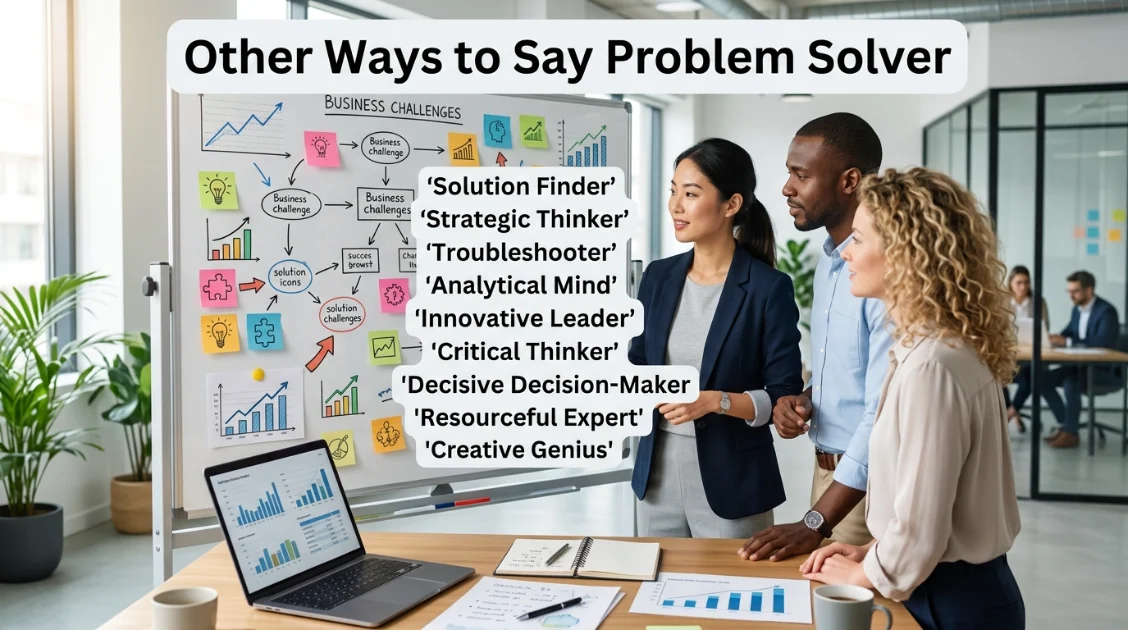
Quick Answer:
The best alternatives to problem solver include troubleshooter, solution finder, critical thinker, analytical thinker, strategic thinker, and solution oriented person. The best choice depends on whether you are describing someone casually, professionally, or in a resume or interview.
Knowing other ways to say problem solver can help you describe a person’s abilities with greater precision. The phrase is commonly used for employees, leaders, students, managers, and professionals who can identify challenges and develop practical solutions. Choosing the right alternative can make your English sound more polished and purposeful.
Learning alternatives to problem solver is especially useful for resumes, interviews, performance reviews, business conversations, and professional writing. Different expressions can highlight creativity, analytical thinking, leadership, or practical decision making. Just as learners practice how to express excitement in English, understanding professional vocabulary helps them communicate strengths naturally. This guide explains 30 useful alternatives, their meanings, examples, tones, and best contexts so you can choose the right phrase with confidence.
Quick Categories
Formal alternatives to “problem solver”
- Analytical thinker
- Strategic thinker
- Solution oriented professional
- Critical thinker
Pro Tip: Use these expressions in resumes, professional profiles, reports, and formal introductions when you want to emphasize intellectual and strategic abilities.
Casual alternatives
- Troubleshooter
- Fixer
- Solution finder
- Someone who figures things out
Pro Tip: Casual alternatives sound natural in everyday conversations, but choose more specific professional language for formal situations.
Professional alternatives
- Solution oriented individual
- Strategic problem solver
- Decision maker
- Issue resolution specialist
Pro Tip: In professional English, connect the phrase with a specific skill or result to make your description more credible.
Informal expressions
- Go to person
- Fix it person
- Someone who gets things sorted
- A person who finds a way
Pro Tip: Informal expressions in English are useful in conversations, but they may sound too relaxed for resumes and formal business writing.
“Strong professional English does not just describe what someone does. It shows how they create value.”
Common Mistakes
1. Treating “problem solver” as a job title
Mistake: “She is a problem solver at our company.”
Better: “She is a project manager who is an excellent problem solver.”
Why: Problem solver usually describes a skill or characteristic rather than a specific job title.
2. Using “fixer” in every professional situation
Mistake: “Our company needs a good fixer.”
Better: “Our company needs someone with strong issue resolution skills.”
Why: “Fixer” is informal and can sound vague in professional writing.
3. Using “critical thinker” as an exact synonym
Mistake: “A critical thinker always solves every problem.”
Better: “A critical thinker evaluates information carefully and can develop effective solutions.”
Why: Critical thinking and problem solving are related skills, but they are not identical.
4. Using “decision maker” as a complete replacement
Mistake: “He is a great decision maker because he solves technical issues.”
Better: “He is an effective problem solver and decision maker.”
Why: A decision maker chooses between options, while a problem solver identifies and addresses challenges.
5. Using overly vague expressions
Mistake: “She is good at things.”
Better: “She is highly effective at identifying problems and developing practical solutions.”
Why: Specific professional language makes your meaning clearer and more persuasive.
What Does “Problem Solver” Mean?
A problem solver is a person who identifies challenges, analyzes possible causes, and develops effective solutions. The phrase describes someone who can respond constructively when something goes wrong.
It is a compound noun made from problem, meaning a difficulty or challenge, and solver, meaning someone who finds a solution.
Example: “Our team needs a creative problem solver who can handle unexpected challenges.”
When to Use “Problem Solver”
You can use problem solver in many professional and everyday contexts:
- Resumes: To describe an important workplace skill.
- Job interviews: To explain how you handle challenges.
- Performance reviews: To recognize an employee’s ability to resolve issues.
- Business conversations: To describe someone who finds practical solutions.
- Team discussions: To identify people who can handle unexpected problems.
- Academic settings: To describe analytical or logical abilities.
Spoken vs. Written: The phrase works naturally in both spoken and written English.
Formal vs. Informal: “Problem solver” is neutral and professional enough for most contexts, although more specific alternatives can make formal writing stronger.
Is It Professional or Polite to Say “Problem Solver”?
Polite? ✔️ Yes
Professional? ✔️ Yes
“Problem solver” is a positive and widely accepted professional expression. However, simply calling someone a problem solver can be less persuasive than explaining what type of problems they solve or what results they achieve.
Business-style example: “She is a highly effective problem solver who consistently develops practical solutions to complex operational challenges.”
“Specific skills create a stronger impression than generic praise.”
Pros and Cons of Using “Problem Solver”
Pros
- Simple and natural: The phrase is easy to understand.
- Positive meaning: It communicates competence and reliability.
- Common usage: It is widely used in professional English.
- Easy to apply: It works in resumes, interviews, and everyday conversations.
Cons
- Can sound generic: Many resumes use the phrase without supporting evidence.
- Overused: Repetition can make professional writing less distinctive.
- Limited detail: It does not explain what kind of problems someone solves.
- May need evidence: Employers usually value examples and measurable results.
Other Ways to Say “Problem Solver” With Examples
These alternatives will help you sound more fluent, confident, and natural in different situations.
Use them according to tone, context, and audience to describe creativity, analytical ability, leadership, or practical decision making.
1. Phrase: Troubleshooter
Meaning: A person who identifies and resolves problems.
Explanation: This is one of the closest alternatives to problem solver, especially in technical and workplace contexts.
Example Sentence: “She is an excellent troubleshooter who quickly identifies technical issues.”
Best Use: Technical workplaces
Worst Use: Formal biographies
Tone: Professional, practical, direct
Context Variability: Casual: “He is a great troubleshooter.” Professional: “She works as a technical troubleshooter.” Spoken: “We need someone who can troubleshoot this issue.”
2. Phrase: Solution Finder
Meaning: A person who finds answers to problems.
Explanation: This phrase emphasizes the ability to develop useful solutions.
Example Sentence: “Our manager is a creative solution finder who stays calm under pressure.”
Best Use: Team descriptions
Worst Use: Academic writing
Tone: Positive, practical, friendly
Context Variability: Casual: “She is a natural solution finder.” Professional: “He is recognized as an effective solution finder.” Spoken: “She always finds a solution.”
3. Phrase: Analytical Thinker
Meaning: A person who examines information logically.
Explanation: This phrase highlights analysis as an important part of effective problem solving.
Example Sentence: “We need an analytical thinker who can evaluate complex business challenges.”
Best Use: Resumes
Worst Use: Casual conversations
Tone: Formal, intelligent, professional
Context Variability: Casual: “He thinks things through.” Professional: “She is a highly analytical thinker.” Spoken: “He is very analytical when solving problems.”
4. Phrase: Strategic Thinker
Meaning: A person who considers long term goals when making decisions.
Explanation: This phrase emphasizes planning and thinking beyond immediate problems.
Example Sentence: “She is a strategic thinker who develops solutions that support long term growth.”
Best Use: Leadership contexts
Worst Use: Simple problems
Tone: Professional, strategic, confident
Context Variability: Casual: “He thinks ahead.” Professional: “She is a strong strategic thinker.” Spoken: “He always considers the bigger picture.”
5. Phrase: Critical Thinker
Meaning: A person who evaluates information carefully and logically.
Explanation: Critical thinking supports problem solving by helping someone assess evidence and possible solutions.
Example Sentence: “A strong critical thinker can evaluate several solutions before making a decision.”
Best Use: Academic settings
Worst Use: Casual praise
Tone: Formal, analytical, intellectual
Context Variability: Casual: “She thinks carefully.” Professional: “He demonstrates strong critical thinking skills.” Spoken: “She is a very critical thinker.”
6. Phrase: Solution Oriented Professional
Meaning: A professional who focuses on finding practical solutions.
Explanation: This phrase is particularly effective for resumes and professional profiles.
Example Sentence: “She is a solution oriented professional who handles complex client concerns effectively.”
Best Use: Professional profiles
Worst Use: Casual chat
Tone: Formal, confident, polished
Context Variability: Casual: “She focuses on solutions.” Professional: “He is a solution oriented professional.” Spoken: “She has a very solution oriented approach.”
7. Phrase: Strategic Problem Solver
Meaning: A person who solves problems using careful planning.
Explanation: This expression combines problem solving with strategic thinking.
Example Sentence: “He is a strategic problem solver with extensive experience in operations.”
Best Use: Resumes
Worst Use: Informal chat
Tone: Professional, confident, strategic
Context Variability: Casual: “He thinks before solving problems.” Professional: “She is a strategic problem solver.” Spoken: “He approaches problems strategically.”
8. Phrase: Issue Resolution Specialist
Meaning: A person who specializes in resolving issues.
Explanation: This phrase sounds highly professional and is useful in customer service and business contexts.
Example Sentence: “As an issue resolution specialist, she handles complex customer concerns.”
Best Use: Business contexts
Worst Use: Friendly chat
Tone: Formal, professional, precise
Context Variability: Casual: “She is good at fixing issues.” Professional: “He works as an issue resolution specialist.” Spoken: “She specializes in resolving customer issues.”
9. Phrase: Decision Maker
Meaning: A person who makes important choices.
Explanation: This phrase is related to problem solving but focuses specifically on making decisions.
Example Sentence: “Effective decision makers evaluate risks before choosing a solution.”
Best Use: Leadership contexts
Worst Use: Technical descriptions
Tone: Professional, confident, direct
Context Variability: Casual: “She makes good decisions.” Professional: “He is an effective decision maker.” Spoken: “She is a strong decision maker.”
10. Phrase: Creative Thinker
Meaning: A person who develops original ideas.
Explanation: Creative thinking can help someone find solutions that are not immediately obvious.
Example Sentence: “She is a creative thinker who approaches difficult challenges from new perspectives.”
Best Use: Creative workplaces
Worst Use: Highly technical descriptions
Tone: Positive, professional, creative
Context Variability: Casual: “He thinks outside the box.” Professional: “She is a creative thinker.” Spoken: “He comes up with creative solutions.”
11. Phrase: Innovative Thinker
Meaning: A person who develops new and effective ideas.
Explanation: This phrase emphasizes originality and improvement.
Example Sentence: “The company values innovative thinkers who can improve existing processes.”
Best Use: Business writing
Worst Use: Basic conversations
Tone: Professional, modern, confident
Context Variability: Casual: “She has fresh ideas.” Professional: “He is an innovative thinker.” Spoken: “She often suggests innovative solutions.”
12. Phrase: Logical Thinker
Meaning: A person who uses reason and evidence when thinking.
Explanation: This phrase highlights logical reasoning as a foundation for solving problems.
Example Sentence: “He is a logical thinker who approaches challenges systematically.”
Best Use: Job interviews
Worst Use: Informal praise
Tone: Clear, professional, analytical
Context Variability: Casual: “He thinks logically.” Professional: “She is a highly logical thinker.” Spoken: “He approaches problems logically.”
13. Phrase: Practical Thinker
Meaning: A person who focuses on realistic solutions.
Explanation: This phrase is useful when someone values workable solutions over theoretical ideas.
Example Sentence: “She is a practical thinker who develops solutions that can be implemented quickly.”
Best Use: Workplace English
Worst Use: Academic theory
Tone: Practical, professional, positive
Context Variability: Casual: “He is very practical.” Professional: “She is a practical thinker.” Spoken: “He always looks for practical solutions.”
14. Phrase: Fixer
Meaning: A person who is good at resolving problems.
Explanation: “Fixer” is a natural informal expression, especially when talking about someone who can handle difficult situations.
Example Sentence: “Ask Maria to handle it because she is the team’s best fixer.”
Best Use: Informal speech
Worst Use: Formal resumes
Tone: Informal, confident, direct
Context Variability: Casual: “He is our go to fixer.” Professional: “He specializes in issue resolution.” Spoken: “She is the person who fixes difficult problems.”
15. Phrase: Go To Person
Meaning: A person people rely on for help.
Explanation: This phrase highlights trust and reliability rather than problem solving alone.
Example Sentence: “James is our go to person whenever the team faces a difficult challenge.”
Best Use: Team conversations
Worst Use: Formal reports
Tone: Friendly, informal, positive
Context Variability: Casual: “She is my go to person.” Professional: “He is a trusted resource for complex issues.” Spoken: “She is the team’s go to person.”
16. Phrase: Resourceful Person
Meaning: A person who finds effective ways to deal with difficulties.
Explanation: Resourcefulness strongly overlaps with problem solving because it emphasizes finding solutions with available resources.
Example Sentence: “She is a resourceful professional who performs well under pressure.”
Best Use: Resumes
Worst Use: Technical diagnosis
Tone: Professional, positive, confident
Context Variability: Casual: “He is very resourceful.” Professional: “She is a highly resourceful employee.” Spoken: “He is incredibly resourceful.”
17. Phrase: Solution Driven Professional
Meaning: A professional who focuses strongly on achieving solutions.
Explanation: This phrase emphasizes action and results rather than simply identifying problems.
Example Sentence: “We are looking for a solution driven professional with strong communication skills.”
Best Use: Job applications
Worst Use: Casual conversation
Tone: Formal, confident, results focused
Context Variability: Casual: “She focuses on solutions.” Professional: “He is a solution driven professional.” Spoken: “She has a solution driven mindset.”
18. Phrase: Results Oriented Professional
Meaning: A person who focuses on achieving measurable outcomes.
Explanation: This phrase is broader than problem solver but can communicate strong practical performance.
Example Sentence: “He is a results oriented professional who consistently resolves operational challenges.”
Best Use: Resumes
Worst Use: Everyday speech
Tone: Professional, confident, formal
Context Variability: Casual: “She gets things done.” Professional: “He is highly results oriented.” Spoken: “She focuses strongly on results.”
19. Phrase: Troubleshooting Expert
Meaning: A person with advanced ability to identify and resolve problems.
Explanation: This phrase is particularly useful for technical, engineering, and IT contexts.
Example Sentence: “Our troubleshooting expert resolved the software issue within an hour.”
Best Use: Technical roles
Worst Use: General social chat
Tone: Professional, technical, confident
Context Variability: Casual: “He is great at fixing tech problems.” Professional: “She is a troubleshooting expert.” Spoken: “He is our troubleshooting expert.”
20. Phrase: Challenge Solver
Meaning: A person who effectively handles difficult challenges.
Explanation: This phrase provides a positive alternative when you want to focus on overcoming obstacles.
Example Sentence: “She is a strong challenge solver who performs well in demanding situations.”
Best Use: Professional profiles
Worst Use: Formal academic writing
Tone: Positive, modern, confident
Context Variability: Casual: “He handles challenges well.” Professional: “She is an effective challenge solver.” Spoken: “He is good at solving difficult challenges.”
21. Phrase: Strategic Decision Maker
Meaning: A person who makes decisions based on long term goals.
Explanation: This phrase emphasizes planning, judgment, and leadership.
Example Sentence: “Successful leaders are strategic decision makers who evaluate multiple outcomes.”
Best Use: Leadership profiles
Worst Use: Basic conversations
Tone: Formal, strategic, authoritative
Context Variability: Casual: “She thinks before deciding.” Professional: “He is a strategic decision maker.” Spoken: “She makes strategic decisions.”
22. Phrase: Analytical Problem Solver
Meaning: A person who uses careful analysis to solve problems.
Explanation: This phrase is a more specific version of problem solver and works especially well in professional profiles.
Example Sentence: “We need an analytical problem solver who can interpret complex data.”
Best Use: Technical resumes
Worst Use: Casual introductions
Tone: Formal, precise, analytical
Context Variability: Casual: “He analyzes problems carefully.” Professional: “She is an analytical problem solver.” Spoken: “He takes an analytical approach to problems.”
23. Phrase: Solution Architect
Meaning: A person who designs solutions for complex needs.
Explanation: This is especially common in technology and business contexts, where designing systems or approaches is involved.
Example Sentence: “As a solution architect, she develops technology strategies for complex business needs.”
Best Use: Technology roles
Worst Use: General conversation
Tone: Technical, formal, specialized
Context Variability: Casual: “He designs solutions.” Professional: “She works as a solution architect.” Spoken: “He designs technical solutions.”
24. Phrase: Issue Solver
Meaning: A person who resolves problems or concerns.
Explanation: This phrase is understandable but less common and polished than “problem solver.”
Example Sentence: “He is an effective issue solver who responds quickly to customer concerns.”
Best Use: General workplace
Worst Use: Formal resumes
Tone: Neutral, direct, practical
Context Variability: Casual: “She solves issues quickly.” Professional: “He is an effective issue resolution specialist.” Spoken: “She is good at solving issues.”
25. Phrase: Solution Focused Individual
Meaning: A person who concentrates on finding solutions.
Explanation: This professional expression emphasizes a positive response to challenges.
Example Sentence: “She is a solution focused individual who remains calm during difficult situations.”
Best Use: Professional profiles
Worst Use: Casual conversations
Tone: Formal, positive, polished
Context Variability: Casual: “She focuses on solutions.” Professional: “He is a solution focused individual.” Spoken: “She takes a solution focused approach.”
26. Phrase: Strategic Problem Handler
Meaning: A person who manages difficult problems effectively.
Explanation: This phrase emphasizes both strategic thinking and the ability to manage challenges.
Example Sentence: “He is a strategic problem handler who helps teams navigate complex situations.”
Best Use: Team descriptions
Worst Use: Casual introductions
Tone: Professional, strategic, confident
Context Variability: Casual: “He handles tough problems well.” Professional: “She is a strategic problem handler.” Spoken: “He handles complex problems strategically.”
27. Phrase: Practical Solution Provider
Meaning: A person who provides workable answers to problems.
Explanation: This phrase focuses on practical results and can work well in customer service or consulting contexts.
Example Sentence: “Our team is known as a practical solution provider for complex client needs.”
Best Use: Business communication
Worst Use: Personal conversation
Tone: Professional, practical, confident
Context Variability: Casual: “She finds practical answers.” Professional: “He is a practical solution provider.” Spoken: “We focus on providing practical solutions.”
28. Phrase: Creative Solution Finder
Meaning: A person who discovers original ways to solve problems.
Explanation: This phrase combines creativity with practical problem solving.
Example Sentence: “She is a creative solution finder who approaches challenges from different perspectives.”
Best Use: Creative teams
Worst Use: Formal job titles
Tone: Positive, creative, professional
Context Variability: Casual: “He always finds creative answers.” Professional: “She is a creative solution finder.” Spoken: “He comes up with creative solutions.”
29. Phrase: Effective Issue Resolver
Meaning: A person who successfully resolves difficult issues.
Explanation: This is a polished professional expression for describing someone who handles challenges efficiently.
Example Sentence: “She is an effective issue resolver with excellent communication and leadership skills.”
Best Use: Performance reviews
Worst Use: Casual chat
Tone: Professional, polished, confident
Context Variability: Casual: “She solves issues well.” Professional: “He is an effective issue resolver.” Spoken: “She is excellent at resolving issues.”
30. Phrase: Someone Who Gets Things Done
Meaning: A person who takes action and achieves practical results.
Explanation: This is an informal but highly positive way to describe someone who turns problems into action and solutions.
Example Sentence: “We need someone who gets things done when unexpected challenges arise.”
Best Use: Casual conversations
Worst Use: Formal resumes
Tone: Informal, confident, positive
Context Variability: Casual: “She is someone who gets things done.” Professional: “She is a results oriented professional.” Spoken: “He is the kind of person who gets things done.”
“If you want stronger professional English, replace vague praise with a phrase that shows exactly how someone solves problems.”
Mini Quiz / Self Check
1. Which alternative is most suitable for a technical professional?
A. Go to person
B. Troubleshooting expert
C. Fixer
D. Someone who gets things done
Answer: B. Troubleshooting expert
2. Which phrase best describes someone who thinks about long term goals?
A. Strategic thinker
B. Fixer
C. Stomach problem
D. Go to person
Answer: A. Strategic thinker
3. Which sentence is best for a professional resume?
A. I am a great fixer.
B. I am someone who gets things done.
C. I am a solution oriented professional who resolves complex operational challenges.
D. I fix stuff quickly.
Answer: C. I am a solution oriented professional who resolves complex operational challenges.
4. Which phrase is most informal?
A. Analytical thinker
B. Issue resolution specialist
C. Go to person
D. Strategic decision maker
Answer: C. Go to person
Comparison Table: Top Alternatives
| Phrase | Tone | Best Use |
|---|---|---|
| Troubleshooter | Professional, practical | Technical work |
| Analytical thinker | Formal, intelligent | Resumes |
| Strategic thinker | Professional, strategic | Leadership |
| Critical thinker | Formal, analytical | Academic settings |
| Solution finder | Positive, practical | Team descriptions |
| Resourceful person | Professional, positive | Interviews |
| Solution oriented professional | Formal, polished | Professional profiles |
| Creative thinker | Positive, creative | Creative roles |
| Go to person | Friendly, informal | Team conversations |
| Someone who gets things done | Informal, confident | Everyday speech |
FAQs
What are the best other ways to say problem solver?
Some of the strongest alternatives are troubleshooter, analytical thinker, strategic thinker, solution finder, resourceful person, and solution oriented professional.
What is a professional way to say problem solver?
For professional writing, you can use analytical thinker, strategic thinker, solution oriented professional, or issue resolution specialist, depending on the skill you want to emphasize.
How can I say problem solver on a resume?
Instead of simply writing “problem solver,” describe the specific ability, such as analytical problem solver, strategic thinker, or solution oriented professional, and support it with a measurable achievement.
Is “troubleshooter” another word for problem solver?
Yes. Troubleshooter is one of the closest alternatives, especially for technical, IT, engineering, and operational situations where someone identifies and resolves specific problems.
What is a casual way to say problem solver?
Casual options include fixer, go to person, someone who gets things done, and someone who figures things out. These are natural in conversation but less suitable for formal resumes.
Conclusion
Learning other ways to say problem solver gives you more flexibility when describing professional strengths. Words such as troubleshooter, strategic thinker, analytical thinker, and resourceful person highlight different aspects of the same general ability.
Practice using these alternatives in resumes, interviews, workplace conversations, and everyday English. Pay attention to tone and context, because the most effective phrase is the one that accurately communicates the skill you want to emphasize.
Read More Related Articles:
Other Ways to Say Please | Make Every Request Sound More …
Other Ways to Say Diarrhea | Polite, Professional & Clear …
30+ Other Ways to Say Showcase | Powerful Words That Steal …

Logan Hayes is a content writer at Replynst.com. He specializes in turning complex topics into simple, engaging and useful articles. His work combines careful research, clear writing to create content readers can trust.