Quick Answer:
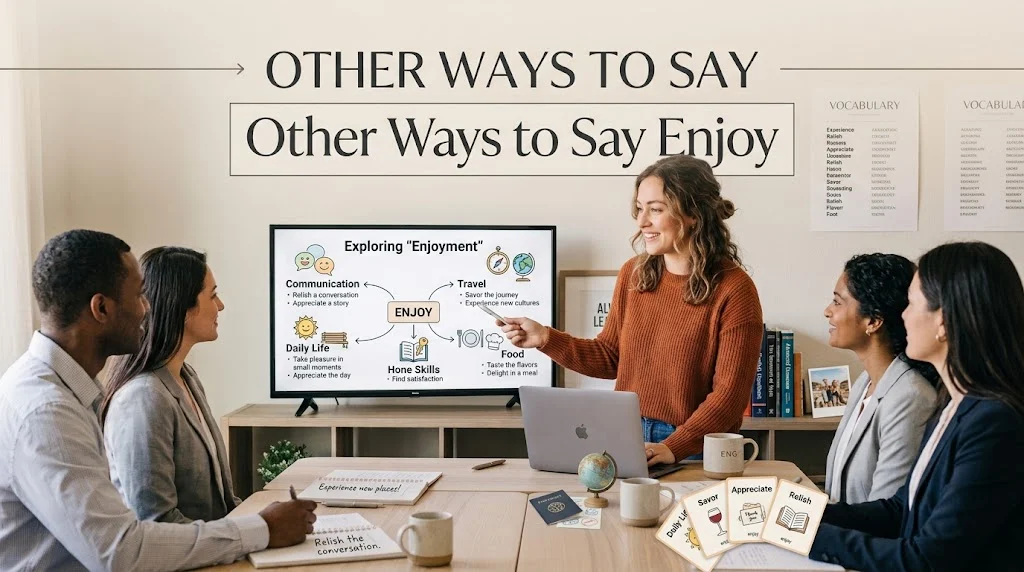
Looking for other ways to say enjoy? The best alternatives include have fun, savor it, take pleasure in, appreciate it, and have a great time. The right phrase depends on your audience, setting, and level of formality.
The word “enjoy” is one of the most common ways to show pleasure, happiness, or approval in English. You might use it when talking about food, travel, entertainment, hobbies, events, or a pleasant experience. For example, you can say, “I enjoyed the movie” or “Enjoy your weekend.”
However, using the same word repeatedly can make your English sound less varied. Learning alternatives to enjoy helps you choose words that match the situation more naturally. A professional email may need a polished expression, while a friendly conversation can use something warmer and more relaxed.
Knowing other ways to say enjoy can also help you express excitement in English without sounding repetitive. This guide gives you useful phrases, meanings, examples, and tone advice so you can choose the right expression with confidence.
Formal Alternatives to “Enjoy”
Formal English often requires more precise language. These expressions work well in academic, respectful, or polished communication.
1. Take pleasure in
2. Appreciate
3. Derive pleasure from
4. Take delight in
Pro Tip: Use formal alternatives when writing reports, academic content, official messages, or polished correspondence.
Casual Alternatives
These phrases sound natural in everyday conversations with friends, family, or people you know well.
5. Have fun
6. Have a great time
7. Love it
8. Have a blast
Pro Tip: Choose simple expressions such as “have fun” or “have a great time” when you want your English to sound friendly and natural.
Professional Alternatives
Professional communication benefits from expressions that sound positive without being overly casual.
9. Appreciate it
10. Value
11. Find it rewarding
12. Find it fulfilling
Pro Tip: Use professional reaction phrases such as “I found the experience rewarding” when discussing work, projects, training, or business experiences.
Informal Expressions
Informal expressions can make conversations sound warm, relaxed, and personal.
13. Have a good one
14. Dig it
15. Savor it
16. Make the most of it
Pro Tip: Keep informal expressions in friendly conversations unless you are certain they fit the workplace culture.
“Tone matters as much as meaning. A correct phrase can still sound wrong in the wrong setting.”
Common Mistakes When Using “Enjoy”
1. Using “enjoy” with the wrong grammar
Incorrect: “I enjoy to read books.”
Correct: “I enjoy reading books.”
After “enjoy,” use a noun or the gerund form of a verb.
2. Using “enjoy” when “have fun” sounds more natural
Less natural: “Enjoy at the party.”
Natural: “Have fun at the party.”
3. Using an informal expression in formal writing
Less suitable: “I had a blast at the conference.”
Better: “I greatly enjoyed the conference.”
4. Repeating “enjoy” too often
Repetitive: “I enjoyed the food, enjoyed the music, and enjoyed the event.”
Better: “I enjoyed the food, appreciated the music, and had a great time at the event.”
5. Confusing “enjoy” with “like”
“Enjoy” often describes pleasure from an experience, while “like” can describe preference.
Example: “I enjoy hiking” focuses on the pleasure of the activity.
What Does “Enjoy” Mean?
“Enjoy” means to get pleasure, satisfaction, or happiness from something.
It can describe an activity, object, experience, or situation.
Example: “She enjoys reading novels.”
Grammatically, “enjoy” is usually followed by a noun, pronoun, or gerund.
Examples:
• I enjoy music.
• We enjoyed the trip.
• He enjoys playing tennis.
When to Use “Enjoy”
You can use “enjoy” in many everyday and professional situations.
• Talking about food or drinks
• Discussing movies, books, or music
• Describing travel experiences
• Talking about hobbies
• Wishing someone a pleasant experience
• Discussing events
• Describing work experiences
• Giving positive feedback
Spoken English
“Enjoy” is very common in everyday speech.
Example: “Did you enjoy the concert?”
Written English
It is also suitable for emails, articles, reviews, and general writing.
Example: “We hope you enjoy your visit.”
Formal English
The word itself is acceptable in formal English, but alternatives such as “appreciate” or “take pleasure in” may sometimes sound more polished.
Informal English
Expressions such as “have fun,” “have a blast,” and “have a good one” create a more relaxed tone.
Is It Professional or Polite to Say “Enjoy”?
“Enjoy” is polite and can be professional in many situations, especially when wishing someone well.
For example:
Business example: “I hope you enjoy the conference and find the sessions useful.”
Polite? ✔ Yes
Professional? ❌ No, in most cases when used as a casual reaction or repeated unnecessarily
The important point is context. “Enjoy your vacation” can sound perfectly professional, while “Have a blast” may be too casual for some business situations.
Pros and Cons of Using “Enjoy”
Pros
• Simple and natural
• Friendly tone
• Common usage
• Easy to understand
Cons
• Too informal for some work situations
• Can become overused
• Has limited emotional range
• May not suit highly formal writing
Other Ways to Say “Enjoy” With Examples
These alternatives will help you sound more fluent, confident, and natural in different situations.
Use them according to tone, context, and audience to express excitement, admiration, or approval.
1. Phrase: Have Fun
Meaning: To enjoy yourself during an activity or event.
Explanation: This is one of the most natural casual alternatives to “enjoy.”
Example Sentence: “Have fun at the party tonight!”
Best Use: Friendly conversations
Worst Use: Formal reports
Tone: Friendly, casual, warm
Context Variability: Casual: “Have fun!” Professional: “Have fun at the team event.” Spoken: “Have fun tonight.”
2. Phrase: Have a Great Time
Meaning: To experience something pleasantly.
Explanation: It is a warm way to wish someone an enjoyable experience.
Example Sentence: “I hope you have a great time on your trip.”
Best Use: Social situations
Worst Use: Academic writing
Tone: Warm, positive, friendly
Context Variability: Casual: “Have a great time!” Professional: “I hope you have a great time at the conference.” Spoken: “Have a great time.”
3. Phrase: Appreciate
Meaning: To recognize the value or quality of something.
Explanation: “Appreciate” is useful when enjoyment comes from recognizing quality or value.
Example Sentence: “I really appreciated the thoughtful presentation.”
Best Use: Professional feedback
Worst Use: Simple entertainment
Tone: Polished, respectful, professional
Context Variability: Casual: “I appreciate the gesture.” Professional: “We appreciate your support.” Spoken: “I really appreciate it.”
4. Phrase: Take Pleasure In
Meaning: To experience happiness or satisfaction from something.
Explanation: This is a formal alternative that works well in polished writing.
Example Sentence: “She takes pleasure in helping new employees.”
Best Use: Formal writing
Worst Use: Casual chat
Tone: Formal, refined, respectful
Context Variability: Casual: Rarely used. Professional: “He takes pleasure in mentoring others.” Spoken: Formal conversations.
5. Phrase: Savor
Meaning: To enjoy something slowly and fully.
Explanation: “Savor” suggests paying attention to the quality of an experience.
Example Sentence: “Take your time and savor every moment.”
Best Use: Food, experiences
Worst Use: Routine tasks
Tone: Elegant, expressive, thoughtful
Context Variability: Casual: “Savor the moment.” Professional: “Guests can savor the dining experience.” Spoken: “Just savor it.”
6. Phrase: Take Delight In
Meaning: To feel great pleasure from something.
Explanation: This phrase emphasizes strong enjoyment and is more formal than “enjoy.”
Example Sentence: “The children took delight in the colorful displays.”
Best Use: Descriptive writing
Worst Use: Quick messages
Tone: Formal, expressive, positive
Context Variability: Casual: Less common. Professional: Suitable for descriptive content. Spoken: Formal speech.
7. Phrase: Derive Pleasure From
Meaning: To gain pleasure from something.
Explanation: This expression is formal and useful when explaining the source of enjoyment.
Example Sentence: “Many people derive pleasure from creative activities.”
Best Use: Academic writing
Worst Use: Casual conversation
Tone: Academic, formal, precise
Context Variability: Casual: Uncommon. Professional: Useful in reports. Spoken: Formal discussion.
8. Phrase: Love It
Meaning: To enjoy something very much.
Explanation: This is a short, natural expression of strong approval.
Example Sentence: “I love it! The new design looks fantastic.”
Best Use: Casual reactions
Worst Use: Formal reports
Tone: Enthusiastic, casual, warm
Context Variability: Casual: “I love it.” Professional: “I love the overall concept” in relaxed workplaces. Spoken: Very common.
9. Phrase: Value
Meaning: To consider something important or worthwhile.
Explanation: “Value” works especially well when discussing professional experiences or relationships.
Example Sentence: “I value the opportunity to learn from experienced colleagues.”
Best Use: Professional writing
Worst Use: Casual entertainment
Tone: Professional, respectful, thoughtful
Context Variability: Casual: “I value our friendship.” Professional: “We value your feedback.” Spoken: “I really value this opportunity.”
10. Phrase: Find It Rewarding
Meaning: To gain satisfaction or benefit from an experience.
Explanation: This phrase is especially useful when discussing work or personal growth.
Example Sentence: “I found the training highly rewarding.”
Best Use: Work experiences
Worst Use: Casual greetings
Tone: Professional, positive, mature
Context Variability: Casual: “I found it rewarding.” Professional: “The project was highly rewarding.” Spoken: “I found the experience rewarding.”
11. Phrase: Find It Fulfilling
Meaning: To feel that something provides personal satisfaction.
Explanation: It suggests deeper satisfaction rather than simple temporary enjoyment.
Example Sentence: “She finds teaching young learners deeply fulfilling.”
Best Use: Career discussions
Worst Use: Quick reactions
Tone: Thoughtful, professional, sincere
Context Variability: Casual: “I find it fulfilling.” Professional: “The role is personally fulfilling.” Spoken: Natural in reflective conversations.
12. Phrase: Have a Blast
Meaning: To have a very enjoyable time.
Explanation: This is an informal expression for strong enjoyment.
Example Sentence: “We had a blast at the festival.”
Best Use: Friendly speech
Worst Use: Business letters
Tone: Energetic, informal, enthusiastic
Context Variability: Casual: Very natural. Professional: Usually avoid. Spoken: Common among friends.
13. Phrase: Make the Most of It
Meaning: To get as much benefit or enjoyment as possible from something.
Explanation: This phrase encourages someone to use an opportunity well.
Example Sentence: “You only have one day here, so make the most of it.”
Best Use: Encouragement
Worst Use: Formal reports
Tone: Positive, encouraging, conversational
Context Variability: Casual: Very common. Professional: Useful for opportunities. Spoken: Natural.
14. Phrase: Have a Good One
Meaning: To have a pleasant day, evening, or experience.
Explanation: This is a relaxed expression often used when saying goodbye.
Example Sentence: “Thanks for stopping by. Have a good one!”
Best Use: Casual goodbyes
Worst Use: Formal emails
Tone: Friendly, informal, relaxed
Context Variability: Casual: Very common. Professional: Depends on workplace culture. Spoken: Natural.
15. Phrase: Dig It
Meaning: To like or enjoy something.
Explanation: This is an informal expression and should be used carefully because it is less neutral.
Example Sentence: “I really dig the new design.”
Best Use: Informal speech
Worst Use: Formal communication
Tone: Informal, relaxed, expressive
Context Variability: Casual: Suitable. Professional: Usually avoid. Spoken: Informal only.
16. Phrase: Relish
Meaning: To enjoy something greatly.
Explanation: “Relish” can express strong enjoyment and is especially effective in descriptive writing.
Example Sentence: “She relished the opportunity to lead the project.”
Best Use: Strong enjoyment
Worst Use: Simple greetings
Tone: Expressive, polished, confident
Context Variability: Casual: “He relished the challenge.” Professional: “She relished the opportunity.” Spoken: More formal.
17. Phrase: Delight In
Meaning: To gain great pleasure from something.
Explanation: This phrase shows strong enjoyment and works well in formal or descriptive contexts.
Example Sentence: “He delights in solving difficult problems.”
Best Use: Descriptive writing
Worst Use: Quick replies
Tone: Refined, positive, expressive
Context Variability: Casual: Less common. Professional: Suitable in writing. Spoken: Formal.
18. Phrase: Appreciate the Experience
Meaning: To recognize the value of an experience.
Explanation: This phrase focuses more on value and reflection than simple pleasure.
Example Sentence: “I really appreciated the experience and everything I learned.”
Best Use: Professional feedback
Worst Use: Casual invitations
Tone: Mature, professional, grateful
Context Variability: Casual: Appropriate. Professional: Excellent. Spoken: Natural.
19. Phrase: Take Satisfaction In
Meaning: To feel satisfied because of something.
Explanation: It emphasizes satisfaction gained from an activity or achievement.
Example Sentence: “She takes satisfaction in producing high quality work.”
Best Use: Work contexts
Worst Use: Casual parties
Tone: Formal, thoughtful, professional
Context Variability: Casual: Less common. Professional: Strong choice. Spoken: Formal.
20. Phrase: Be Pleased With
Meaning: To feel satisfied or happy about something.
Explanation: This phrase is useful when expressing approval rather than simple enjoyment.
Example Sentence: “We are pleased with the final results.”
Best Use: Professional feedback
Worst Use: Personal hobbies
Tone: Polite, professional, positive
Context Variability: Casual: “I’m pleased with it.” Professional: Very useful. Spoken: Natural and polite.
21. Phrase: Enjoy Yourself
Meaning: To have an enjoyable experience.
Explanation: This is a direct and natural way to encourage someone to have fun.
Example Sentence: “Enjoy yourself at the wedding!”
Best Use: Social events
Worst Use: Academic essays
Tone: Friendly, warm, natural
Context Variability: Casual: Very common. Professional: Suitable for social events. Spoken: Natural.
22. Phrase: Have an Enjoyable Experience
Meaning: To experience something pleasantly.
Explanation: This is a more formal and descriptive alternative.
Example Sentence: “We hope you have an enjoyable experience during your stay.”
Best Use: Customer communication
Worst Use: Casual chat
Tone: Polite, formal, professional
Context Variability: Casual: Less natural. Professional: Excellent. Spoken: Polite and formal.
23. Phrase: Find Pleasure In
Meaning: To experience pleasure from something.
Explanation: This phrase is useful in formal and reflective writing.
Example Sentence: “He finds pleasure in helping others.”
Best Use: Formal writing
Worst Use: Quick conversation
Tone: Formal, reflective, polished
Context Variability: Casual: Less common. Professional: Appropriate. Spoken: Formal.
24. Phrase: Be Enthralled By
Meaning: To be extremely interested and delighted by something.
Explanation: This expression is stronger than “enjoy” because it suggests deep attention and fascination.
Example Sentence: “The audience was enthralled by the performance.”
Best Use: Strong reactions
Worst Use: Routine activities
Tone: Expressive, polished, enthusiastic
Context Variability: Casual: Possible. Professional: Useful in reviews. Spoken: More advanced.
25. Phrase: Be Delighted By
Meaning: To feel very pleased about something.
Explanation: This is a polished alternative for expressing strong positive feelings.
Example Sentence: “We were delighted by the quality of the service.”
Best Use: Positive feedback
Worst Use: Casual slang
Tone: Polite, positive, professional
Context Variability: Casual: Appropriate. Professional: Excellent. Spoken: Polished.
26. Phrase: Treasure
Meaning: To value and enjoy something deeply.
Explanation: “Treasure” suggests that something has lasting personal importance.
Example Sentence: “I will always treasure those memories.”
Best Use: Personal memories
Worst Use: Routine tasks
Tone: Emotional, warm, sincere
Context Variability: Casual: Natural. Professional: Limited use. Spoken: Personal conversations.
27. Phrase: Admire
Meaning: To appreciate something because of its quality or excellence.
Explanation: “Admire” focuses more on respect and appreciation than pleasure.
Example Sentence: “I really admire the creativity behind this project.”
Best Use: Positive feedback
Worst Use: Food experiences
Tone: Respectful, positive, professional
Context Variability: Casual: “I admire your work.” Professional: Excellent. Spoken: Natural.
28. Phrase: Welcome
Meaning: To receive or accept something positively.
Explanation: “Welcome” can express approval when discussing ideas, changes, or opportunities.
Example Sentence: “We welcome the opportunity to work together.”
Best Use: Business communication
Worst Use: Entertainment
Tone: Professional, positive, courteous
Context Variability: Casual: “You’re welcome here.” Professional: “We welcome your feedback.” Spoken: Common.
29. Phrase: Enjoy to the Fullest
Meaning: To experience something as fully as possible.
Explanation: This phrase emphasizes getting maximum pleasure from an experience.
Example Sentence: “Take some time to relax and enjoy your vacation to the fullest.”
Best Use: Travel advice
Worst Use: Formal reports
Tone: Warm, expressive, encouraging
Context Variability: Casual: Natural. Professional: Suitable for customer content. Spoken: Friendly.
30. Phrase: Make It Count
Meaning: To use an opportunity in a meaningful way.
Explanation: This expression focuses on making an experience valuable rather than simply enjoying it.
Example Sentence: “You have one day in the city, so make it count.”
Best Use: Motivational speech
Worst Use: Formal analysis
Tone: Motivational, confident, conversational
Context Variability: Casual: Common. Professional: Useful for motivation. Spoken: Natural.
“Strong vocabulary gives you options. Strong communication comes from knowing when to use each option.”
See Also
• Other Ways to Say “Highlights” in an Essay: Learn stronger alternatives for academic and professional writing.
• Professional English Guide: Improve workplace vocabulary, tone, clarity, and professional communication.
Mini Quiz and Self Check
1. Which phrase is best for a formal business report?
A. Have a blast
B. Dig it
C. Appreciate
D. Have a good one
Answer: C. Appreciate
2. Your friend is leaving for a vacation. What sounds most natural?
A. Derive pleasure from your vacation.
B. Have a great time!
C. Take satisfaction in your vacation.
D. Be delighted by your vacation.
Answer: B. Have a great time!
3. Which phrase best describes deep personal satisfaction from work?
A. Have fun
B. Have a blast
C. Find it fulfilling
D. Have a good one
Answer: C. Find it fulfilling
4. Which sentence is grammatically correct?
A. I enjoy to read.
B. I enjoy read.
C. I enjoy reading.
D. I enjoy to reading.
Answer: C. I enjoy reading.
Comparison Table: Top Alternatives
| Phrase | Tone | Best Use |
|---|---|---|
| Have fun | Casual | Social situations |
| Have a great time | Friendly | Events and travel |
| Appreciate | Professional | Feedback |
| Take pleasure in | Formal | Formal writing |
| Savor | Expressive | Food and experiences |
| Value | Professional | Work and opportunities |
| Find it rewarding | Professional | Projects and training |
| Find it fulfilling | Reflective | Career discussions |
| Relish | Polished | Strong enjoyment |
| Make the most of it | Encouraging | Opportunities |
FAQs
What are the best alternatives to “enjoy”?
Some of the best alternatives are have fun, have a great time, appreciate, savor, value, relish, and find it rewarding. The best choice depends on the context.
What are professional ways to say “enjoy”?
Professional options include appreciate, value, find it rewarding, find it fulfilling, take pleasure in, and be pleased with.
How can I say “enjoy” in a formal way?
For formal writing, try take pleasure in, derive pleasure from, take delight in, relish, or find satisfaction in.
What are informal expressions in English for “enjoy”?
Common informal expressions include have fun, have a great time, have a blast, have a good one, and make the most of it.
How can I express excitement in English without saying “enjoy”?
You can use phrases such as have a blast, love it, be delighted by, be enthralled by, or make the most of it depending on the situation and level of excitement.
Conclusion
Learning different alternatives to “enjoy” gives you more control over your English. Instead of repeating one common word, you can choose an expression that shows pleasure, appreciation, excitement, satisfaction, or admiration.
The key is tone awareness. Practice a few phrases each day and use them in real conversations, emails, reviews, and professional situations. With regular practice, your vocabulary will become more natural, flexible, and confident.
Read More Related Articles:
- 30+ What Are Other Ways to Say “No”? | Speak Your Mind …
- 30+ Other Ways to Say Highlights in an Essay – Replynst.com
- 30+ Other Ways to Say Happy Birthday Funny | Hilarious Wishes …

Emma Richardson is a professional content writer at Replynst.com. She creates clear, engaging and well-researched content designed to answer readers’ questions while following modern SEO best practices. Her focus is on helpful, reader-friendly articles that deliver genuine value.