Quick Answer:
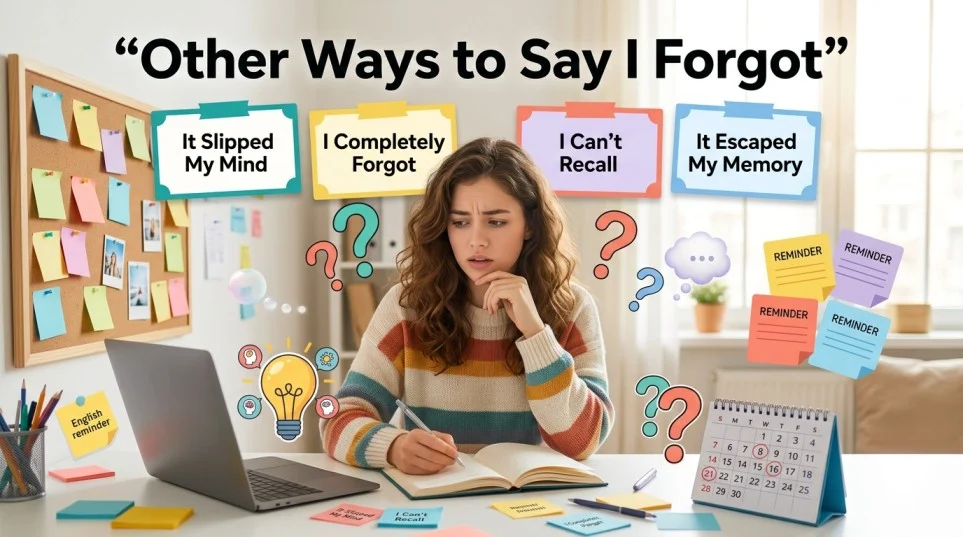
Looking for other ways to say I forgot? You can use phrases like It slipped my mind, I completely overlooked it, I didn’t remember, It escaped my memory, and I lost track of it. These alternatives help you sound more natural, polite, and professional when explaining that you forgot something.
Forgetting something is a normal part of everyday life, but the way you explain it can make a difference in how others perceive your communication. Whether you missed an appointment, forgot to reply to an email, or overlooked an important task, choosing the right words helps you express yourself naturally. Learning other ways to say I forgot allows you to communicate with greater confidence in personal, academic, and professional situations.
Some expressions sound casual and friendly, while others are more suitable for workplace conversations and formal writing. Understanding these differences can improve your English fluency and help you avoid repetitive language. In this guide, you will discover 30 useful alternatives, complete with meanings, explanations, examples, and practical usage tips to help you choose the right phrase for every situation.
Quick Categories
Formal alternatives to “I forgot”
- I overlooked it.
- It escaped my memory.
- I failed to remember.
- I unintentionally omitted it.
Pro Tip: Use these expressions in formal emails, academic writing, and situations where clear, respectful communication matters.
Casual alternatives
- It slipped my mind.
- I totally forgot.
- I lost track of it.
- I completely blanked.
Pro Tip: These expressions work naturally in everyday conversations with friends, family, and familiar colleagues.
Professional alternatives
- I apologize for overlooking that.
- It was an oversight on my part.
- I missed that detail.
- I failed to keep that in mind.
Pro Tip: In professional communication, acknowledge the oversight and focus on how you will correct it.
Informal expressions
- I spaced out.
- It went right over my head.
- I had a brain freeze.
- I didn’t even think of it.
Pro Tip: Use informal expressions when the conversation is relaxed. Avoid them in serious workplace situations.
“A simple apology paired with the right expression can turn a forgotten task into a professional conversation.”
Common Mistakes
1. Saying “I am forgot”
Mistake: I am forgot to call you.
Correct: I forgot to call you.
Why: “Forgot” is the past tense of “forget.” It does not require “am.”
2. Confusing “I forgot” with “I have forgotten”
Mistake: I have forgot about the meeting.
Correct: I have forgotten about the meeting.
Why: Present perfect requires the past participle “forgotten.”
3. Using “I overlooked it” for every situation
Mistake: I overlooked your birthday because I forgot it completely.
Better: Your birthday slipped my mind.
Why: “Overlooked” often suggests missing or failing to notice something rather than simply forgetting it.
4. Using informal expressions in professional emails
Mistake: I totally blanked on the deadline.
Better: I apologize for overlooking the deadline.
Why: Professional messages usually require more polished language.
5. Forgetting to take responsibility
Mistake: It was forgotten by someone.
Better: I forgot to send the document, and I apologize for the delay.
Why: Taking responsibility makes your communication clearer and more accountable.
What Does “I Forgot” Mean?
“I forgot” means that you failed to remember something you previously knew, intended to do, or needed to recall.
Grammatically, “forgot” is the simple past tense of the verb “forget.” It is commonly followed by a noun, pronoun, or infinitive phrase.
Example: “I forgot to bring my notebook to class.”
The expression can describe forgotten information, missed responsibilities, appointments, or everyday details.
When to Use “I Forgot”
You can use this expression in several situations:
- Everyday conversations: When you forget someone’s name, birthday, or a small detail.
- Professional communication: When explaining a missed task or overlooked responsibility.
- Academic settings: When discussing forgotten assignments, deadlines, or instructions.
- Written messages: When apologizing for a delayed response.
- Personal situations: When explaining why you missed an appointment or commitment.
Spoken vs. Written: “I forgot” is natural in both spoken and written English.
Formal vs. Informal: The expression is neutral, but alternatives such as “I overlooked that” may sound more appropriate in formal communication.
Is It Professional or Polite to Say “I Forgot”?
Polite? Yes
Professional? Yes, depending on the context.
“I forgot” is not rude or inappropriate. However, in professional situations, a more responsible expression can communicate accountability and consideration.
Business-style example:
“I apologize for overlooking your previous email. I will review it and respond shortly.”
When communicating professionally, avoid making excuses. Acknowledge the mistake and explain the next step.
Pros and Cons of Using “I Forgot”
Pros
- Simple and natural: Easy to understand and use in everyday English.
- Friendly tone: Sounds honest and conversational.
- Common usage: Widely understood by English speakers.
- Easy to understand: Clearly communicates a memory lapse.
Cons
- Too informal for some situations: May sound insufficiently polished in serious professional communication.
- Overused: Repeating the same phrase can make your writing less engaging.
- Limited emotional range: Does not always communicate regret or responsibility.
- Not suitable for every formal context: Some situations require a more specific explanation.
“Instead of repeating ‘I forgot,’ choose words that communicate honesty, responsibility, and the right level of politeness.”
Other Ways to Say “I Forgot” With Examples
These alternatives will help you sound more fluent, confident, and natural in different situations.
Choose each expression according to your tone, context, and audience to communicate clearly and professionally.
1. Phrase: It Slipped My Mind
Meaning: Something was unintentionally forgotten.
Explanation: This is a natural and polite expression used when you forget something without intending to.
Example Sentence: “I meant to call you yesterday, but it slipped my mind.”
Best Use: Everyday conversations
Worst Use: Formal reports
Tone: Friendly, natural, casual
Context Variability: Casual: “Sorry, it slipped my mind.” Professional: “The deadline unfortunately slipped my mind.” Spoken: “I was supposed to call, but it slipped my mind.”
2. Phrase: I Overlooked It
Meaning: You failed to notice or consider something.
Explanation: This phrase is useful when you miss an important detail, instruction, or responsibility.
Example Sentence: “I apologize for overlooking that important detail in your email.”
Best Use: Professional emails
Worst Use: Personal memories
Tone: Formal, polite, accountable
Context Variability: Casual: “I overlooked that.” Professional: “I apologize for overlooking the attachment.” Spoken: “I think I overlooked that detail.”
3. Phrase: It Escaped My Memory
Meaning: Something unintentionally left your memory.
Explanation: This is a slightly formal expression that emphasizes an unintentional memory lapse.
Example Sentence: “Your appointment date escaped my memory, and I sincerely apologize.”
Best Use: Polite conversations
Worst Use: Casual texting
Tone: Formal, gentle, respectful
Context Variability: Casual: “The date escaped my memory.” Professional: “Unfortunately, the appointment date escaped my memory.” Spoken: “It somehow escaped my memory.”
4. Phrase: I Completely Forgot
Meaning: You did not remember something at all.
Explanation: This straightforward expression emphasizes that something was entirely forgotten.
Example Sentence: “I completely forgot to bring the documents.”
Best Use: Everyday speech
Worst Use: Formal apologies
Tone: Direct, casual, honest
Context Variability: Casual: “I completely forgot.” Professional: “I completely forgot to attach the file.” Spoken: “I completely forgot about the meeting.”
5. Phrase: I Lost Track of It
Meaning: You stopped keeping track of something.
Explanation: This phrase works when you forget to monitor a task, deadline, or ongoing activity.
Example Sentence: “I lost track of the submission deadline during the busy week.”
Best Use: Work responsibilities
Worst Use: Important promises
Tone: Neutral, conversational, honest
Context Variability: Casual: “I lost track of it.” Professional: “I lost track of the project deadline.” Spoken: “I got busy and lost track of the date.”
6. Phrase: I Didn’t Remember
Meaning: You were unable to recall something.
Explanation: This is a simple alternative that clearly communicates a lack of memory.
Example Sentence: “I didn’t remember that you had already sent the invitation.”
Best Use: Everyday conversations
Worst Use: Formal apologies
Tone: Simple, neutral, direct
Context Variability: Casual: “I didn’t remember.” Professional: “I didn’t remember receiving the previous update.” Spoken: “I didn’t remember that.”
7. Phrase: I Failed to Remember
Meaning: You did not successfully recall something.
Explanation: This expression sounds more formal and is useful when acknowledging a forgotten responsibility.
Example Sentence: “I failed to remember the scheduled meeting, and I apologize.”
Best Use: Formal communication
Worst Use: Friendly chatting
Tone: Formal, serious, accountable
Context Variability: Casual: “I forgot about it.” Professional: “I failed to remember the scheduled appointment.” Spoken: “I failed to remember the date.”
8. Phrase: I Completely Overlooked That
Meaning: You missed something important without noticing it.
Explanation: This phrase is particularly useful when acknowledging a mistake involving information or instructions.
Example Sentence: “I completely overlooked that requirement in the original instructions.”
Best Use: Workplace communication
Worst Use: Casual jokes
Tone: Professional, responsible, polite
Context Variability: Casual: “I completely missed that.” Professional: “I completely overlooked that requirement.” Spoken: “I completely overlooked that detail.”
9. Phrase: It Slipped My Memory
Meaning: Something was unintentionally forgotten.
Explanation: This is similar to “It slipped my mind,” although it is less common in everyday English.
Example Sentence: “Your request slipped my memory while I was handling other tasks.”
Best Use: Casual explanations
Worst Use: Formal reports
Tone: Gentle, conversational, neutral
Context Variability: Casual: “It slipped my memory.” Professional: “The request slipped my memory.” Spoken: “Sorry, that slipped my memory.”
10. Phrase: I Had a Memory Lapse
Meaning: You temporarily failed to remember something.
Explanation: This phrase sounds more formal and emphasizes a temporary failure to recall information.
Example Sentence: “I had a memory lapse and forgot the name of the speaker.”
Best Use: Formal conversations
Worst Use: Casual texting
Tone: Neutral, formal, explanatory
Context Variability: Casual: “I had a memory lapse.” Professional: “I experienced a brief memory lapse.” Spoken: “I had a little memory lapse.”
11. Phrase: I Missed That Detail
Meaning: You failed to notice or remember a particular piece of information.
Explanation: This phrase is especially useful when discussing instructions, documents, or conversations.
Example Sentence: “Thank you for pointing that out. I missed that detail in the report.”
Best Use: Professional discussions
Worst Use: Personal memories
Tone: Professional, clear, accountable
Context Variability: Casual: “I missed that detail.” Professional: “I missed that detail in the proposal.” Spoken: “I think I missed that part.”
12. Phrase: I Didn’t Keep It in Mind
Meaning: You did not continue remembering or considering something.
Explanation: This expression works when you forget to consider information while making plans or decisions.
Example Sentence: “I didn’t keep your schedule in mind when arranging the meeting.”
Best Use: Planning discussions
Worst Use: Formal apologies
Tone: Neutral, reflective, polite
Context Variability: Casual: “I didn’t keep that in mind.” Professional: “I didn’t keep the updated schedule in mind.” Spoken: “I should have kept that in mind.”
13. Phrase: I Completely Blankеd
Meaning: Your mind temporarily became unable to recall something.
Explanation: This informal expression is common when someone suddenly cannot remember information.
Example Sentence: “I completely blanked on her name during the introduction.”
Best Use: Casual conversations
Worst Use: Formal emails
Tone: Informal, friendly, conversational
Context Variability: Casual: “I completely blanked.” Professional: “I was unable to recall the name.” Spoken: “I completely blanked when she asked me.”
14. Phrase: I Didn’t Think of It
Meaning: You did not consider or remember something at the time.
Explanation: This phrase is useful when something simply did not occur to you.
Example Sentence: “I didn’t think of bringing an umbrella before leaving home.”
Best Use: Everyday speech
Worst Use: Serious mistakes
Tone: Casual, natural, straightforward
Context Variability: Casual: “I didn’t think of it.” Professional: “That possibility did not occur to me.” Spoken: “I honestly didn’t think of that.”
15. Phrase: It Went Right Over My Head
Meaning: You failed to understand or notice something.
Explanation: This idiom is useful when information was not understood, rather than simply forgotten.
Example Sentence: “The reminder about the deadline went right over my head.”
Best Use: Casual conversations
Worst Use: Formal reports
Tone: Informal, conversational, expressive
Context Variability: Casual: “That went right over my head.” Professional: “I missed that information.” Spoken: “Sorry, that went right over my head.”
16. Phrase: I Wasn’t Mindful of It
Meaning: You were not paying attention to or remembering something.
Explanation: This phrase is useful when acknowledging a lack of awareness or consideration.
Example Sentence: “I wasn’t mindful of the updated schedule when planning my day.”
Best Use: Reflective discussions
Worst Use: Casual texting
Tone: Thoughtful, formal, respectful
Context Variability: Casual: “I wasn’t thinking about it.” Professional: “I wasn’t mindful of the revised instructions.” Spoken: “I wasn’t mindful of that change.”
17. Phrase: I Forgot All About It
Meaning: You completely stopped remembering something.
Explanation: This conversational phrase emphasizes that something was entirely forgotten.
Example Sentence: “I forgot all about our lunch plans because my day became so busy.”
Best Use: Friendly conversations
Worst Use: Formal reports
Tone: Casual, friendly, expressive
Context Variability: Casual: “I forgot all about it.” Professional: “I completely forgot about the scheduled discussion.” Spoken: “I forgot all about our plans.”
18. Phrase: I Let It Slip My Mind
Meaning: You unintentionally allowed yourself to forget something.
Explanation: This expression is a polite way to acknowledge a forgotten task or commitment.
Example Sentence: “I let it slip my mind, and I apologize for not responding sooner.”
Best Use: Polite apologies
Worst Use: Serious formal reports
Tone: Polite, conversational, apologetic
Context Variability: Casual: “I let it slip my mind.” Professional: “Unfortunately, I let the follow-up slip my mind.” Spoken: “Sorry, I let that slip my mind.”
19. Phrase: I Wasn’t Aware of That
Meaning: You did not know or realize something.
Explanation: This phrase is useful when explaining that information was not known to you, although it does not always mean you forgot it.
Example Sentence: “I wasn’t aware of the revised deadline until you mentioned it.”
Best Use: Professional discussions
Worst Use: Clear admissions
Tone: Neutral, polite, professional
Context Variability: Casual: “I didn’t know about that.” Professional: “I wasn’t aware of the updated policy.” Spoken: “I wasn’t aware of that change.”
20. Phrase: It Slipped Through the Cracks
Meaning: Something was accidentally missed or neglected.
Explanation: This idiom is commonly used for forgotten tasks, details, or responsibilities.
Example Sentence: “Your request unfortunately slipped through the cracks during the transition.”
Best Use: Workplace communication
Worst Use: Personal apologies
Tone: Professional, conversational, indirect
Context Variability: Casual: “It slipped through the cracks.” Professional: “The request slipped through the cracks during processing.” Spoken: “Somehow, that task slipped through the cracks.”
21. Phrase: I Failed to Keep Track
Meaning: You did not monitor or remember something properly.
Explanation: This phrase works well when discussing deadlines, tasks, schedules, or ongoing responsibilities.
Example Sentence: “I failed to keep track of the changes to the project timeline.”
Best Use: Work discussions
Worst Use: Casual small talk
Tone: Formal, responsible, direct
Context Variability: Casual: “I didn’t keep track.” Professional: “I failed to keep track of the revised timeline.” Spoken: “I failed to keep track of the dates.”
22. Phrase: I Had It Slip My Mind
Meaning: You unintentionally forgot something.
Explanation: This wording is understandable, but “It slipped my mind” is more natural and grammatically preferred.
Example Sentence: “I had it slip my mind that we were meeting today.”
Best Use: Casual speech
Worst Use: Formal writing
Tone: Informal, conversational, hesitant
Context Variability: Casual: “It slipped my mind.” Professional: “I overlooked the meeting.” Spoken: “I had it slip my mind.”
23. Phrase: I Spaced Out
Meaning: You stopped paying attention and missed information.
Explanation: This informal expression describes a moment when your attention wandered.
Example Sentence: “I spaced out during the instructions and missed the final step.”
Best Use: Friendly conversations
Worst Use: Professional apologies
Tone: Informal, relaxed, conversational
Context Variability: Casual: “I spaced out.” Professional: “I missed part of the instructions.” Spoken: “Sorry, I spaced out for a moment.”
24. Phrase: I Wasn’t Thinking
Meaning: You failed to consider something before acting or responding.
Explanation: This phrase can communicate regret when you forget an important detail or responsibility.
Example Sentence: “I wasn’t thinking about the deadline when I scheduled the appointment.”
Best Use: Personal conversations
Worst Use: Formal reports
Tone: Honest, casual, reflective
Context Variability: Casual: “I wasn’t thinking.” Professional: “I failed to consider the deadline.” Spoken: “I wasn’t thinking about that.”
25. Phrase: I Didn’t Recall
Meaning: You were unable to remember something.
Explanation: This is a slightly more formal alternative that works well when discussing previously received information.
Example Sentence: “I didn’t recall receiving the updated document.”
Best Use: Formal discussions
Worst Use: Casual texting
Tone: Formal, neutral, precise
Context Variability: Casual: “I didn’t remember that.” Professional: “I didn’t recall receiving the earlier notification.” Spoken: “I didn’t recall that conversation.”
26. Phrase: I Unintentionally Overlooked It
Meaning: You accidentally failed to notice something.
Explanation: This phrase emphasizes that the mistake was not deliberate.
Example Sentence: “I unintentionally overlooked your previous message, and I apologize.”
Best Use: Professional emails
Worst Use: Casual conversations
Tone: Professional, respectful, accountable
Context Variability: Casual: “I accidentally missed it.” Professional: “I unintentionally overlooked the request.” Spoken: “I unintentionally overlooked that detail.”
27. Phrase: I Let It Slip
Meaning: You accidentally failed to remember or mention something.
Explanation: This expression is useful when you forget to share information or complete a small responsibility.
Example Sentence: “I let it slip that the meeting had been rescheduled.”
Best Use: Everyday conversations
Worst Use: Formal reports
Tone: Casual, natural, conversational
Context Variability: Casual: “I let it slip.” Professional: “I inadvertently omitted that information.” Spoken: “I let that slip earlier.”
28. Phrase: I Lost Sight of It
Meaning: You stopped considering or remembering something important.
Explanation: This phrase works when you become distracted from a goal, responsibility, or priority.
Example Sentence: “I lost sight of the original deadline while managing other projects.”
Best Use: Professional discussions
Worst Use: Simple memory lapses
Tone: Reflective, formal, thoughtful
Context Variability: Casual: “I lost sight of it.” Professional: “I lost sight of the original objective.” Spoken: “I lost sight of that priority.”
29. Phrase: I Didn’t Have It on My Radar
Meaning: You were not aware of or paying attention to something.
Explanation: This informal idiom is commonly used in workplace conversations to describe something that was not on your list of priorities.
Example Sentence: “That deadline wasn’t on my radar, but I will make sure to address it.”
Best Use: Workplace conversations
Worst Use: Formal letters
Tone: Conversational, informal, relaxed
Context Variability: Casual: “It wasn’t on my radar.” Professional: “That task wasn’t on my radar.” Spoken: “I didn’t have that on my radar.”
30. Phrase: It Was an Oversight on My Part
Meaning: You made an unintentional mistake by failing to notice or remember something.
Explanation: This is a highly useful professional expression for acknowledging responsibility without sounding overly casual.
Example Sentence: “It was an oversight on my part, and I will ensure it does not happen again.”
Best Use: Professional apologies
Worst Use: Casual chatting
Tone: Formal, accountable, respectful
Context Variability: Casual: “That was my mistake.” Professional: “It was an oversight on my part.” Spoken: “That was an oversight on my part, and I apologize.”
“Professional English is not about using complicated words. It is about expressing simple ideas with clarity and accountability.”
Mini Quiz / Self-Check
Test your understanding of these expressions with the following questions.
1. Which expression is most appropriate for a professional email?
A. I totally blanked. B. It was an oversight on my part. C. I spaced out. D. I forgot all about it.
Correct Answer: B. It was an oversight on my part.
2. Which phrase means you accidentally forgot something?
A. It slipped my mind. B. I was aware of it. C. I remembered everything. D. I kept track of it.
Correct Answer: A. It slipped my mind.
3. You forgot to attach a document to an email. Which response sounds professional?
A. I completely blanked on it. B. I wasn’t thinking. C. I apologize for overlooking the attachment. D. It went over my head.
Correct Answer: C. I apologize for overlooking the attachment.
4. Which expression is most suitable for a casual conversation?
A. I failed to remember. B. It was an oversight on my part. C. I spaced out. D. I unintentionally omitted it.
Correct Answer: C. I spaced out.
Comparison Table: Top Alternatives
| Phrase | Tone | Best Use |
|---|---|---|
| It slipped my mind | Friendly, natural | Everyday conversations |
| I overlooked it | Professional, polite | Work emails |
| I completely forgot | Direct, casual | Personal conversations |
| I lost track of it | Neutral, conversational | Deadlines and tasks |
| It escaped my memory | Formal, gentle | Polite explanations |
| I had a memory lapse | Formal, neutral | Explanations |
| I missed that detail | Professional, clear | Workplace discussions |
| I didn’t recall | Formal, precise | Professional conversations |
| I spaced out | Informal, relaxed | Casual speech |
| It was an oversight on my part | Professional, accountable | Formal apologies |
FAQs
1. What are the best other ways to say I forgot professionally?
The best professional alternatives include “I overlooked that,” “It was an oversight on my part,” and “I apologize for missing that detail.” These expressions communicate responsibility politely.
2. What is a polite way to say I forgot?
“It slipped my mind” is one of the most natural polite alternatives. You can also say, “I apologize for overlooking that.”
3. How do you say I forgot without sounding rude?
Use expressions such as “I completely overlooked that” or “I apologize for missing that.” Acknowledge the mistake and avoid blaming others.
4. What is a formal synonym for I forgot?
Formal alternatives include “I failed to recall,” “I unintentionally overlooked it,” and “It was an oversight on my part.”
5. Is “It slipped my mind” professional?
Yes. It is polite and acceptable in many professional conversations, although “I overlooked that” may sound more appropriate in formal emails and reports.
Conclusion
Learning other ways to say I forgot helps you communicate more naturally in personal, academic, and professional situations. Expressions such as “It slipped my mind,” “I overlooked it,” and “It was an oversight on my part” allow you to explain forgotten responsibilities without repeating the same words.
Practice these alternatives in everyday conversations and professional messages to improve your English fluency. Remember that choosing the right phrase depends on your audience, purpose, and level of formality. With regular practice, you can express forgetfulness clearly while maintaining a polite, confident, and responsible tone.
Read More Related Articles:
- Other Ways to Say Especially | 30+ Fresh Alternatives for …
- Other Ways to Say Problem Solver | Smart, Professional …
- Ways to Say Bye in Other Languages | Global Goodbye Guide …

Logan Hayes is a content writer at Replynst.com. He specializes in turning complex topics into simple, engaging and useful articles. His work combines careful research, clear writing to create content readers can trust.