Quick Answer
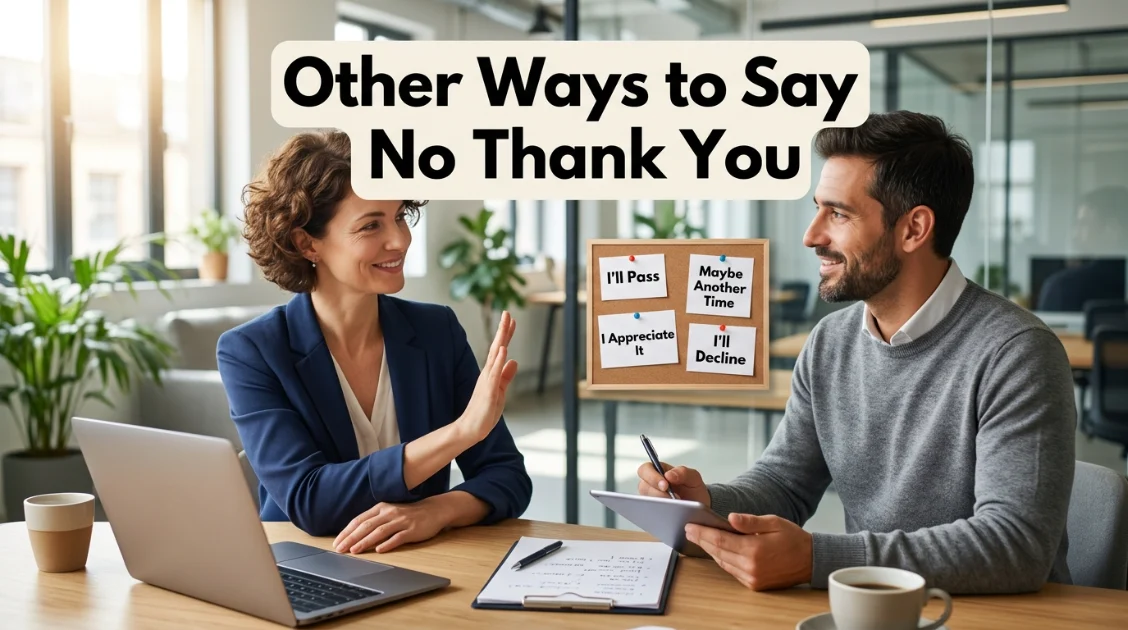
The best alternatives include I appreciate it, but no thanks, I’ll pass, I’m okay, maybe another time, and thank you, but I’ll decline. Choose your phrase based on whether you want to sound polite, formal, friendly, or professional.
Knowing other ways to say no thank you can make your English sound more natural, polite, and confident. Although “no thank you” is already respectful, repeating the same phrase can sometimes make conversations feel less flexible. Different situations call for different expressions, especially when you are declining an offer, invitation, suggestion, or request.
Learning alternatives to “no thank you” is particularly useful for English learners and professionals. You may need a softer expression with a friend, a diplomatic response at work, or a more formal phrase in a professional email. Understanding tone helps you communicate your decision without sounding rude or dismissive. These expressions can also strengthen your broader communication skills, just as learning professional reaction phrases can help you express excitement in English naturally and appropriately.
Quick Categories
Formal alternatives to “no thank you”
- Thank you, but I must decline
- I appreciate the offer, but I’ll decline
- Thank you, but I’m unable to accept
- I’m afraid I’ll have to decline
Pro Tip: Use these phrases when responding to formal invitations, business offers, or professional requests.
Casual alternatives
- I’ll pass
- Maybe another time
- I’m okay, thanks
- Not this time
Pro Tip: Casual alternatives work best when speaking with friends, family, or people you know well.
Professional alternatives
- I appreciate the offer, but I’ll pass
- Thank you for considering me, but I’ll decline
- I appreciate the opportunity, but I’m unable to accept
- Thank you, but I’ll have to pass
Pro Tip: Add appreciation before declining when you want your response to sound diplomatic and professional.
Informal expressions
- No, I’m good
- I’m all set
- I’m okay, thanks
- Not for me, thanks
Pro Tip: Informal expressions in English are natural in relaxed conversations but may sound too casual in formal workplace communication.
“A polite refusal can be clear without being cold.”
Common Mistakes
1. Saying “No thank you” too abruptly
Mistake: “No thank you.”
Better: “No thank you, I appreciate the offer.”
Why: Adding appreciation can make the refusal sound warmer.
2. Using “I’ll pass” in every situation
Mistake: “I’ll pass” in a formal business email.
Better: “Thank you for the opportunity, but I’ll decline.”
Why: “I’ll pass” is generally casual.
3. Saying “I don’t want it”
Mistake: “I don’t want it.”
Better: “Thank you, but I don’t think I’ll take it.”
Why: The second version sounds more considerate.
4. Overexplaining your refusal
Mistake: Giving a long explanation for a simple decline.
Better: “Thank you, but I’m unable to accept.”
Why: A short and respectful response is often enough.
5. Using “No thanks” in formal writing
Mistake: “No thanks, I’m not interested.”
Better: “Thank you for reaching out, but I’m not interested at this time.”
Why: The formal version sounds more polished and diplomatic.
What Does “No Thank You” Mean?
“No thank you” is a polite expression used to decline an offer, invitation, suggestion, or request.
It combines no, which communicates refusal, with thank you, which acknowledges the other person’s effort or kindness.
Example: “Would you like some coffee?” “No, thank you.”
When to Use “No Thank You”
You can use “no thank you” in many everyday situations:
- Declining an offer: When someone offers you food, help, or something else.
- Refusing an invitation: When you do not want to attend an event.
- Rejecting a suggestion: When you prefer another option.
- Professional conversations: When a direct but polite refusal is appropriate.
- Customer interactions: When declining a product or service.
Spoken vs. Written: It works naturally in both spoken and written English.
Formal vs. Informal: It is neutral and polite, although more formal situations may benefit from a longer expression.
Is It Professional or Polite to Say “No Thank You”?
Polite? ✔️ Yes
Professional? ✔️ Yes, depending on context
“No thank you” is polite and can be professional when the situation is simple and conversational. In formal emails, however, a slightly more detailed response may sound more diplomatic.
Business-style example: “Thank you for the invitation, but I’m unable to attend.”
Pros and Cons of Using “No Thank You”
Pros
- Simple and natural: It is easy to say and understand.
- Friendly tone: The “thank you” makes the refusal more courteous.
- Common usage: Native speakers use it frequently.
- Easy to understand: The meaning is immediately clear.
Cons
- Too brief for some work situations: Formal communication may require more context.
- Overused: Repeating it can make your responses sound predictable.
- Limited emotional range: It does not always show appreciation or explanation.
- Not suitable for every formal situation: Some refusals benefit from more diplomatic wording.
“The best refusal protects both your boundaries and the other person’s feelings.”
Other Ways to Say “No Thank You” With Examples
These alternatives will help you sound more fluent, confident, and natural in different situations.
Use them according to tone, context, and audience to express appreciation while clearly declining an offer.
1. Phrase: I Appreciate It, But No Thanks
Meaning: You appreciate the offer but choose not to accept it.
Explanation: This is a warm and polite way to decline without sounding dismissive.
Example Sentence: “I appreciate it, but no thanks. I already have everything I need.”
Best Use: Friendly conversations
Worst Use: Formal reports
Tone: Warm, polite, friendly
Context Variability: Casual: “I appreciate it, but no thanks.” Professional: “I appreciate the offer, but I’ll decline.” Spoken: “Thanks, but I’m okay.”
2. Phrase: I’ll Pass
Meaning: You choose not to accept or participate.
Explanation: This is a concise and common informal expression.
Example Sentence: “Thanks for the invitation, but I’ll pass this time.”
Best Use: Casual situations
Worst Use: Formal emails
Tone: Casual, direct, friendly
Context Variability: Casual: “I’ll pass.” Professional: “I’ll have to decline.” Spoken: “I think I’ll pass.”
3. Phrase: Maybe Another Time
Meaning: You are declining now while leaving open the possibility of accepting later.
Explanation: This phrase is useful when you want your refusal to sound gentle.
Example Sentence: “Thanks for inviting me, but maybe another time.”
Best Use: Social invitations
Worst Use: Firm refusals
Tone: Friendly, gentle, positive
Context Variability: Casual: “Maybe another time.” Professional: “Perhaps we can consider this another time.” Spoken: “Maybe another time.”
4. Phrase: I’m Okay, Thanks
Meaning: You do not need or want what was offered.
Explanation: This is a natural and friendly way to decline an offer.
Example Sentence: “Would you like some more tea?” “I’m okay, thanks.”
Best Use: Everyday speech
Worst Use: Formal correspondence
Tone: Friendly, casual, polite
Context Variability: Casual: “I’m okay, thanks.” Professional: “Thank you, but I’m fine for now.” Spoken: “I’m okay, thanks.”
5. Phrase: Not This Time
Meaning: You are declining on this occasion.
Explanation: It gives a clear refusal without sounding harsh.
Example Sentence: “Thanks for the invitation, but not this time.”
Best Use: Social situations
Worst Use: Permanent refusals
Tone: Gentle, casual, polite
Context Variability: Casual: “Not this time.” Professional: “I’ll have to decline this time.” Spoken: “Not this time, thanks.”
6. Phrase: Thank You, But I’ll Decline
Meaning: You politely refuse an offer or invitation.
Explanation: This is a clear and professional expression of refusal.
Example Sentence: “Thank you, but I’ll decline the invitation.”
Best Use: Professional settings
Worst Use: Casual jokes
Tone: Formal, polite, direct
Context Variability: Casual: “No thanks, I’ll pass.” Professional: “Thank you, but I’ll decline.” Spoken: “Thank you, but I’ll decline.”
7. Phrase: I Appreciate the Offer, But I’ll Pass
Meaning: You recognize the offer but choose not to accept it.
Explanation: This combines appreciation with a friendly refusal.
Example Sentence: “I appreciate the offer, but I’ll pass for now.”
Best Use: Professional conversations
Worst Use: Very formal documents
Tone: Polite, diplomatic, friendly
Context Variability: Casual: “Thanks, but I’ll pass.” Professional: “I appreciate the offer, but I’ll pass.” Spoken: “I appreciate it, but I’ll pass.”
8. Phrase: I’m Afraid I’ll Have to Decline
Meaning: You politely communicate that you cannot accept.
Explanation: This phrase softens a firm refusal and works well in formal communication.
Example Sentence: “I’m afraid I’ll have to decline the invitation.”
Best Use: Formal situations
Worst Use: Casual chats
Tone: Formal, diplomatic, courteous
Context Variability: Casual: “I can’t make it.” Professional: “I’m afraid I’ll have to decline.” Spoken: “I’m afraid I’ll have to decline.”
9. Phrase: Thank You, But I’m Unable to Accept
Meaning: You politely refuse an offer.
Explanation: This is appropriate when a professional or formal response is needed.
Example Sentence: “Thank you, but I’m unable to accept the position at this time.”
Best Use: Formal communication
Worst Use: Casual conversations
Tone: Formal, respectful, professional
Context Variability: Casual: “Thanks, but I can’t.” Professional: “Thank you, but I’m unable to accept.” Written: “Thank you for the offer, but I’m unable to accept.”
10. Phrase: I’m All Set
Meaning: You have everything you need and do not require the offer.
Explanation: This is a friendly way to decline help, food, or another offer.
Example Sentence: “Would you like another glass of water?” “No, I’m all set, thanks.”
Best Use: Everyday situations
Worst Use: Formal letters
Tone: Casual, friendly, relaxed
Context Variability: Casual: “I’m all set.” Professional: “Thank you, I have everything I need.” Spoken: “I’m all set, thanks.”
11. Phrase: No, I’m Good
Meaning: You do not need or want what was offered.
Explanation: This is a common conversational expression.
Example Sentence: “Do you need anything else?” “No, I’m good, thanks.”
Best Use: Casual speech
Worst Use: Formal writing
Tone: Informal, friendly, relaxed
Context Variability: Casual: “No, I’m good.” Professional: “Thank you, I’m all set.” Spoken: “No, I’m good.”
12. Phrase: Not for Me, Thanks
Meaning: You politely say that something is not suitable for you.
Explanation: This expression is direct but remains courteous.
Example Sentence: “Would you like to try the spicy dish?” “Not for me, thanks.”
Best Use: Casual situations
Worst Use: Formal negotiations
Tone: Casual, polite, direct
Context Variability: Casual: “Not for me, thanks.” Professional: “I don’t think this option is suitable for me.” Spoken: “Not for me, thanks.”
13. Phrase: I’ll Have to Say No
Meaning: You are choosing to refuse something.
Explanation: This phrase clearly communicates a decision while remaining conversational.
Example Sentence: “I appreciate the invitation, but I’ll have to say no.”
Best Use: Polite refusals
Worst Use: Formal contracts
Tone: Direct, polite, conversational
Context Variability: Casual: “I’ll have to say no.” Professional: “I’ll have to decline.” Spoken: “I’m sorry, but I’ll have to say no.”
14. Phrase: Thank You, But I’ll Sit This One Out
Meaning: You will not participate this time.
Explanation: This is a friendly expression often used for social activities.
Example Sentence: “Thanks for inviting me, but I’ll sit this one out.”
Best Use: Social invitations
Worst Use: Formal business offers
Tone: Casual, friendly, relaxed
Context Variability: Casual: “I’ll sit this one out.” Professional: “I won’t be able to participate this time.” Spoken: “Thanks, but I’ll sit this one out.”
15. Phrase: I’ll Have to Pass This Time
Meaning: You are declining on this particular occasion.
Explanation: This sounds slightly softer than a simple “I’ll pass.”
Example Sentence: “Thank you for the invitation, but I’ll have to pass this time.”
Best Use: Social situations
Worst Use: Formal contracts
Tone: Friendly, polite, casual
Context Variability: Casual: “I’ll pass this time.” Professional: “I’ll have to decline this time.” Spoken: “I’ll have to pass this time.”
16. Phrase: Thank You, But I’m Fine
Meaning: You do not need what has been offered.
Explanation: This is a simple and polite response to an offer of help or something physical.
Example Sentence: “Can I get you another coffee?” “Thank you, but I’m fine.”
Best Use: Everyday offers
Worst Use: Formal refusals
Tone: Polite, simple, friendly
Context Variability: Casual: “I’m fine, thanks.” Professional: “Thank you, I’m fine for now.” Spoken: “Thank you, but I’m fine.”
17. Phrase: I Appreciate the Invitation, But I Can’t Make It
Meaning: You are grateful for an invitation but cannot attend.
Explanation: This is more specific and natural than simply saying no.
Example Sentence: “I appreciate the invitation, but I can’t make it this weekend.”
Best Use: Social invitations
Worst Use: Product offers
Tone: Warm, polite, conversational
Context Variability: Casual: “Thanks, but I can’t make it.” Professional: “I appreciate the invitation, but I’m unable to attend.” Written: “Thank you for the invitation, but unfortunately I cannot attend.”
18. Phrase: Thank You, But That Won’t Work for Me
Meaning: You politely reject an option because it does not suit your circumstances.
Explanation: This is useful for schedules, proposals, arrangements, and offers.
Example Sentence: “Thank you, but that meeting time won’t work for me.”
Best Use: Professional discussions
Worst Use: Simple food offers
Tone: Professional, polite, direct
Context Variability: Casual: “That won’t work for me.” Professional: “Thank you, but that option won’t work for me.” Spoken: “Thanks, but that won’t work for me.”
19. Phrase: I Don’t Think I’ll Take You Up on That
Meaning: You are politely declining someone’s offer.
Explanation: This conversational phrase acknowledges the offer while refusing it.
Example Sentence: “Thanks for offering to drive me, but I don’t think I’ll take you up on that.”
Best Use: Friendly conversations
Worst Use: Formal emails
Tone: Conversational, polite, warm
Context Variability: Casual: “I don’t think I’ll take you up on that.” Professional: “Thank you, but I’ll decline the offer.” Spoken: “Thanks, but I don’t think I’ll take you up on that.”
20. Phrase: I’m Going to Decline
Meaning: You have decided not to accept.
Explanation: This is direct and suitable for clear professional communication.
Example Sentence: “Thank you for the proposal, but I’m going to decline.”
Best Use: Professional settings
Worst Use: Casual invitations
Tone: Direct, formal, professional
Context Variability: Casual: “I’m going to pass.” Professional: “I’m going to decline.” Written: “After consideration, I have decided to decline.”
21. Phrase: I’ll Have to Decline the Offer
Meaning: You are respectfully refusing an offer.
Explanation: This phrase is especially useful in business communication.
Example Sentence: “Thank you for your time, but I’ll have to decline the offer.”
Best Use: Business communication
Worst Use: Casual snacks
Tone: Formal, respectful, professional
Context Variability: Casual: “Thanks, but I’ll pass.” Professional: “I’ll have to decline the offer.” Written: “Thank you for the opportunity, but I must decline.”
22. Phrase: I’m Not Interested, Thank You
Meaning: You politely state that you do not want the offer or opportunity.
Explanation: This is direct and commonly used when declining sales offers or proposals.
Example Sentence: “Thank you, but I’m not interested at this time.”
Best Use: Business offers
Worst Use: Close friendships
Tone: Direct, polite, neutral
Context Variability: Casual: “No thanks, I’m not interested.” Professional: “Thank you, but I’m not interested at this time.” Written: “Thank you for reaching out, but I’m not interested.”
23. Phrase: I’ll Decline for Now
Meaning: You are refusing at present without necessarily rejecting the idea permanently.
Explanation: This phrase leaves room for a future change.
Example Sentence: “I appreciate the opportunity, but I’ll decline for now.”
Best Use: Professional offers
Worst Use: Firm rejections
Tone: Polite, diplomatic, professional
Context Variability: Casual: “I’ll pass for now.” Professional: “I’ll decline for now.” Spoken: “I appreciate it, but I’ll decline for now.”
24. Phrase: Perhaps Another Time
Meaning: You are politely declining while suggesting a future possibility.
Explanation: This is a slightly more formal version of “maybe another time.”
Example Sentence: “Thank you for the invitation. Perhaps another time.”
Best Use: Polite invitations
Worst Use: Firm refusals
Tone: Polite, gentle, formal
Context Variability: Casual: “Maybe another time.” Professional: “Perhaps we can revisit this another time.” Spoken: “Perhaps another time.”
25. Phrase: I’m Unable to Accept
Meaning: You cannot accept an offer or invitation.
Explanation: This formal phrase is appropriate when professionalism is important.
Example Sentence: “Thank you for the invitation, but I’m unable to accept.”
Best Use: Formal communication
Worst Use: Casual conversations
Tone: Formal, respectful, professional
Context Variability: Casual: “I can’t accept.” Professional: “I’m unable to accept.” Written: “Unfortunately, I’m unable to accept the offer.”
26. Phrase: Thank You, But I’ll Have to Decline
Meaning: You respectfully refuse an offer or request.
Explanation: This phrase combines gratitude with a firm but courteous refusal.
Example Sentence: “Thank you for the opportunity, but I’ll have to decline.”
Best Use: Professional communication
Worst Use: Casual banter
Tone: Formal, polite, diplomatic
Context Variability: Casual: “Thanks, but I’ll pass.” Professional: “Thank you, but I’ll have to decline.” Written: “Thank you for the opportunity, but I must respectfully decline.”
27. Phrase: I’m Sorry, But I Can’t
Meaning: You apologize while explaining that you cannot accept.
Explanation: This is a simple way to soften a refusal.
Example Sentence: “I’m sorry, but I can’t attend the event.”
Best Use: Personal invitations
Worst Use: Formal business writing
Tone: Apologetic, polite, direct
Context Variability: Casual: “Sorry, I can’t.” Professional: “Unfortunately, I’m unable to attend.” Spoken: “I’m sorry, but I can’t.”
28. Phrase: Thank You for the Offer, But I’ll Decline
Meaning: You acknowledge an offer before politely refusing it.
Explanation: This is an excellent choice for formal and professional communication.
Example Sentence: “Thank you for the offer, but I’ll decline at this time.”
Best Use: Business communication
Worst Use: Casual food offers
Tone: Professional, respectful, formal
Context Variability: Casual: “Thanks, but no thanks.” Professional: “Thank you for the offer, but I’ll decline.” Written: “Thank you for the offer, but I have decided to decline.”
29. Phrase: I’m Grateful, But I’ll Decline
Meaning: You express appreciation while refusing.
Explanation: This phrase is warm and respectful when the offer deserves acknowledgment.
Example Sentence: “I’m grateful for the opportunity, but I’ll decline.”
Best Use: Formal refusals
Worst Use: Quick casual replies
Tone: Warm, formal, appreciative
Context Variability: Casual: “Thanks, but I’ll pass.” Professional: “I’m grateful for the opportunity, but I’ll decline.” Spoken: “I’m grateful, but I’ll decline.”
30. Phrase: Thank You, But I’ll Pass for Now
Meaning: You politely decline at the present time.
Explanation: This phrase is friendly and leaves open the possibility of accepting later.
Example Sentence: “Thank you for the offer, but I’ll pass for now.”
Best Use: Polite refusals
Worst Use: Permanent rejection
Tone: Friendly, polite, diplomatic
Context Variability: Casual: “I’ll pass for now.” Professional: “Thank you, but I’ll decline for now.” Spoken: “Thanks, but I’ll pass for now.”
“When you need to say no, appreciation first can make your message feel more respectful.”
Mini Quiz / Self-Check
1. Which phrase is most suitable for a formal business email?
A. No, I’m good
B. I’ll pass
C. Thank you for the offer, but I’ll decline
D. Not for me, thanks
Answer: C. Thank you for the offer, but I’ll decline
2. Which phrase sounds most casual?
A. I’m unable to accept
B. I’ll pass
C. I must decline
D. I appreciate the opportunity, but I’ll decline
Answer: B. I’ll pass
3. Someone offers you another cup of coffee. Which response sounds natural?
A. I’m all set, thanks.
B. I must respectfully decline your beverage offer.
C. I am unable to accept the coffee.
D. I hereby decline.
Answer: A. I’m all set, thanks.
4. Which phrase leaves open the possibility of accepting later?
A. Absolutely not
B. I refuse
C. Maybe another time
D. I reject the offer
Answer: C. Maybe another time
Comparison Table: Top Alternatives
| Phrase | Tone | Best Use |
|---|---|---|
| I appreciate it, but no thanks | Warm, polite | Everyday conversations |
| I’ll pass | Casual, direct | Informal situations |
| Maybe another time | Gentle, friendly | Social invitations |
| I’m okay, thanks | Casual, polite | Everyday offers |
| Thank you, but I’ll decline | Formal, professional | Business communication |
| I appreciate the offer, but I’ll pass | Diplomatic, polite | Professional conversations |
| I’m afraid I’ll have to decline | Formal, courteous | Formal invitations |
| I’m all set | Casual, friendly | Everyday offers |
| Thank you, but I’m unable to accept | Formal, respectful | Professional writing |
| Perhaps another time | Polite, gentle | Formal invitations |
FAQs
What are the best other ways to say no thank you?
Useful alternatives include I’ll pass, I’m okay, thanks, maybe another time, I appreciate it, but no thanks, and thank you, but I’ll decline.
How can I say no thank you professionally?
Try “Thank you for the offer, but I’ll decline” or “I appreciate the opportunity, but I’m unable to accept.” These phrases sound respectful and professional.
What is a polite way to say no thank you?
“I appreciate it, but no thanks” is warm and natural. For a softer refusal, you can also say “Maybe another time.”
Is “I’ll pass” rude?
Usually, no. “I’ll pass” is a common and generally polite informal expression, but a more formal alternative is better for professional communication.
How do I say no thank you without sounding rude?
Acknowledge the offer before declining. Phrases such as “Thank you, but I’ll have to decline” show appreciation while making your decision clear.
Conclusion
Learning other ways to say no thank you gives you more control over tone, politeness, and context. You can choose a casual phrase such as “I’ll pass,” a friendly option such as “maybe another time,” or a professional expression such as “thank you, but I’ll decline.”
Practice these alternatives in everyday conversations and https://www.merriam-webster.com/dictionary/professional situations. The key is not simply knowing more phrases, but understanding when each expression sounds natural. With regular practice and tone awareness, your English refusals can become clearer, more respectful, and more confident.
Discover More Post:
30+ Other Ways to Say Leave Me Alone | Set Boundaries with …
Other Ways to Say It Means a Lot | Meaningful Expressions …
30+ What Are Other Ways to Say According to? Smart …

Logan Hayes is a content writer at Replynst.com. He specializes in turning complex topics into simple, engaging and useful articles. His work combines careful research, clear writing to create content readers can trust.