Quick Answer:
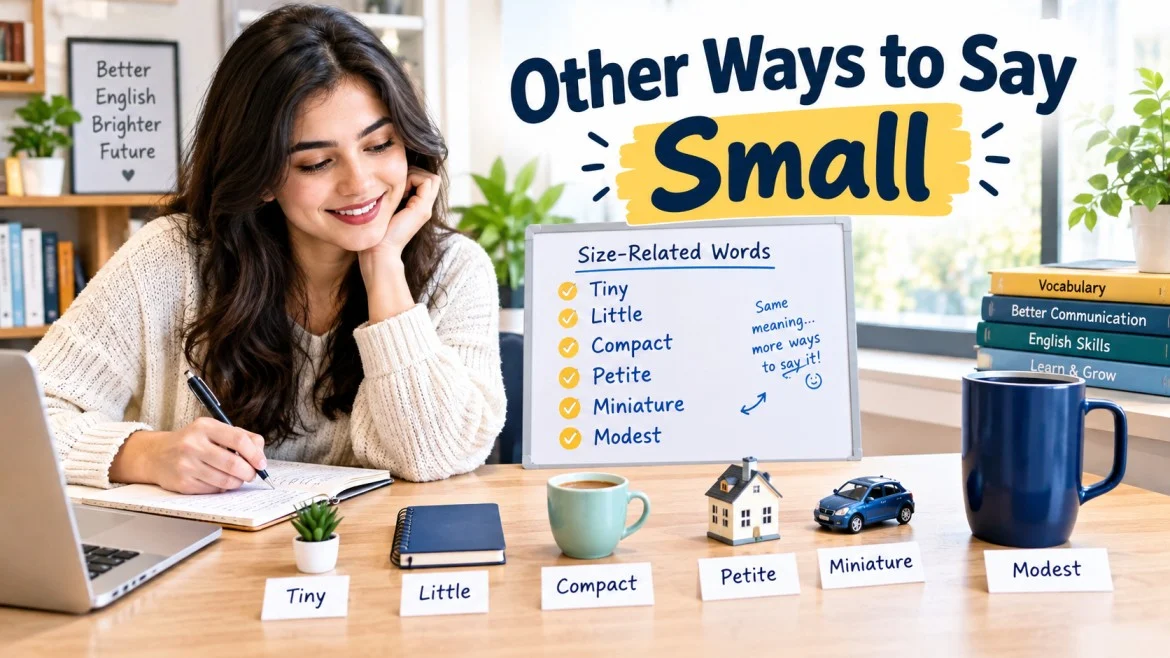
There are many natural ways to say small, including tiny, little, petite, compact, miniature, slight, narrow, and modest. The best alternative depends on whether you are describing size, amount, space, importance, or something informal.
Learning other ways to say small can make your English more precise, natural, and expressive. The word “small” is extremely common, but repeating it in every conversation or piece of writing can make your language sound basic. Choosing a more specific alternative helps you describe objects, spaces, amounts, people, and ideas with greater accuracy.
Understanding alternatives to small is especially useful for English learners, professionals, students, and writers who want stronger vocabulary. A word such as “compact” may suit a product description, while “tiny” sounds natural in casual speech and “modest” may describe an amount. Just as learners practice how to express excitement in English, learning vocabulary variations can help you communicate confidently in different situations and make your spoken and written English more effective.
Quick Categories
Formal alternatives to “small”
- Modest
- Limited
- Minimal
- Minor
Pro Tip: Use formal alternatives when discussing amounts, significance, limitations, or professional subjects.
Casual alternatives
- Little
- Tiny
- Teeny
- Petite
Pro Tip: Casual alternatives work best in everyday conversations when the tone is friendly and relaxed.
Professional alternatives
- Compact
- Concise
- Limited
- Minimal
Pro Tip: Choose precise professional vocabulary based on whether you are describing physical size, quantity, or scope.
Informal expressions
- Teeny
- Bitty
- Little bit
- Dinky
Pro Tip: Informal expressions in English can add personality, but avoid them in formal reports and professional communication.
“The right synonym does more than replace a word. It tells your reader exactly what you mean.”
Common Mistakes
1. Using “tiny” for everything
Mistake: “The company has a tiny budget.”
Better: “The company has a limited budget.”
Why: “Tiny” usually emphasizes physical size or an extremely small amount and may sound exaggerated for professional subjects.
2. Using “little” when you mean “young”
Mistake: “My little brother is small.”
Better: “My younger brother is small.”
Why: “Little” can describe size, but it can also refer to age or affection, so context matters.
3. Using “minor” for physical size
Mistake: “She bought a minor apartment.”
Better: “She bought a small apartment.”
Why: “Minor” usually describes importance, seriousness, or degree rather than physical dimensions.
4. Using “compact” for people
Mistake: “He is compact.”
Better: “He is short” or “He has a small build.”
Why: “Compact” is more natural for objects, spaces, products, or designs.
5. Using “minimal” when you mean physically tiny
Mistake: “She lives in a minimal house.”
Better: “She lives in a tiny house.”
Why: “Minimal” usually refers to quantity, style, or design rather than physical dimensions alone.
What Does “Small” Mean?
Small describes something that has a size, amount, degree, or scale that is less than usual or less than another thing being compared.
It can describe physical objects, spaces, quantities, groups, businesses, problems, and even levels of importance.
The word is an adjective.
Example: “She lives in a small apartment.”
When to Use “Small”
You can use small in many contexts:
- Physical size: “I bought a small table.”
- Amount: “We made a small profit.”
- Space: “The office has a small meeting room.”
- Quantity: “Only a small number of people attended.”
- Business: “He owns a small company.”
- Importance: “It was a small mistake.”
- Degree: “There was a small improvement.”
Spoken vs. Written: “Small” is natural in both spoken and written English.
Formal vs. Informal: The word is neutral and appropriate in almost every context, although a more specific synonym can make formal writing more precise.
Is It Professional or Polite to Say “Small”?
Polite? ✔️ Yes
Professional? ✔️ Yes
“Small” is a neutral word and is completely acceptable in professional communication. However, choosing a more specific term can make business writing clearer.
Business-style example: “We operate from a compact office in the city center.”
Here, compact gives a more polished description than simply saying “small.”
Pros and Cons of Using “Small”
Pros
- Simple and natural: Everyone understands it.
- Friendly tone: It works comfortably in everyday conversations.
- Common usage: Native speakers use it frequently.
- Easy to understand: It communicates basic size or quantity clearly.
Cons
- Can be vague: It may not explain exactly how small something is.
- Overused: Repeating it can make writing less varied.
- Limited descriptive range: It does not always show the exact meaning you intend.
- Less precise in formal writing: A specific synonym can sometimes communicate the idea better.
“Good vocabulary is not about using difficult words. It is about choosing the most accurate word.”
Other Ways to Say “Small” With Examples
These alternatives will help you sound more fluent, confident, and natural in different situations.
Use them according to tone, context, and audience to describe size, quantity, scale, or degree accurately.
1. Phrase: Tiny
Meaning: Extremely small in size.
Explanation: “Tiny” is stronger than “small” and is common in everyday English.
Example Sentence: “She found a tiny apartment near the university.”
Best Use: Physical objects
Worst Use: Formal business
Tone: Casual, vivid, friendly
Context Variability: Casual: “That puppy is tiny.” Professional: “The device has a tiny sensor.” Spoken: “It is really tiny.”
2. Phrase: Little
Meaning: Small in size or amount.
Explanation: “Little” is one of the most common alternatives and can sound warm or affectionate.
Example Sentence: “She lives in a little house near the park.”
Best Use: Everyday speech
Worst Use: Technical writing
Tone: Casual, warm, friendly
Context Variability: Casual: “I have a little car.” Professional: “The device has a small capacity.” Spoken: “It is a little one.”
3. Phrase: Compact
Meaning: Small but efficiently arranged.
Explanation: “Compact” often suggests that something takes up little space while remaining practical.
Example Sentence: “This compact laptop is ideal for travel.”
Best Use: Product descriptions
Worst Use: Describing emotions
Tone: Professional, positive, precise
Context Variability: Casual: “It is nice and compact.” Professional: “The compact design saves space.” Spoken: “I prefer something compact.”
4. Phrase: Petite
Meaning: Small and delicately built, especially when describing a person.
Explanation: “Petite” is commonly used for women and clothing sizes.
Example Sentence: “The store offers several styles for petite customers.”
Best Use: Clothing contexts
Worst Use: General objects
Tone: Polished, descriptive, elegant
Context Variability: Casual: “She is quite petite.” Professional: “The brand offers petite sizes.” Spoken: “Do you have a petite size?”
5. Phrase: Miniature
Meaning: A very small representation or version of something.
Explanation: “Miniature” often suggests that an object is deliberately made smaller than the original.
Example Sentence: “He collects miniature models of classic cars.”
Best Use: Models and replicas
Worst Use: Large spaces
Tone: Descriptive, precise, neutral
Context Variability: Casual: “That is a miniature house.” Professional: “The company produced a miniature prototype.” Spoken: “It is a miniature version.”
6. Phrase: Modest
Meaning: Relatively small or limited in size, amount, or extent.
Explanation: “Modest” is often used positively when discussing amounts, homes, achievements, or expectations.
Example Sentence: “They live in a modest home outside the city.”
Best Use: Formal descriptions
Worst Use: Exact measurements
Tone: Formal, positive, restrained
Context Variability: Casual: “They have a modest house.” Professional: “The project requires a modest investment.” Spoken: “It is a fairly modest amount.”
7. Phrase: Minimal
Meaning: Very small in amount or degree.
Explanation: “Minimal” emphasizes that there is very little of something.
Example Sentence: “The changes had a minimal effect on the results.”
Best Use: Formal writing
Worst Use: Physical descriptions
Tone: Formal, precise, professional
Context Variability: Casual: “There was very little damage.” Professional: “The project requires minimal resources.” Spoken: “The impact was minimal.”
8. Phrase: Minor
Meaning: Small in importance, seriousness, or degree.
Explanation: “Minor” is usually about significance rather than physical size.
Example Sentence: “The report contains only a few minor errors.”
Best Use: Professional writing
Worst Use: Describing objects
Tone: Formal, neutral, professional
Context Variability: Casual: “It was just a small mistake.” Professional: “The issue is minor.” Spoken: “It is only a minor problem.”
9. Phrase: Limited
Meaning: Small in amount, range, or availability.
Explanation: “Limited” focuses on restriction rather than physical dimensions.
Example Sentence: “The project has a limited budget.”
Best Use: Business communication
Worst Use: Physical objects
Tone: Professional, neutral, precise
Context Variability: Casual: “We have only a little money.” Professional: “Resources are limited.” Spoken: “We have limited time.”
10. Phrase: Slight
Meaning: Small in degree or extent.
Explanation: “Slight” is useful for describing small changes, differences, or amounts.
Example Sentence: “There was a slight improvement in performance.”
Best Use: Formal writing
Worst Use: Large objects
Tone: Formal, subtle, precise
Context Variability: Casual: “There is a small difference.” Professional: “There was a slight increase.” Spoken: “I noticed a slight change.”
11. Phrase: Narrow
Meaning: Having a small distance from one side to the other.
Explanation: “Narrow” specifically describes width or limited space.
Example Sentence: “The house is located on a narrow street.”
Best Use: Physical spaces
Worst Use: Amounts
Tone: Neutral, descriptive, precise
Context Variability: Casual: “The road is narrow.” Professional: “The design includes a narrow passage.” Spoken: “It is quite narrow.”
12. Phrase: Compact-Sized
Meaning: Designed or made to occupy relatively little space.
Explanation: This phrase is useful in product and marketing descriptions.
Example Sentence: “The compact-sized printer fits easily on the desk.”
Best Use: Product descriptions
Worst Use: Formal essays
Tone: Professional, practical, descriptive
Context Variability: Casual: “It is compact-sized.” Professional: “The compact-sized model saves workspace.” Spoken: “I need a compact-sized option.”
13. Phrase: Petite-Sized
Meaning: Made for people with a smaller body frame.
Explanation: It is mainly associated with clothing and fashion.
Example Sentence: “This jacket is available in petite-sized options.”
Best Use: Fashion writing
Worst Use: General objects
Tone: Polished, specific, descriptive
Context Variability: Casual: “I need a petite size.” Professional: “The collection includes petite-sized garments.” Spoken: “Do you have this in petite?”
14. Phrase: Insignificant
Meaning: So small that it has little importance or effect.
Explanation: “Insignificant” describes importance rather than physical dimensions.
Example Sentence: “The difference in cost was insignificant.”
Best Use: Formal analysis
Worst Use: Describing people
Tone: Formal, analytical, precise
Context Variability: Casual: “The difference was tiny.” Professional: “The cost difference was insignificant.” Spoken: “The change was insignificant.”
15. Phrase: Negligible
Meaning: So small that it can almost be ignored.
Explanation: This is a strong formal word often used for quantities, effects, risks, or differences.
Example Sentence: “The additional cost was negligible.”
Best Use: Business analysis
Worst Use: Casual conversation
Tone: Formal, technical, precise
Context Variability: Casual: “The extra cost was tiny.” Professional: “The additional expense was negligible.” Spoken: “The difference is negligible.”
16. Phrase: Trivial
Meaning: Very small or unimportant.
Explanation: “Trivial” usually describes importance rather than physical size.
Example Sentence: “The error was considered trivial.”
Best Use: Formal analysis
Worst Use: Personal criticism
Tone: Formal, analytical, direct
Context Variability: Casual: “It was a tiny issue.” Professional: “The error was trivial.” Spoken: “That is a trivial matter.”
17. Phrase: Scant
Meaning: Barely enough or available in a very small amount.
Explanation: “Scant” is a formal word often used with resources, evidence, or information.
Example Sentence: “The report provides scant evidence to support the claim.”
Best Use: Formal writing
Worst Use: Casual speech
Tone: Formal, critical, precise
Context Variability: Casual: “There was very little evidence.” Professional: “The study provides scant evidence.” Spoken: “There was scant information available.”
18. Phrase: Meager
Meaning: Smaller or less than what is needed or expected.
Explanation: “Meager” often suggests that an amount is insufficient.
Example Sentence: “The workers received a meager salary.”
Best Use: Formal descriptions
Worst Use: Neutral product descriptions
Tone: Formal, critical, descriptive
Context Variability: Casual: “They earned very little.” Professional: “The position offers a meager salary.” Spoken: “The amount was meager.”
19. Phrase: Diminutive
Meaning: Unusually or noticeably small.
Explanation: “Diminutive” is a formal descriptive word often used for people or objects.
Example Sentence: “The diminutive sculpture attracted considerable attention.”
Best Use: Descriptive writing
Worst Use: Workplace chat
Tone: Formal, literary, descriptive
Context Variability: Casual: “The sculpture is very small.” Professional: “The diminutive design is visually distinctive.” Spoken: “It has a diminutive form.”
20. Phrase: Undersized
Meaning: Smaller than the expected or standard size.
Explanation: “Undersized” implies that something is smaller than it should be.
Example Sentence: “The undersized room was difficult to furnish.”
Best Use: Comparisons
Worst Use: Compliments
Tone: Neutral, direct, descriptive
Context Variability: Casual: “The room is too small.” Professional: “The equipment is undersized for the facility.” Spoken: “This feels undersized.”
21. Phrase: Petite in Scale
Meaning: Small in overall dimensions or proportion.
Explanation: This phrase gives a more polished description of a small design or object.
Example Sentence: “The furniture is petite in scale but highly functional.”
Best Use: Design writing
Worst Use: Casual speech
Tone: Polished, descriptive, professional
Context Variability: Casual: “The furniture is small.” Professional: “The furniture is petite in scale.” Spoken: “It is petite in scale.”
22. Phrase: Limited in Size
Meaning: Restricted to a relatively small physical dimension.
Explanation: This phrase is useful when discussing capacity or dimensions formally.
Example Sentence: “The facility is limited in size but efficiently organized.”
Best Use: Professional writing
Worst Use: Casual chat
Tone: Formal, neutral, precise
Context Variability: Casual: “The place is small.” Professional: “The facility is limited in size.” Spoken: “The space is limited in size.”
23. Phrase: Reduced
Meaning: Made smaller in size, amount, or extent.
Explanation: “Reduced” focuses on a change from a previous or original level.
Example Sentence: “The company introduced a reduced-size package.”
Best Use: Product descriptions
Worst Use: Personal descriptions
Tone: Professional, neutral, precise
Context Variability: Casual: “They made it smaller.” Professional: “The product is available in a reduced size.” Spoken: “We chose the reduced version.”
24. Phrase: Subtle
Meaning: Small or difficult to notice.
Explanation: “Subtle” is useful for small differences, changes, effects, or details.
Example Sentence: “The designer added a subtle change to the color.”
Best Use: Creative descriptions
Worst Use: Exact measurements
Tone: Elegant, descriptive, refined
Context Variability: Casual: “There is a small difference.” Professional: “The design includes a subtle variation.” Spoken: “It is a subtle change.”
25. Phrase: Low-Volume
Meaning: Existing or occurring in a small quantity or amount.
Explanation: “Low-volume” is commonly used for business activity, production, traffic, or sound.
Example Sentence: “The company currently handles low-volume orders.”
Best Use: Business contexts
Worst Use: General objects
Tone: Professional, technical, precise
Context Variability: Casual: “There are not many orders.” Professional: “We currently have low-volume production.” Spoken: “It is a low-volume operation.”
26. Phrase: Small-Scale
Meaning: Operating or existing on a limited scale.
Explanation: “Small-scale” is useful for businesses, projects, operations, and activities.
Example Sentence: “They started with a small-scale business.”
Best Use: Business writing
Worst Use: Personal appearance
Tone: Professional, neutral, descriptive
Context Variability: Casual: “It is a small project.” Professional: “The company began with small-scale production.” Spoken: “It is a small-scale operation.”
27. Phrase: Limited-Scale
Meaning: Existing within a restricted range or scope.
Explanation: This phrase emphasizes limited extent rather than physical dimensions.
Example Sentence: “The study was conducted on a limited scale.”
Best Use: Academic writing
Worst Use: Casual conversation
Tone: Formal, academic, precise
Context Variability: Casual: “The study was small.” Professional: “The study was conducted on a limited scale.” Spoken: “It was a limited-scale project.”
28. Phrase: Compact in Size
Meaning: Small and efficiently arranged.
Explanation: This phrase emphasizes practical dimensions and space efficiency.
Example Sentence: “The machine is compact in size and easy to transport.”
Best Use: Product writing
Worst Use: Describing people
Tone: Professional, practical, clear
Context Variability: Casual: “The machine is small.” Professional: “The machine is compact in size.” Spoken: “It is compact in size.”
29. Phrase: Of Limited Dimensions
Meaning: Having relatively small physical measurements.
Explanation: This formal expression is useful when discussing physical space or objects.
Example Sentence: “The equipment is of limited dimensions and can fit inside the cabinet.”
Best Use: Technical writing
Worst Use: Casual speech
Tone: Formal, technical, precise
Context Variability: Casual: “The equipment is small.” Professional: “The equipment is of limited dimensions.” Spoken: “It has limited dimensions.”
30. Phrase: Small in Scale
Meaning: Limited in overall size, scope, or extent.
Explanation: This phrase works for physical projects as well as broader activities or operations.
Example Sentence: “The company began with a small-scale operation.”
Best Use: Business descriptions
Worst Use: Personal appearance
Tone: Professional, neutral, descriptive
Context Variability: Casual: “The project is small.” Professional: “The project is small in scale.” Spoken: “It is relatively small in scale.”
“Small, tiny, compact, modest, and minimal are not interchangeable in every sentence. Context determines the strongest choice.”
Mini Quiz / Self-Check
1. Which word best describes a laptop designed to save space?
A. Minor
B. Compact
C. Trivial
D. Scant
Answer: B. Compact
2. Which alternative is best for a small difference in results?
A. Narrow
B. Petite
C. Slight
D. Miniature
Answer: C. Slight
3. Which phrase is most suitable for a professional discussion about a restricted budget?
A. Tiny budget
B. Little budget
C. Limited budget
D. Teeny budget
Answer: C. Limited budget
4. Which word means so small that it can almost be ignored?
A. Negligible
B. Petite
C. Narrow
D. Compact
Answer: A. Negligible
Comparison Table: Top Alternatives
| Phrase | Tone | Best Use |
|---|---|---|
| Tiny | Casual, vivid | Everyday descriptions |
| Little | Casual, warm | Everyday speech |
| Compact | Professional, practical | Products and spaces |
| Petite | Polished, elegant | People and clothing |
| Miniature | Descriptive, precise | Models and replicas |
| Modest | Formal, positive | Homes and amounts |
| Minimal | Formal, precise | Amounts and effects |
| Minor | Formal, neutral | Problems and importance |
| Limited | Professional, precise | Resources and amounts |
| Slight | Formal, subtle | Changes and differences |
FAQs
What are the best other ways to say small?
Some of the most useful alternatives are tiny, little, compact, petite, miniature, modest, minimal, slight, limited, and small-scale.
What is a professional way to say small?
Depending on the context, compact, limited, modest, minimal, or small-scale can sound more precise and professional.
What is a polite way to say small?
Modest, compact, and petite can be polite alternatives when the context supports them. Avoid words that may sound critical, such as “undersized.”
What is the difference between small and tiny?
Small describes something below average or relatively limited in size. Tiny is stronger and suggests that something is extremely small.
Can “little” and “small” always be used interchangeably?
No. Although they can both describe size, little can also express affection, informality, or age. Context determines which word sounds most natural.
Conclusion
Learning other ways to say small gives you more control over your English vocabulary. Instead of repeatedly using one general word, you can choose terms such as tiny, compact, modest, limited, slight, or miniature based on exactly what you want to communicate.
The key is to practice each alternative in context. Notice whether you are describing physical size, quantity, importance, space, or scope. With regular practice, these professional reaction phrases and descriptive vocabulary choices can make your English clearer, more natural, and more confident.
Discover More Post:
- 30+ Other Ways to Say Hope This Email Finds You Well
- Other Ways to Say Survived By in an Obituary – Replynst.com
- 30+ Other Ways to Say Bless You When Someone Sneezes

Emma Richardson is a professional content writer at Replynst.com. She creates clear, engaging and well-researched content designed to answer readers’ questions while following modern SEO best practices. Her focus is on helpful, reader-friendly articles that deliver genuine value.