Quick Answer:
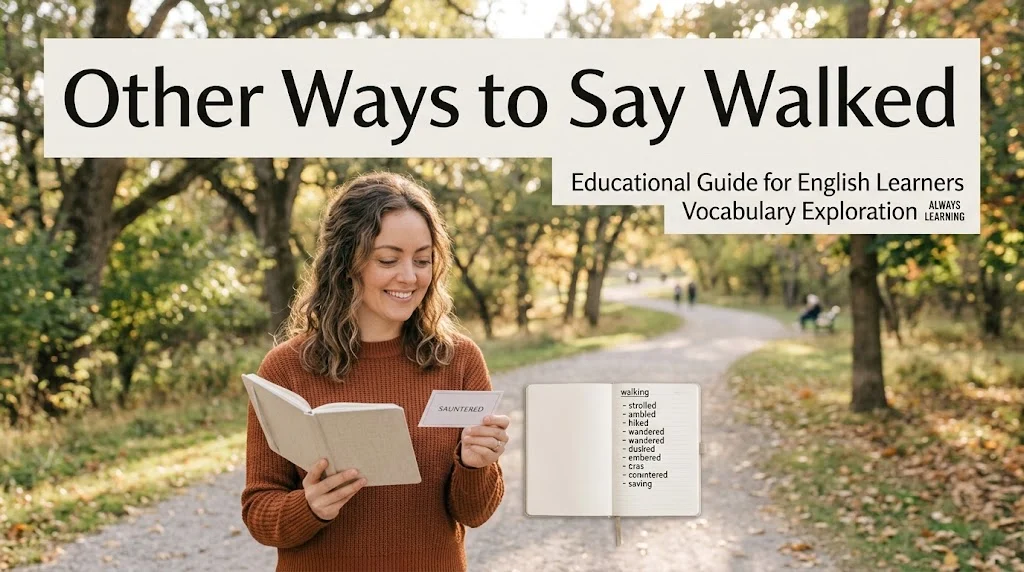
The best alternatives to walked include strolled, wandered, marched, hurried, and paced. The right word depends on how someone moved, why they moved, and whether you are writing a story, an essay, or a professional description.
Knowing other ways to say walked helps you describe movement with more detail and feeling. The word “walked” is correct, but it does not always show speed, mood, or direction. A better verb can make your writing clearer and more interesting.
You can use alternatives to walked in stories, essays, conversations, and professional writing. Words like “strolled” suggest a relaxed pace, while “marched” suggests purpose. Learning these differences improves fluency and helps you express excitement in English when describing a memorable moment.
Quick Categories
Formal alternatives to “walked”
- Proceeded
- Advanced
- Traversed
- Ambled
Pro Tip: Use precise movement verbs in formal writing when you want to describe direction, pace, or purpose clearly.
Casual alternatives
- Strolled
- Wandered
- Roamed
- Sauntered
Pro Tip: Choose a relaxed verb when the person moved without urgency or a strict destination.
Professional alternatives
- Proceeded
- Advanced
- Moved forward
- Made their way
Pro Tip: In professional writing, choose a movement verb that matches the situation without adding unnecessary emotion.
Informal expressions
- Headed over
- Went over
- Walked off
- Paced around
Pro Tip: Informal expressions in English can sound natural in conversation, but use more precise verbs in formal reports.
“A strong movement verb shows not only where someone went, but how they felt along the way.”
Common Mistakes
1. Using “walked” when you mean “ran”
Mistake: “He walked across the finish line as fast as he could.”
Better: “He ran across the finish line as fast as he could.”
Why: “Walked” means moving on foot without running.
2. Using “strolled” for a hurried movement
Mistake: “She strolled to catch the last bus.”
Better: “She hurried to catch the last bus.”
Why: “Strolled” suggests a relaxed pace, not urgency.
3. Using “marched” for a casual walk
Mistake: “We marched through the park while enjoying the sunshine.”
Better: “We strolled through the park while enjoying the sunshine.”
Why: “Marched” suggests purpose, discipline, or a firm pace.
4. Using “wandered” when the person had a clear destination
Mistake: “He wandered to the office for his scheduled meeting.”
Better: “He walked to the office for his scheduled meeting.”
Why: “Wandered” suggests moving without a clear direction or purpose.
5. Using “paced” for a single movement
Mistake: “She paced to the kitchen to get a glass of water.”
Better: “She walked to the kitchen to get a glass of water.”
Why: “Paced” usually means walking back and forth, often because of worry or thought.
What Does “Walked” Mean?
Walked is the past tense of walk. It means moving from one place to another by taking steps on your feet.
The word is a regular verb, so its past tense is formed by adding -ed.
Example: “She walked to the library after school.”
When to Use “Walked”
You can use the word in several common situations:
- Everyday conversations: When describing normal movement.
- Story writing: When showing what a character did.
- Essay writing: When explaining how someone moved from one place to another.
- Professional writing: When describing a person’s movement in a clear, neutral way.
- Written messages: When the movement itself is more important than the mood.
Spoken vs. Written: “Walked” is natural in both spoken and written English.
Formal vs. Informal: It is a neutral word that works in almost any situation. More specific verbs can make your writing more vivid.
Is It Professional or Polite to Say “Walked”?
Polite? ✔️ Yes
Professional? ✔️ Yes
“Walked” is a simple, neutral word that is suitable for professional communication. However, more precise alternatives can make formal writing stronger when the speed, direction, or purpose matters.
Business-style example: “The manager walked to the conference room before the meeting began.”
In a report, you might use “proceeded” or “advanced” if the context requires a more formal tone.
Pros and Cons of Using “Walked”
Pros
- Simple and natural: Most English speakers understand it.
- Friendly tone: It sounds neutral and easygoing.
- Common usage: It works in everyday speech and writing.
- Easy to understand: It clearly describes movement on foot.
Cons
- Too general for detailed writing: It does not show speed or mood.
- Overused: Repeating it can make a story feel flat.
- Limited emotional range: It does not show whether someone was relaxed, nervous, or determined.
- Not always suitable for vivid descriptions: A more specific verb may create a stronger image.
“The right verb can turn a simple action into a clear picture.”
Other Ways to Say “Walked” With Examples
These alternatives will help you sound more fluent, confident, and natural in different situations.
Use them according to tone, context, and audience to describe movement, mood, and purpose.
1. Phrase: Strolled
Meaning: Walked slowly in a relaxed way.
Explanation: This verb suggests that someone was enjoying the walk and had no need to hurry.
Example Sentence: “We strolled through the park on a sunny afternoon.”
Best Use: Relaxed descriptions
Worst Use: Urgent situations
Tone: Relaxed, pleasant, casual
Context Variability: Casual: “We strolled around the park.” Professional: “The visitors strolled through the garden.” Spoken: “I strolled home after dinner.”
2. Phrase: Wandered
Meaning: Walked without a clear direction or destination.
Explanation: This verb often suggests curiosity, uncertainty, or a lack of a fixed plan.
Example Sentence: “She wandered through the old market, looking at the shops.”
Best Use: Descriptive writing
Worst Use: Strict schedules
Tone: Casual, curious, relaxed
Context Variability: Casual: “We wandered around town.” Professional: “The visitors wandered through the exhibition.” Spoken: “I wandered around until I found the café.”
3. Phrase: Marched
Meaning: Walked with a firm, steady, or purposeful pace.
Explanation: This verb often suggests determination, discipline, or a strong sense of direction.
Example Sentence: “The students marched toward the main entrance.”
Best Use: Purposeful movement
Worst Use: Gentle walks
Tone: Firm, strong, determined
Context Variability: Casual: “He marched into the room.” Professional: “The group marched toward the entrance.” Spoken: “She marched straight to the office.”
4. Phrase: Hurried
Meaning: Walked quickly because of a need to save time.
Explanation: This verb suggests that someone was in a rush or trying to reach a place quickly.
Example Sentence: “He hurried to the station before the train left.”
Best Use: Urgent situations
Worst Use: Relaxed scenes
Tone: Fast, urgent, active
Context Variability: Casual: “I hurried home.” Professional: “The employee hurried to the meeting.” Spoken: “I hurried to catch the bus.”
5. Phrase: Rushed
Meaning: Moved very quickly.
Explanation: This verb suggests urgency and often implies that someone had little time.
Example Sentence: “She rushed to the door when she heard the alarm.”
Best Use: Emergency scenes
Worst Use: Calm descriptions
Tone: Urgent, fast, intense
Context Variability: Casual: “I rushed out of the house.” Professional: “The staff rushed to the entrance.” Spoken: “He rushed to the station.”
6. Phrase: Ambled
Meaning: Walked slowly and comfortably.
Explanation: This verb suggests a relaxed pace, often with no pressure to hurry.
Example Sentence: “The old man ambled down the quiet street.”
Best Use: Descriptive writing
Worst Use: Emergency scenes
Tone: Relaxed, slow, gentle
Context Variability: Casual: “We ambled along the path.” Professional: “The visitors ambled through the grounds.” Spoken: “I ambled home after lunch.”
7. Phrase: Sauntered
Meaning: Walked slowly in a confident or relaxed way.
Explanation: This verb can suggest that someone was moving casually and without concern.
Example Sentence: “He sauntered into the room with a smile.”
Best Use: Character descriptions
Worst Use: Urgent tasks
Tone: Casual, confident, relaxed
Context Variability: Casual: “He sauntered into the café.” Professional: “The guest sauntered toward the entrance.” Spoken: “She sauntered over to us.”
8. Phrase: Roamed
Meaning: Walked around freely without a fixed destination.
Explanation: This verb suggests exploring a place without a strict plan.
Example Sentence: “We roamed around the city for hours.”
Best Use: Travel descriptions
Worst Use: Scheduled movement
Tone: Free, casual, exploratory
Context Variability: Casual: “We roamed around town.” Professional: “The visitors roamed through the grounds.” Spoken: “I roamed around the market.”
9. Phrase: Proceeded
Meaning: Moved forward or continued toward a place.
Explanation: This is a formal alternative that works well in professional and written English.
Example Sentence: “The guests proceeded to the dining room.”
Best Use: Formal writing
Worst Use: Casual chat
Tone: Formal, neutral, precise
Context Variability: Casual: “We went to the next room.” Professional: “The guests proceeded to the conference room.” Spoken: “We proceeded toward the exit.”
10. Phrase: Advanced
Meaning: Moved forward, often toward a place or goal.
Explanation: This verb suggests purposeful movement and is common in formal or descriptive writing.
Example Sentence: “The team advanced toward the final checkpoint.”
Best Use: Formal descriptions
Worst Use: Casual small talk
Tone: Formal, purposeful, precise
Context Variability: Casual: “We moved forward.” Professional: “The team advanced toward the next stage.” Spoken: “He advanced toward the entrance.”
11. Phrase: Paced
Meaning: Walked back and forth, often while thinking or feeling worried.
Explanation: This verb suggests repeated movement rather than simply going from one place to another.
Example Sentence: “She paced around the room while waiting for the call.”
Best Use: Emotional descriptions
Worst Use: One-way movement
Tone: Nervous, thoughtful, restless
Context Variability: Casual: “I paced around the room.” Professional: “The manager paced while considering the decision.” Spoken: “He paced back and forth.”
12. Phrase: Crept
Meaning: Walked slowly and quietly.
Explanation: This verb often suggests caution, secrecy, or fear.
Example Sentence: “The cat crept across the floor without making a sound.”
Best Use: Suspenseful writing
Worst Use: Normal movement
Tone: Quiet, cautious, secretive
Context Variability: Casual: “He crept into the room.” Professional: “The animal crept toward the opening.” Spoken: “I crept downstairs.”
13. Phrase: Tiptoed
Meaning: Walked quietly on the toes.
Explanation: This verb suggests that someone wanted to avoid making noise.
Example Sentence: “She tiptoed past the sleeping baby.”
Best Use: Quiet movement
Worst Use: Fast travel
Tone: Quiet, careful, gentle
Context Variability: Casual: “I tiptoed into the room.” Professional: “The visitor tiptoed past the sleeping child.” Spoken: “He tiptoed across the floor.”
14. Phrase: Trudged
Meaning: Walked slowly and with effort.
Explanation: This verb often suggests tiredness, difficulty, or an unpleasant journey.
Example Sentence: “They trudged through the snow after the long hike.”
Best Use: Difficult journeys
Worst Use: Happy celebrations
Tone: Tired, heavy, difficult
Context Variability: Casual: “We trudged home in the rain.” Professional: “The hikers trudged through the snow.” Spoken: “I trudged back after work.”
15. Phrase: Plodded
Meaning: Walked slowly and heavily.
Explanation: This verb suggests a steady but tiring movement, often with little energy.
Example Sentence: “He plodded along the muddy path.”
Best Use: Descriptive writing
Worst Use: Exciting movement
Tone: Slow, heavy, tired
Context Variability: Casual: “I plodded home.” Professional: “The hikers plodded along the trail.” Spoken: “He plodded through the mud.”
16. Phrase: Shuffled
Meaning: Walked slowly without lifting the feet much.
Explanation: This verb often suggests tiredness, discomfort, or a lack of energy.
Example Sentence: “The tired child shuffled toward the bedroom.”
Best Use: Character descriptions
Worst Use: Energetic scenes
Tone: Slow, tired, casual
Context Variability: Casual: “I shuffled into the kitchen.” Professional: “The patient shuffled toward the chair.” Spoken: “He shuffled across the room.”
17. Phrase: Limped
Meaning: Walked with difficulty because of an injury or pain.
Explanation: This verb specifically describes movement affected by a problem with a leg or foot.
Example Sentence: “He limped home after hurting his ankle.”
Best Use: Injury descriptions
Worst Use: Normal movement
Tone: Careful, painful, descriptive
Context Variability: Casual: “I limped home.” Professional: “The patient limped toward the examination room.” Spoken: “He limped back to the car.”
18. Phrase: Staggered
Meaning: Walked unsteadily, as if about to fall.
Explanation: This verb suggests that someone had difficulty keeping their balance.
Example Sentence: “He staggered toward the chair after feeling dizzy.”
Best Use: Physical descriptions
Worst Use: Confident movement
Tone: Unsteady, weak, dramatic
Context Variability: Casual: “He staggered into the room.” Professional: “The patient staggered toward the chair.” Spoken: “She staggered back to her seat.”
19. Phrase: Strutted
Meaning: Walked with a proud or confident manner.
Explanation: This verb often suggests that someone wanted to look important or impressive.
Example Sentence: “He strutted across the stage after winning the award.”
Best Use: Character descriptions
Worst Use: Serious injury scenes
Tone: Proud, confident, playful
Context Variability: Casual: “He strutted into the room.” Professional: “The performer strutted across the stage.” Spoken: “She strutted down the hallway.”
20. Phrase: Skulked
Meaning: Walked quietly and secretly to avoid being noticed.
Explanation: This verb often suggests that someone was trying to hide or avoid attention.
Example Sentence: “The thief skulked away from the building.”
Best Use: Suspenseful writing
Worst Use: Friendly conversations
Tone: Secretive, cautious, suspicious
Context Variability: Casual: “He skulked around the corner.” Professional: “The suspect skulked away from the building.” Spoken: “She skulked out of the room.”
21. Phrase: Traipsed
Meaning: Walked around in a casual or slightly tiring way.
Explanation: This verb is often used for a long or repeated walk, sometimes with a hint of annoyance.
Example Sentence: “We traipsed through several shops looking for a gift.”
Best Use: Casual descriptions
Worst Use: Formal reports
Tone: Casual, tired, playful
Context Variability: Casual: “We traipsed around the shops.” Professional: “The visitors traipsed through the exhibition.” Spoken: “I traipsed around town all day.”
22. Phrase: Trotted
Meaning: Walked or moved with short, quick steps.
Explanation: This verb often describes animals, children, or people moving with light, quick steps.
Example Sentence: “The little dog trotted beside its owner.”
Best Use: Light movement
Worst Use: Formal business writing
Tone: Light, quick, playful
Context Variability: Casual: “The dog trotted beside me.” Professional: “The child trotted toward the playground.” Spoken: “He trotted over to the gate.”
23. Phrase: Hiked
Meaning: Walked a long distance, usually outdoors.
Explanation: This verb is commonly used for walking in nature, especially on trails or through hills.
Example Sentence: “We hiked through the forest all morning.”
Best Use: Outdoor activities
Worst Use: Short indoor walks
Tone: Active, outdoorsy, energetic
Context Variability: Casual: “We hiked up the hill.” Professional: “The group hiked along the trail.” Spoken: “I hiked through the mountains.”
24. Phrase: Meandered
Meaning: Walked slowly along a winding or indirect path.
Explanation: This verb suggests relaxed movement without a direct route.
Example Sentence: “We meandered along the river, enjoying the view.”
Best Use: Scenic descriptions
Worst Use: Urgent travel
Tone: Relaxed, scenic, gentle
Context Variability: Casual: “We meandered along the path.” Professional: “The visitors meandered through the gardens.” Spoken: “I meandered around the park.”
25. Phrase: Made Their Way
Meaning: Walked or moved toward a destination.
Explanation: This flexible phrase works in many situations and does not strongly suggest a particular pace.
Example Sentence: “The guests made their way to the main hall.”
Best Use: General descriptions
Worst Use: Precise movement
Tone: Neutral, natural, flexible
Context Variability: Casual: “We made our way home.” Professional: “The guests made their way to the conference room.” Spoken: “I made my way to the station.”
26. Phrase: Headed Over
Meaning: Went toward a place.
Explanation: This casual phrase is useful when describing movement toward a nearby destination.
Example Sentence: “I headed over to the café after work.”
Best Use: Casual speech
Worst Use: Formal reports
Tone: Casual, natural, conversational
Context Variability: Casual: “I headed over to the shop.” Professional: “The employee proceeded to the office.” Spoken: “I headed over to your desk.”
27. Phrase: Went Over
Meaning: Went to a nearby place.
Explanation: This is a simple informal phrase that often replaces “walked over” in everyday speech.
Example Sentence: “She went over to the neighbor’s house.”
Best Use: Casual conversations
Worst Use: Formal descriptions
Tone: Informal, simple, friendly
Context Variability: Casual: “I went over to the store.” Professional: “The employee went to the meeting room.” Spoken: “I went over to his desk.”
28. Phrase: Walked Off
Meaning: Left a place by walking.
Explanation: This phrase is often used when someone leaves suddenly or moves away from a situation.
Example Sentence: “He walked off without saying goodbye.”
Best Use: Casual descriptions
Worst Use: Formal reports
Tone: Casual, direct, sometimes emotional
Context Variability: Casual: “She walked off after the argument.” Professional: “The employee left the room.” Spoken: “He walked off without a word.”
29. Phrase: Walked Away
Meaning: Moved away from a person or place by walking.
Explanation: This phrase can describe physical movement or leaving a situation.
Example Sentence: “She walked away from the conversation.”
Best Use: Everyday speech
Worst Use: Precise movement
Tone: Neutral, direct, emotional
Context Variability: Casual: “He walked away from the group.” Professional: “The employee left the discussion.” Spoken: “She walked away without answering.”
30. Phrase: Walked Along
Meaning: Walked beside or along a path, road, or place.
Explanation: This phrase is useful when describing movement along a specific route.
Example Sentence: “We walked along the beach at sunset.”
Best Use: Descriptive writing
Worst Use: Urgent movement
Tone: Neutral, relaxed, descriptive
Context Variability: Casual: “We walked along the river.” Professional: “The visitors walked along the designated path.” Spoken: “I walked along the beach.”
“Choose a verb that matches the movement, and your writing will feel more natural.”
Mini Quiz / Self-Check
1. Which word best describes a relaxed walk?
A. Rushed
B. Strolled
C. Staggered
D. Marched
Answer: B. Strolled
2. Which word is most suitable for a formal report?
A. Headed over
B. Went over
C. Proceeded
D. Traipsed
Answer: C. Proceeded
3. Which sentence shows a person walking because they are tired?
A. She strutted across the stage.
B. He hurried to the station.
C. They trudged through the snow.
D. She marched toward the door.
Answer: C. They trudged through the snow.
4. Which phrase means walking back and forth?
A. Paced
B. Wandered
C. Hiked
D. Sauntered
Answer: A. Paced
Comparison Table: Top Alternatives
| Phrase | Tone | Best Use |
|---|---|---|
| Strolled | Relaxed, pleasant | Casual descriptions |
| Wandered | Curious, casual | Descriptive writing |
| Marched | Firm, determined | Purposeful movement |
| Hurried | Fast, urgent | Urgent situations |
| Rushed | Urgent, intense | Emergency scenes |
| Ambled | Relaxed, slow | Descriptive writing |
| Sauntered | Casual, confident | Character descriptions |
| Proceeded | Formal, neutral | Professional writing |
| Paced | Nervous, restless | Emotional descriptions |
| Trudged | Tired, heavy | Difficult journeys |
FAQs
What are the best other ways to say walked?
The best alternatives include strolled, wandered, marched, hurried, and proceeded. The right choice depends on pace, mood, and context.
What is a formal way to say walked?
Proceeded, advanced, and traversed are formal alternatives that work well in essays, reports, and professional writing.
What is a casual way to say walked?
Strolled, ambled, sauntered, and wandered are natural casual alternatives.
What is the difference between walked and strolled?
“Walked” is a general movement verb. “Strolled” suggests a slow, relaxed, and pleasant walk.
What is the difference between walked and marched?
“Walked” describes normal movement. “Marched” suggests a firm, steady, or purposeful pace.
Conclusion
Learning other ways to say walked helps you describe movement with more detail and confidence. From strolled to marched, each verb adds a different meaning to your writing.
Practice these alternatives in short sentences and everyday conversations. The more you notice pace, mood, and context, the more naturally you will communicate in English.
Read More Related Articles:
- 30+ Other Ways to Say Leading | Fresh, Powerful Alternatives …
- 30+ Other Ways to Say Demonstrate | Smart Alternatives for …
- Other Ways to Say I Appreciate | Warm Words That Leave an …

Ethan Parker is a professional content writer at Replynst.com. He creates clear, engaging and well-researched articles focused on providing useful information, answering readers’ questions.