Quick Answer
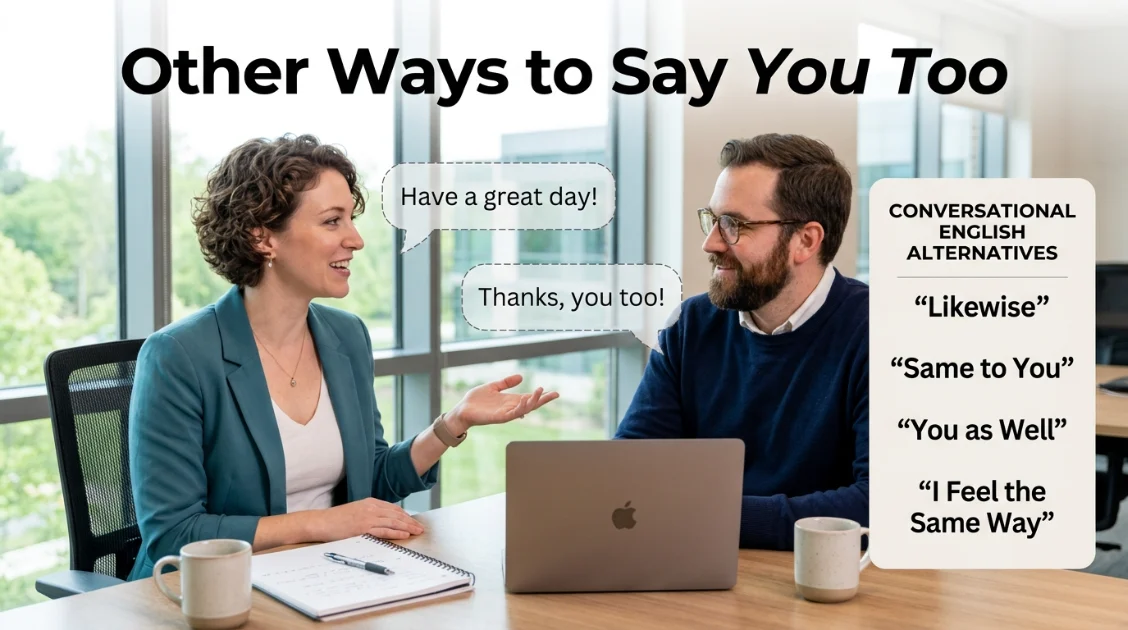
The best alternatives to you too include same to you, likewise, and you as well, back at you, and I feel the same way. The right choice depends on whether you are responding casually, politely, professionally, or warmly.
Knowing other ways to say you too can make your English sound more natural, flexible, and confident. Although “you too” is a common response, repeating the same phrase in every conversation can make your communication feel limited. Different situations call for different expressions, especially when responding to greetings, compliments, good wishes, or friendly remarks.
Learning alternatives to you too helps English learners understand tone and choose expressions that fit the situation. You can use “likewise” in professional conversations, “same to you” in everyday speech, or “I feel the same way” when responding to a personal statement. These phrases also strengthen conversational fluency and help you express excitement in English, appreciation, agreement, and goodwill more naturally.
Quick Categories
Formal alternatives to “you too”
- Likewise
- The same to you
- I wish you the same
- And to you as well
Pro Tip: Use “likewise” or “I wish you the same” when you want your response to sound polished and respectful.
Casual alternatives
- Same to you
- Back at you
- Right back at you
- You as well
Pro Tip: These phrases work naturally with friends, family members, and people you know well.
Professional alternatives
- Likewise
- I appreciate that, and the same to you
- I wish you the same
- Thank you, and likewise
Pro Tip: Professional reaction phrases should acknowledge the other person’s statement while keeping your response concise.
Informal expressions
- Back at you
- Same here
- Right back at you
- You too, absolutely
Pro Tip: Informal expressions in English are useful in relaxed conversations, but avoid overly casual wording in formal emails or workplace communication.
“A simple response can sound much more natural when you choose the expression that matches the moment.”
Common Mistakes
1. Using “you too” when agreement is needed
Mistake: “I love working with this team.” “You too.”
Better: “I feel the same way.”
Why: “You too” may sound unclear when responding to a personal opinion rather than a wish or greeting.
2. Using “likewise” with an unrelated statement
Mistake: “I bought a new laptop.” “Likewise.”
Better: “I bought one too.”
Why: “Likewise” usually responds to a comparable sentiment, action, or statement.
3. Saying “same to you” after a personal compliment
Mistake: “You are such a thoughtful person.” “Same to you.”
Better: “Thank you, I appreciate that.”
Why: Returning a compliment naturally often requires a more specific response.
4. Using “back at you” in a formal email
Mistake: “Have a wonderful weekend.” “Back at you!”
Better: “Thank you. I hope you have a wonderful weekend as well.”
Why: “Back at you” is conversational and may sound too casual professionally.
5. Responding with “you too” when the meaning is unclear
Mistake: “It was great meeting you.” “You too.”
Better: “It was great meeting you too.”
Why: A complete response can make the intended meaning clearer.
“Fluent English is not only about knowing words. It is about knowing when each expression sounds natural.”
What Does “You Too” Mean?
You too means that the same statement, feeling, wish, or action applies to the person you are speaking with.
It is commonly used as a short response to greetings, good wishes, compliments, and expressions of goodwill.
Example: “Have a great day!” “You too!”
Grammatically, “you too” is an elliptical expression because some words are understood rather than spoken. The full meaning may be “I hope you have a great day too.”
When to Use “You Too”
You can use you too in many everyday situations:
- Greetings and good wishes: “Have a nice weekend.” “You too.”
- Compliments: “You look great.” “You too.”
- Friendly expressions: “Take care.” “You too.”
- Positive statements: “I hope everything goes well.” “You too.”
- Farewells: “Enjoy your evening.” “You too.”
Spoken vs. Written
“You too” is especially common in spoken English. It can also be used naturally in texts, chats, emails, and informal written communication.
Formal vs. Informal
“You too” is neutral and widely acceptable. In formal or professional communication, alternatives such as likewise, the same to you, or I wish you the same can sometimes sound more polished.
Is It Professional or Polite to Say “You Too”?
Polite? ✔️ Yes
Professional? ✔️ Yes, depending on context
“You too” is polite and acceptable in many professional conversations, particularly when responding to simple good wishes.
Business-style example: “Have a productive afternoon.” “Thank you, you too.”
For more formal communication, you can write: “Thank you. I wish you a productive afternoon as well.”
Pros and Cons of Using “You Too”
Pros
- Simple and natural: It is easy to use and understand.
- Friendly tone: It creates a warm conversational response.
- Common usage: Native speakers use it frequently.
- Easy to understand: Its meaning is usually clear from context.
Cons
- Can sound repetitive: Using it constantly may limit vocabulary variety.
- Sometimes too brief: Certain situations need a more complete response.
- Limited emotional range: It may not fully communicate appreciation or enthusiasm.
- Not always the best professional choice: A specific response can sound more polished in formal situations.
Other Ways to Say “You Too” With Examples
These alternatives will help you sound more fluent, confident, and natural in different situations.
Use them according to tone, context, and audience to express agreement, appreciation, goodwill, or approval.
1. Phrase: Same to You
Meaning: I wish or feel the same for you.
Explanation: This is a natural alternative for returning a good wish or greeting.
Example Sentence: “Have a wonderful holiday.” “Same to you!”
Best Use: Friendly conversations
Worst Use: Formal letters
Tone: Casual, warm, friendly
Context Variability: Casual: “Same to you!” Professional: “The same to you.” Spoken: “Same to you.”
2. Phrase: Likewise
Meaning: The same applies to you.
Explanation: This concise expression works especially well in professional and polite conversations.
Example Sentence: “It was a pleasure meeting you.” “Likewise.”
Best Use: Professional settings
Worst Use: Casual affection
Tone: Polished, concise, professional
Context Variability: Casual: “Likewise!” Professional: “Likewise, it was a pleasure.” Spoken: “Likewise.”
3. Phrase: You as Well
Meaning: The same applies to you.
Explanation: This is a polite and slightly more complete alternative to “you too.”
Example Sentence: “Have a safe trip.” “Thank you, you as well.”
Best Use: Polite conversations
Worst Use: Very casual jokes
Tone: Polite, neutral, natural
Context Variability: Casual: “You as well.” Professional: “Thank you, you as well.” Spoken: “You as well.”
4. Phrase: The Same to You
Meaning: I wish the same thing for you.
Explanation: This phrase directly returns a wish or greeting.
Example Sentence: “Wishing you a successful year ahead.” “The same to you.”
Best Use: Good wishes
Worst Use: Personal opinions
Tone: Polite, warm, neutral
Context Variability: Casual: “Same to you.” Professional: “The same to you.” Spoken: “The same to you.”
5. Phrase: I Wish You the Same
Meaning: I hope the same positive thing happens to you.
Explanation: This is a thoughtful alternative for returning good wishes.
Example Sentence: “I hope you have a relaxing weekend.” “I wish you the same.”
Best Use: Polite exchanges
Worst Use: Quick greetings
Tone: Warm, respectful, thoughtful
Context Variability: Casual: “Same to you.” Professional: “I wish you the same.” Spoken: “I wish you the same.”
6. Phrase: And to You as Well
Meaning: I extend the same wish to you.
Explanation: This phrase sounds polished when responding to a good wish.
Example Sentence: “Best wishes for your new role.” “And to you as well.”
Best Use: Professional exchanges
Worst Use: Close friends
Tone: Formal, courteous, polished
Context Variability: Casual: “You too.” Professional: “And to you as well.” Spoken: “And to you as well.”
7. Phrase: Back at You
Meaning: The same applies to you.
Explanation: This is a friendly informal response to a compliment or good wish.
Example Sentence: “You are always so positive.” “Back at you!”
Best Use: Friendly conversations
Worst Use: Business emails
Tone: Casual, playful, friendly
Context Variability: Casual: “Back at you!” Professional: “Likewise.” Spoken: “Back at you!”
8. Phrase: Right Back at You
Meaning: The same feeling or wish is returned immediately.
Explanation: This is a more enthusiastic version of “back at you.”
Example Sentence: “Have an amazing weekend!” “Right back at you!”
Best Use: Informal speech
Worst Use: Formal writing
Tone: Energetic, casual, friendly
Context Variability: Casual: “Right back at you!” Professional: “Likewise.” Spoken: “Right back at you!”
9. Phrase: Same Here
Meaning: I feel or experience the same thing.
Explanation: Use this when agreeing with someone’s personal statement rather than simply returning a wish.
Example Sentence: “I am really excited about the event.” “Same here!”
Best Use: Casual agreement
Worst Use: Formal reports
Tone: Casual, natural, conversational
Context Variability: Casual: “Same here!” Professional: “I feel the same way.” Spoken: “Same here.”
10. Phrase: I Feel the Same Way
Meaning: I share the same feeling or opinion.
Explanation: This is clearer than “you too” when responding to an emotional or personal statement.
Example Sentence: “I really enjoyed working with you.” “I feel the same way.”
Best Use: Personal statements
Worst Use: Simple greetings
Tone: Warm, sincere, expressive
Context Variability: Casual: “Same here.” Professional: “I feel the same way.” Spoken: “I feel the same way.”
11. Phrase: I Agree
Meaning: I have the same opinion.
Explanation: This expression is appropriate when responding to an opinion rather than a good wish.
Example Sentence: “This project was challenging but rewarding.” “I agree.”
Best Use: Professional discussions
Worst Use: Returning greetings
Tone: Direct, professional, clear
Context Variability: Casual: “I agree.” Professional: “I completely agree.” Spoken: “I agree.”
12. Phrase: I Feel That Way Too
Meaning: I have the same feeling.
Explanation: This phrase clearly communicates emotional agreement.
Example Sentence: “I am grateful for everyone’s support.” “I feel that way too.”
Best Use: Emotional agreement
Worst Use: Formal greetings
Tone: Warm, sincere, conversational
Context Variability: Casual: “I feel that way too.” Professional: “I share that sentiment.” Spoken: “I feel that way too.”
13. Phrase: I Share That Sentiment
Meaning: I have the same opinion or feeling.
Explanation: This is a formal alternative that works well in professional communication.
Example Sentence: “I am proud of what our team achieved.” “I share that sentiment.”
Best Use: Professional communication
Worst Use: Casual texting
Tone: Formal, polished, respectful
Context Variability: Casual: “I feel the same.” Professional: “I share that sentiment.” Spoken: “I share that sentiment.”
14. Phrase: Thank You, Likewise
Meaning: Thank you, and I return the same wish.
Explanation: This phrase is useful when someone offers you a positive wish or compliment.
Example Sentence: “Have a wonderful evening.” “Thank you, likewise.”
Best Use: Polite exchanges
Worst Use: Informal jokes
Tone: Polite, concise, professional
Context Variability: Casual: “Thanks, you too.” Professional: “Thank you, likewise.” Spoken: “Thank you, likewise.”
15. Phrase: I Appreciate That, and the Same to You
Meaning: I appreciate your words and return the sentiment.
Explanation: This is useful when you want to acknowledge someone’s kindness before returning it.
Example Sentence: “I hope your presentation goes well.” “I appreciate that, and the same to you.”
Best Use: Professional conversations
Worst Use: Quick casual replies
Tone: Respectful, warm, professional
Context Variability: Casual: “Thanks, same to you.” Professional: “I appreciate that, and the same to you.” Spoken: “I appreciate that, and the same to you.”
16. Phrase: Wishing You the Same
Meaning: I hope you experience the same positive outcome.
Explanation: This is a warm way to return a good wish.
Example Sentence: “I hope you enjoy your vacation.” “Wishing you the same.”
Best Use: Good wishes
Worst Use: Opinion debates
Tone: Warm, thoughtful, polite
Context Variability: Casual: “Same to you.” Professional: “Wishing you the same.” Spoken: “Wishing you the same.”
17. Phrase: Thank You, and You as Well
Meaning: Thank you, and I return the same wish.
Explanation: This phrase is clear and courteous in everyday and workplace communication.
Example Sentence: “Enjoy the rest of your day.” “Thank you, and you as well.”
Best Use: Polite exchanges
Worst Use: Close friends
Tone: Courteous, neutral, professional
Context Variability: Casual: “Thanks, you too.” Professional: “Thank you, and you as well.” Spoken: “Thank you, and you as well.”
18. Phrase: I Hope So for You Too
Meaning: I hope the same positive outcome happens to you.
Explanation: This works when someone expresses hope about a future event.
Example Sentence: “I hope we both get some good news.” “I hope so for you too.”
Best Use: Supportive conversations
Worst Use: Formal reports
Tone: Supportive, warm, conversational
Context Variability: Casual: “I hope so for you too.” Professional: “I hope the same for you.” Spoken: “I hope so for you too.”
19. Phrase: I Hope the Same for You
Meaning: I have the same good wish for you.
Explanation: This is a clear and polite response to someone’s hope or wish.
Example Sentence: “I hope everything works out.” “I hope the same for you.”
Best Use: Supportive exchanges
Worst Use: Simple farewells
Tone: Warm, polite, sincere
Context Variability: Casual: “Same here.” Professional: “I hope the same for you.” Spoken: “I hope the same for you.”
20. Phrase: The Feeling Is Mutual
Meaning: I have the same feeling.
Explanation: This expression is especially useful when responding to appreciation or affection.
Example Sentence: “It has been wonderful working with you.” “The feeling is mutual.”
Best Use: Professional relationships
Worst Use: Simple greetings
Tone: Polished, warm, confident
Context Variability: Casual: “I feel the same.” Professional: “The feeling is mutual.” Spoken: “The feeling is mutual.”
21. Phrase: I Could Say the Same About You
Meaning: The same positive statement applies to you.
Explanation: This works particularly well when returning a compliment.
Example Sentence: “You have been incredibly helpful.” “I could say the same about you.”
Best Use: Compliment responses
Worst Use: Basic greetings
Tone: Warm, appreciative, polished
Context Variability: Casual: “Same goes for you.” Professional: “I could say the same about you.” Spoken: “I could say the same about you.”
22. Phrase: Same Goes for You
Meaning: The same statement applies to you.
Explanation: This casual phrase works well when returning a compliment or positive observation.
Example Sentence: “You are doing a great job.” “Same goes for you!”
Best Use: Friendly conversations
Worst Use: Formal letters
Tone: Casual, warm, friendly
Context Variability: Casual: “Same goes for you!” Professional: “The same applies to you.” Spoken: “Same goes for you.”
23. Phrase: The Same Applies to You
Meaning: The same statement or condition applies to you.
Explanation: This is a more formal version of “same goes for you.”
Example Sentence: “Everyone deserves recognition for their work.” “The same applies to you.”
Best Use: Professional discussion
Worst Use: Casual greetings
Tone: Formal, precise, professional
Context Variability: Casual: “Same goes for you.” Professional: “The same applies to you.” Spoken: “The same applies to you.”
24. Phrase: You Too, Absolutely
Meaning: I strongly return the same feeling or wish.
Explanation: Adding “absolutely” makes the response sound more enthusiastic.
Example Sentence: “I hope you have an incredible time.” “You too, absolutely!”
Best Use: Friendly conversations
Worst Use: Formal documents
Tone: Enthusiastic, casual, warm
Context Variability: Casual: “You too, absolutely!” Professional: “Likewise, absolutely.” Spoken: “You too, absolutely.”
25. Phrase: I Return the Sentiment
Meaning: I have the same feeling or wish.
Explanation: This formal phrase is useful when responding to a thoughtful or positive statement.
Example Sentence: “We appreciate your continued support.” “I return the sentiment.”
Best Use: Formal communication
Worst Use: Casual texting
Tone: Formal, polished, respectful
Context Variability: Casual: “I feel the same.” Professional: “I return the sentiment.” Spoken: “I return the sentiment.”
26. Phrase: I Wish You Well Too
Meaning: I also hope good things happen for you.
Explanation: This phrase directly returns a person’s good wishes.
Example Sentence: “I wish you all the best in your new role.” “I wish you well too.”
Best Use: Farewells
Worst Use: Casual compliments
Tone: Warm, respectful, sincere
Context Variability: Casual: “All the best to you too.” Professional: “I wish you well too.” Spoken: “I wish you well too.”
27. Phrase: All the Best to You Too
Meaning: I return the same good wishes.
Explanation: This is especially natural when responding to a farewell or message of encouragement.
Example Sentence: “All the best with your new position.” “All the best to you too.”
Best Use: Farewell messages
Worst Use: Opinion statements
Tone: Warm, polite, friendly
Context Variability: Casual: “All the best to you too.” Professional: “I wish you all the best as well.” Spoken: “All the best to you too.”
28. Phrase: Same to You, My Friend
Meaning: I return the same wish or sentiment to you.
Explanation: Adding “my friend” creates a warmer and more personal response.
Example Sentence: “Have a fantastic weekend, my friend.” “Same to you, my friend.”
Best Use: Close friendships
Worst Use: Business emails
Tone: Warm, personal, friendly
Context Variability: Casual: “Same to you, my friend.” Professional: “Likewise.” Spoken: “Same to you, my friend.”
29. Phrase: I Feel the Same
Meaning: I share the same feeling or opinion.
Explanation: This concise phrase is useful when “you too” would be too vague.
Example Sentence: “I am really happy we worked together.” “I feel the same.”
Best Use: Personal conversations
Worst Use: Formal greetings
Tone: Sincere, warm, natural
Context Variability: Casual: “I feel the same.” Professional: “I share that sentiment.” Spoken: “I feel the same.”
30. Phrase: Thank You, I Feel the Same Way
Meaning: I appreciate what you said and share your feeling.
Explanation: This complete response is excellent when you want to sound warm and sincere.
Example Sentence: “It has been a pleasure working with you.” “Thank you, I feel the same way.”
Best Use: Meaningful exchanges
Worst Use: Quick greetings
Tone: Warm, sincere, professional
Context Variability: Casual: “Thanks, I feel the same.” Professional: “Thank you, I feel the same way.” Spoken: “Thank you, I feel the same way.”
“Choose ‘likewise’ for polish, ‘same to you’ for simplicity, and ‘I feel the same way’ when you want to show genuine emotion.”
Mini Quiz / Self-Check
1. Which response is most appropriate in a professional conversation?
A. Back at you!
B. Right back at you!
C. Likewise.
D. Same here, buddy.
Answer: C. Likewise.
2. Someone says, “Have a wonderful weekend!” What is a natural response?
A. You as well.
B. I agree.
C. Same here.
D. The feeling is mutual.
Answer: A. You as well.
3. Someone says, “I really enjoyed working with you.” Which response best expresses the same feeling?
A. You too.
B. I feel the same way.
C. Back at you.
D. I agree with you too.
Answer: B. I feel the same way.
4. Which expression is most informal?
A. Likewise
B. I wish you the same
C. Back at you
D. I return the sentiment
Answer: C. Back at you.
Comparison Table: Top Alternatives
| Phrase | Tone | Best Use |
|---|---|---|
| Likewise | Professional, polished | Workplace conversations |
| Same to you | Casual, warm | Everyday speech |
| You as well | Polite, neutral | Professional and social |
| The same to you | Polite, formal | Good wishes |
| I wish you the same | Warm, respectful | Thoughtful exchanges |
| Back at you | Casual, playful | Friendly conversations |
| I feel the same way | Warm, sincere | Personal statements |
| Thank you, likewise | Polite, professional | Workplace exchanges |
| The feeling is mutual | Polished, warm | Appreciation |
| Same goes for you | Casual, friendly | Compliments |
FAQs
What are the best other ways to say you too?
Some natural alternatives include same to you, likewise, you as well, the same to you, and I feel the same way. Your choice should match the context and tone.
What is a professional way to say you too?
Likewise, you as well, I wish you the same, and thank you, likewise are professional options for many workplace situations.
Is “you too” grammatically correct?
Yes. “You too” is a natural elliptical expression in English. The omitted words are understood from the context.
What can I say instead of “you too” after a compliment?
You can say likewise, same goes for you, I could say the same about you, or I feel the same depending on the compliment and relationship.
Is “back at you” formal English?
No. “Back at you” is an informal expression. It is natural among friends but is generally unsuitable for formal business writing.
Conclusion
Learning other ways to say you too gives you more flexibility when responding to greetings, compliments, wishes, and personal statements. Expressions such as likewise, same to you, and you as well can help you adjust your language to different audiences and situations.
Make these phrases part of your daily English practice by using one new expression each day. Paying attention to tone and context will help your responses sound more natural, confident, and appropriate.
Discover More Post:
30+ Other Ways to Say Leave Me Alone | Set Boundaries with …
Other Ways to Say It Means a Lot | Meaningful Expressions …
30+ What Are Other Ways to Say According to? Smart …

Emma Richardson is a professional content writer at Replynst.com. She creates clear, engaging and well-researched content designed to answer readers’ questions while following modern SEO best practices. Her focus is on helpful, reader-friendly articles that deliver genuine value.