Quick Answer:
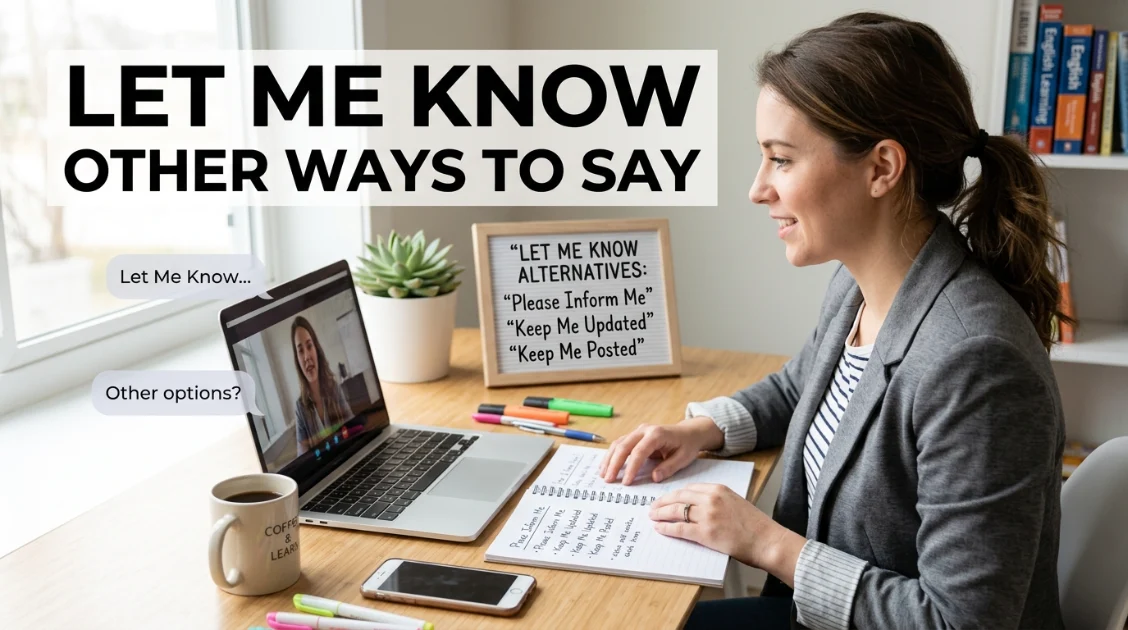
The best alternatives to let me know include please inform me, please keep me updated, feel free to tell me, please advise, and keep me posted. The right phrase depends on your tone, relationship, and communication setting.
Knowing other ways to say let me know can make your English sound more natural, flexible, and professional. Although “let me know” is one of the most common phrases in everyday and workplace communication, repeating it too often can make your emails and conversations sound predictable.
Learning alternatives to let me know helps you choose language that matches your audience and situation. You might use a polite phrase with a client, a friendly expression with a colleague, or a formal alternative in professional writing. Just as learners practice ways to express excitement in English, learning different request phrases builds communication confidence. This guide covers 30 useful alternatives with meanings, examples, tones, and context tips so you can communicate clearly and naturally.
Quick Categories
Formal alternatives to “let me know”
- Please inform me
- Please advise
- Kindly inform me
- I would appreciate an update
Pro Tip: Use formal alternatives when writing to clients, managers, institutions, or people you do not know well.
Casual alternatives
- Tell me
- Keep me posted
- Give me a heads-up
- Let me hear from you
Pro Tip: Casual expressions work best when you already have a comfortable relationship with the person.
Professional alternatives
- Please keep me updated
- Please keep me informed
- I look forward to your update
- Please advise accordingly
Pro Tip: Professional English should sound clear and respectful without becoming unnecessarily complicated.
Informal expressions
- Drop me a message
- Give me a shout
- Send me a note
- Get back to me
Pro Tip: Informal expressions in English are useful with friends and familiar colleagues, but avoid them in highly formal correspondence.
“The best phrase is not always the most formal phrase. Choose the expression that fits your audience.”
Common Mistakes
1. Using “let me know” for an immediate command
Mistake: “Let me know your answer right now.”
Better: “Please give me your answer now.”
Why: “Let me know” usually suggests that the information can be communicated after the person has considered or obtained it.
2. Using “please advise” in every situation
Mistake: “Please advise what you had for lunch.”
Better: “Let me know what you had for lunch.”
Why: “Please advise” is generally more formal and is especially common in business communication.
3. Making the phrase unnecessarily formal
Mistake: “Kindly provide notification regarding your weekend plans.”
Better: “Let me know your weekend plans.”
Why: Excessive formality can make simple communication sound unnatural.
4. Using “keep me posted” in formal writing
Mistake: “Keep me posted regarding the legal documentation.”
Better: “Please keep me informed regarding the legal documentation.”
Why: “Keep me posted” is conversational and may not suit highly formal correspondence.
5. Confusing “tell me” with a polite request
Mistake: “Tell me the details by Friday.”
Better: “Please let me know the details by Friday.”
Why: “Tell me” can sound direct or demanding depending on the context.
What Does “Let Me Know” Mean?
Let me know means tell me or inform me about something when you have the relevant information.
It is a common phrasal expression used to request information, an update, an opinion, or a decision.
Example: “Let me know if you need any help.”
The phrase is grammatically natural and can be followed by if, when, what, whether, or other question structures.
When to Use “Let Me Know”
You can use let me know in many everyday and professional situations:
- Requesting information: “Let me know the meeting time.”
- Asking for an update: “Let me know when you hear back.”
- Offering help: “Let me know if you need anything.”
- Making plans: “Let me know when you are available.”
- Requesting a decision: “Let me know what you decide.”
Spoken vs. Written: It is natural in both spoken and written English.
Formal vs. Informal: It is neutral enough for many professional situations but can be replaced with more formal expressions when necessary.
Is It Professional or Polite to Say “Let Me Know”?
Polite? ✔️ Yes
Professional? ✔️ Yes
“Let me know” is one of the safest and most versatile phrases in professional English. However, alternatives such as please inform me or please keep me informed may sound more formal in certain business contexts.
Business-style example: “Please let me know if you require any additional information.”
“Simple English is often the clearest professional English.”
Pros and Cons of Using “Let Me Know”
Pros
- Simple and natural: Easy for most English speakers to understand.
- Friendly tone: Sounds approachable rather than demanding.
- Common usage: Works in everyday and professional conversations.
- Highly flexible: Can request information, feedback, decisions, or updates.
Cons
- Can become repetitive: Frequent use may make writing sound predictable.
- Less formal than some alternatives: Certain official documents may require more formal wording.
- Can be vague: The listener may not know exactly what information is expected.
- May sound generic: Repeated use can reduce variety in professional writing.
Other Ways to Say “Let Me Know” With Examples
These alternatives will help you sound more fluent, confident, and natural in different situations.
Use them according to tone, context, and audience to make your requests clear and appropriate.
1. Phrase: Please Inform Me
Meaning: Ask someone to provide information.
Explanation: This is a formal alternative that works especially well in professional writing.
Example Sentence: “Please inform me when the documents are ready.”
Best Use: Formal emails
Worst Use: Casual chats
Tone: Formal, polite, direct
Context Variability: Casual: “Tell me when it is ready.” Professional: “Please inform me when it is ready.” Spoken: “Please inform me when you know.”
2. Phrase: Please Advise
Meaning: Ask someone for information, guidance, or a decision.
Explanation: This is a concise business expression frequently used in professional correspondence.
Example Sentence: “Please advise whether the proposed date works for you.”
Best Use: Business emails
Worst Use: Friendly chats
Tone: Formal, concise, professional
Context Variability: Casual: “Let me know what you think.” Professional: “Please advise on the next step.” Spoken: “Please advise me when possible.”
3. Phrase: Please Keep Me Updated
Meaning: Ask someone to provide new information as a situation develops.
Explanation: This phrase is useful when you expect more than one update.
Example Sentence: “Please keep me updated on the project’s progress.”
Best Use: Workplace communication
Worst Use: Casual jokes
Tone: Professional, polite, clear
Context Variability: Casual: “Keep me posted.” Professional: “Please keep me updated.” Spoken: “Please keep me updated.”
4. Phrase: Please Keep Me Informed
Meaning: Ask someone to tell you about important developments.
Explanation: This is a polished professional expression suitable for formal correspondence.
Example Sentence: “Please keep me informed of any changes to the schedule.”
Best Use: Formal communication
Worst Use: Casual conversation
Tone: Formal, respectful, professional
Context Variability: Casual: “Keep me posted.” Professional: “Please keep me informed.” Spoken: “Please keep me informed of any changes.”
5. Phrase: Keep Me Posted
Meaning: Continue giving someone updates.
Explanation: This is a common conversational alternative that is also acceptable in many informal workplace situations.
Example Sentence: “Keep me posted on how the negotiations go.”
Best Use: Friendly work chats
Worst Use: Formal letters
Tone: Casual, friendly, conversational
Context Variability: Casual: “Keep me posted.” Professional: “Please keep me updated.” Spoken: “Keep me posted.”
6. Phrase: Tell Me
Meaning: Ask someone to provide information.
Explanation: This is a simple alternative, but adding “please” can make it sound more polite.
Example Sentence: “Please tell me when you are available.”
Best Use: Everyday speech
Worst Use: Formal reports
Tone: Simple, direct, neutral
Context Variability: Casual: “Tell me when you arrive.” Professional: “Please inform me when you arrive.” Spoken: “Please tell me when you know.”
7. Phrase: Get Back to Me
Meaning: Contact someone again with information or a response.
Explanation: This phrase is especially useful when you expect the person to respond later.
Example Sentence: “Please get back to me when you have reviewed the proposal.”
Best Use: Business communication
Worst Use: Academic writing
Tone: Neutral, professional, conversational
Context Variability: Casual: “Get back to me later.” Professional: “Please get back to me after reviewing the proposal.” Spoken: “Get back to me when you can.”
8. Phrase: Give Me a Heads-Up
Meaning: Give someone advance notice or information.
Explanation: This is an informal expression commonly used when you want to know about something before it happens.
Example Sentence: “Give me a heads-up if the schedule changes.”
Best Use: Informal work chats
Worst Use: Formal emails
Tone: Informal, friendly, conversational
Context Variability: Casual: “Give me a heads-up.” Professional: “Please notify me in advance.” Spoken: “Give me a heads-up if anything changes.”
9. Phrase: I Would Appreciate an Update
Meaning: Politely request new information.
Explanation: This phrase is useful when you want to sound courteous and professional.
Example Sentence: “I would appreciate an update on the status of my application.”
Best Use: Formal emails
Worst Use: Casual conversation
Tone: Polite, formal, respectful
Context Variability: Casual: “Any news?” Professional: “I would appreciate an update.” Spoken: “I would appreciate an update when possible.”
10. Phrase: Please Keep Me Posted
Meaning: Ask someone to continue providing updates.
Explanation: This phrase is polite and works well in professional but not extremely formal communication.
Example Sentence: “Please keep me posted about any developments.”
Best Use: Workplace emails
Worst Use: Legal documents
Tone: Professional, friendly, clear
Context Variability: Casual: “Keep me posted.” Professional: “Please keep me posted.” Spoken: “Please keep me posted.”
11. Phrase: Let Me Hear From You
Meaning: Ask someone to contact you or respond.
Explanation: This phrase can sound warm and personal while still communicating a clear request.
Example Sentence: “Let me hear from you when you have made a decision.”
Best Use: Personal messages
Worst Use: Formal reports
Tone: Warm, friendly, conversational
Context Variability: Casual: “Let me hear from you soon.” Professional: “Please get back to me.” Spoken: “Let me hear from you.”
12. Phrase: Drop Me a Message
Meaning: Send someone a short message.
Explanation: This is an informal expression suitable for friends and familiar colleagues.
Example Sentence: “Drop me a message when you get home.”
Best Use: Casual communication
Worst Use: Formal emails
Tone: Friendly, informal, relaxed
Context Variability: Casual: “Drop me a message.” Professional: “Please send me an update.” Spoken: “Drop me a message later.”
13. Phrase: Send Me a Note
Meaning: Send someone a short written message.
Explanation: This phrase is friendly and can work in both personal and less formal professional contexts.
Example Sentence: “Send me a note when you have a chance.”
Best Use: Friendly messages
Worst Use: Formal notices
Tone: Friendly, neutral, polite
Context Variability: Casual: “Send me a note.” Professional: “Please send me an update.” Spoken: “Send me a note when you know.”
14. Phrase: Keep Me in the Loop
Meaning: Continue including someone in updates or information.
Explanation: This is a common workplace expression for staying informed about developments.
Example Sentence: “Please keep me in the loop as the project progresses.”
Best Use: Workplace communication
Worst Use: Formal reports
Tone: Professional, conversational, friendly
Context Variability: Casual: “Keep me in the loop.” Professional: “Please keep me informed.” Spoken: “Keep me in the loop.”
15. Phrase: Keep Me Updated on the Progress
Meaning: Ask someone to provide progress reports.
Explanation: This phrase is particularly useful for projects, tasks, and ongoing work.
Example Sentence: “Please keep me updated on the progress of the project.”
Best Use: Project communication
Worst Use: Casual invitations
Tone: Professional, clear, formal
Context Variability: Casual: “Keep me posted.” Professional: “Keep me updated on the progress.” Spoken: “Please keep me updated.”
16. Phrase: I Look Forward to Your Update
Meaning: Indicate that you expect or welcome a future response.
Explanation: This phrase is useful at the end of professional emails.
Example Sentence: “I look forward to your update regarding the application.”
Best Use: Professional emails
Worst Use: Casual texting
Tone: Formal, polite, positive
Context Variability: Casual: “Let me know when you hear back.” Professional: “I look forward to your update.” Spoken: “I look forward to hearing from you.”
17. Phrase: Please Notify Me
Meaning: Ask someone to officially tell you about something.
Explanation: This is a formal phrase often used for schedules, decisions, or important changes.
Example Sentence: “Please notify me if there are any changes to the appointment.”
Best Use: Formal notices
Worst Use: Friendly chats
Tone: Formal, direct, professional
Context Variability: Casual: “Tell me if anything changes.” Professional: “Please notify me of any changes.” Spoken: “Please notify me if there are changes.”
18. Phrase: Please Share the Details
Meaning: Ask someone to provide specific information.
Explanation: This phrase is useful when you already know that details are available.
Example Sentence: “Please share the details once the arrangements are finalized.”
Best Use: Professional communication
Worst Use: Casual greetings
Tone: Polite, professional, clear
Context Variability: Casual: “Send me the details.” Professional: “Please share the details.” Spoken: “Please share the details when ready.”
19. Phrase: Please Provide an Update
Meaning: Ask someone to report the latest information.
Explanation: This is a clear and professional alternative for workplace situations.
Example Sentence: “Please provide an update on the current status.”
Best Use: Business emails
Worst Use: Casual conversations
Tone: Formal, direct, professional
Context Variability: Casual: “Any updates?” Professional: “Please provide an update.” Spoken: “Could you provide an update?”
20. Phrase: Please Keep Me Informed of Any Changes
Meaning: Ask someone to report changes as they happen.
Explanation: This phrase is especially appropriate when plans or arrangements may change.
Example Sentence: “Please keep me informed of any changes to the schedule.”
Best Use: Workplace communication
Worst Use: Friendly texting
Tone: Formal, respectful, precise
Context Variability: Casual: “Let me know if anything changes.” Professional: “Please keep me informed of any changes.” Spoken: “Please keep me informed.”
21. Phrase: I Would Be Grateful for an Update
Meaning: Politely express appreciation while requesting information.
Explanation: This is a highly courteous option for formal correspondence.
Example Sentence: “I would be grateful for an update regarding my application.”
Best Use: Formal correspondence
Worst Use: Casual chats
Tone: Formal, courteous, respectful
Context Variability: Casual: “Can you update me?” Professional: “I would be grateful for an update.” Spoken: “I would be grateful for an update.”
22. Phrase: Please Share Any Updates
Meaning: Ask someone to communicate new information.
Explanation: This is concise and useful for workplace collaboration.
Example Sentence: “Please share any updates before the meeting.”
Best Use: Team communication
Worst Use: Personal messages
Tone: Professional, concise, neutral
Context Variability: Casual: “Send me any news.” Professional: “Please share any updates.” Spoken: “Please share any updates.”
23. Phrase: Keep Me Aware
Meaning: Make sure someone continues to know about a situation.
Explanation: This phrase communicates the idea of staying informed, although “keep me informed” is usually more natural.
Example Sentence: “Please keep me aware of any significant developments.”
Best Use: Formal communication
Worst Use: Casual speech
Tone: Formal, neutral, professional
Context Variability: Casual: “Keep me posted.” Professional: “Please keep me informed.” Spoken: “Please keep me aware of any changes.”
24. Phrase: Please Send Me an Update
Meaning: Ask someone to send new information.
Explanation: This is direct, polite, and particularly useful in email communication.
Example Sentence: “Please send me an update once the review is complete.”
Best Use: Professional emails
Worst Use: Casual greetings
Tone: Polite, clear, professional
Context Variability: Casual: “Send me an update.” Professional: “Please send me an update.” Spoken: “Please send me an update when ready.”
25. Phrase: Let Me Know Your Thoughts
Meaning: Ask someone to share an opinion or reaction.
Explanation: This is ideal when requesting feedback rather than factual information.
Example Sentence: “Please let me know your thoughts on the proposal.”
Best Use: Feedback requests
Worst Use: Formal reports
Tone: Friendly, professional, inviting
Context Variability: Casual: “What do you think?” Professional: “Please share your thoughts.” Spoken: “Let me know your thoughts.”
26. Phrase: Please Confirm
Meaning: Ask someone to verify that information is correct.
Explanation: Use this phrase when you need confirmation rather than a general update.
Example Sentence: “Please confirm whether you will attend the meeting.”
Best Use: Business emails
Worst Use: Casual conversation
Tone: Direct, professional, concise
Context Variability: Casual: “Can you confirm?” Professional: “Please confirm your attendance.” Spoken: “Please confirm when you can.”
27. Phrase: Please Get in Touch
Meaning: Ask someone to contact you.
Explanation: This phrase focuses on communication rather than a specific piece of information.
Example Sentence: “Please get in touch if you have any questions.”
Best Use: Professional communication
Worst Use: Formal reports
Tone: Polite, friendly, professional
Context Variability: Casual: “Get in touch sometime.” Professional: “Please get in touch if you need assistance.” Spoken: “Please get in touch.”
28. Phrase: Give Me a Call
Meaning: Ask someone to contact you by telephone.
Explanation: This is a direct but friendly alternative when a phone conversation is preferred.
Example Sentence: “Give me a call when you are available.”
Best Use: Spoken communication
Worst Use: Formal notices
Tone: Friendly, direct, casual
Context Variability: Casual: “Give me a call later.” Professional: “Please call me when convenient.” Spoken: “Give me a call when you can.”
29. Phrase: Reach Out to Me
Meaning: Contact someone for communication or assistance.
Explanation: This phrase is common in professional English and customer communication.
Example Sentence: “Please reach out to me if you need additional assistance.”
Best Use: Professional communication
Worst Use: Very casual chat
Tone: Professional, polite, approachable
Context Variability: Casual: “Message me if you need anything.” Professional: “Please reach out to me.” Spoken: “Feel free to reach out to me.”
30. Phrase: Feel Free to Tell Me
Meaning: Give someone permission or encouragement to share information.
Explanation: This phrase sounds welcoming and is useful when you want the other person to feel comfortable responding.
Example Sentence: “Feel free to tell me if you have any concerns.”
Best Use: Friendly requests
Worst Use: Strict formal notices
Tone: Warm, polite, encouraging
Context Variability: Casual: “Feel free to tell me.” Professional: “Please feel free to contact me.” Spoken: “Feel free to tell me what you think.”
“Choosing the right request phrase can make your English sound more natural, respectful, and confident.”
Mini Quiz / Self-Check
1. Which phrase is most suitable for a formal business email?
A. Give me a shout
B. Please inform me
C. Drop me a message
D. Tell me
Answer: B. Please inform me
2. Which expression is most suitable for a friendly colleague?
A. Please notify me
B. Please advise
C. Keep me posted
D. Kindly inform me
Answer: C. Keep me posted
3. You want someone to share their opinion about your proposal. Which phrase is best?
A. Let me know your thoughts
B. Please notify me
C. Please confirm
D. Give me a call
Answer: A. Let me know your thoughts
4. You need someone to verify that they will attend a meeting. Which phrase fits best?
A. Drop me a message
B. Please confirm
C. Keep me in the loop
D. Let me hear from you
Answer: B. Please confirm
Comparison Table: Top Alternatives
| Phrase | Tone | Best Use |
|---|---|---|
| Please inform me | Formal, polite | Formal emails |
| Please advise | Formal, concise | Business communication |
| Please keep me updated | Professional, clear | Workplace updates |
| Please keep me informed | Formal, respectful | Official communication |
| Keep me posted | Casual, friendly | Informal workplace chats |
| Get back to me | Neutral, direct | Follow-up requests |
| Keep me in the loop | Professional, conversational | Team communication |
| Let me know your thoughts | Friendly, professional | Feedback |
| Please notify me | Formal, direct | Important changes |
| Feel free to tell me | Warm, polite | Friendly requests |
FAQs
What are the best other ways to say let me know?
Popular alternatives include please inform me, please advise, keep me posted, please keep me updated, and get back to me.
What is a professional way to say “let me know”?
You can say please inform me, please keep me informed, please provide an update, or I would appreciate an update.
Is “let me know” professional?
Yes. “Let me know” is polite, natural, and widely accepted in professional English, especially in emails and workplace conversations.
Is “please advise” better than “let me know”?
They serve similar purposes, but “please advise” sounds more formal and business-oriented, while “let me know” is more conversational and flexible.
What is a casual way to say “let me know”?
Casual options include tell me, keep me posted, give me a heads-up, drop me a message, and get back to me.
Conclusion
Learning different ways to say let me know gives you more control over tone, formality, and context. You can use please inform me for formal communication, keep me posted for casual workplace conversations, or let me know your thoughts when requesting feedback.
Practice these expressions in emails, conversations, and professional messages. The goal is not to replace “let me know” every time, but to understand when another phrase communicates your meaning more naturally. Strong English communication comes from choosing words that fit the audience and situation.
Read More Related Articles:
- 30+ Other Ways to Say One-Stop Shop | Better Words for …
- How to Say Yes in Other Ways | 30+ Fresh Replies That …
- 30+ Other Ways to Say Leave Me Alone | Set Boundaries with …

Emma Richardson is a professional content writer at Replynst.com. She creates clear, engaging and well-researched content designed to answer readers’ questions while following modern SEO best practices. Her focus is on helpful, reader-friendly articles that deliver genuine value.