Quick Answer:
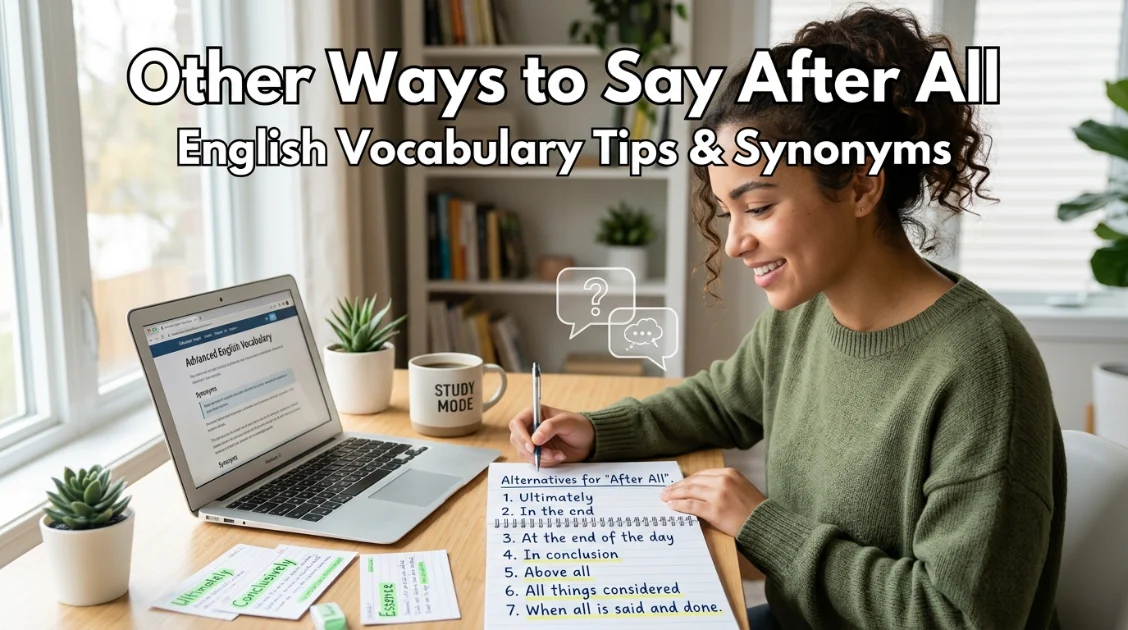
The best alternatives to after all include ultimately, in the end, when you think about it, considering everything, and as it turns out. Choose the phrase based on whether you want to sound formal, casual, persuasive, or conversational.
Learning other ways to say after all can make your English sound more natural, flexible, and precise. The phrase is commonly used to give a reason, emphasize a point, introduce a conclusion, or remind someone of an important fact. However, repeating the same expression can make your communication feel predictable.
Understanding alternatives to after all helps English learners choose language that matches the situation. You may need a formal phrase in professional writing, a conversational option when speaking with friends, or a persuasive expression when explaining your reasoning. These alternatives also strengthen vocabulary skills and make it easier to express excitement in English, agreement, conclusions, and logical connections with confidence. This guide presents 30 useful options with meanings, examples, tones, and practical usage tips.
Quick Categories
Formal alternatives to “after all”
- Ultimately
- Considering everything
- Taking everything into account
- In view of the circumstances
Pro Tip: Use these expressions when presenting conclusions, reasoning, or carefully considered opinions in formal English.
Casual alternatives
- When you think about it
- In the end
- Really
- As it turns out
Pro Tip: These alternatives sound natural in everyday conversations and help you avoid repeating the same phrase.
Professional alternatives
- Ultimately
- All things considered
- Taking this into consideration
- Given the circumstances
Pro Tip: Choose professional alternatives that clearly connect your conclusion to the facts already discussed.
Informal expressions
- When you get down to it
- At the end of the day
- Think about it
- When all is said and done
Pro Tip: Informal expressions in English work well in conversations, but choose more neutral wording for formal reports and business documents.
“Strong English is not about using complicated words. It is about choosing the right expression for the right situation.”
Common Mistakes
1. Using “after all” when no supporting reason follows
Mistake: “I enjoyed the presentation. After all.”
Correct: “I enjoyed the presentation. After all, the speaker explained everything clearly.”
Why: “After all” often introduces a reason, justification, or reminder.
2. Confusing “after all” with “finally”
Mistake: “After all, I finished my assignment at 8 p.m.”
Better: “Finally, I finished my assignment at 8 p.m.”
Why: “Finally” can indicate the last event in a sequence, while “after all” usually provides reasoning or emphasis.
3. Using an informal alternative in formal writing
Mistake: “At the end of the day, the company should reconsider the proposal.”
Better: “Ultimately, the company should reconsider the proposal.”
Why: “At the end of the day” can sound conversational and may not fit formal business writing.
4. Using “ultimately” for a simple sequence
Mistake: “Ultimately, I arrived at the office at 9 a.m.”
Better: “Eventually, I arrived at the office at 9 a.m.”
Why: “Ultimately” usually introduces a final conclusion or result, not simply the next event.
5. Repeating “after all” too often
Mistake: “After all, we need quality. After all, customers expect quality. After all, our reputation matters.”
Better: “Ultimately, we need quality because customers expect it, and our reputation matters.”
Why: Varying professional reaction phrases and logical connectors makes your communication smoother.
What Does “After All” Mean?
After all is an idiomatic expression used to introduce a reason, emphasize a fact, reinforce an argument, or remind someone of something important.
It can appear at the beginning or end of a sentence, depending on the intended meaning.
Example: “We should give her another chance. After all, everyone makes mistakes.”
Here, after all introduces a reason supporting the speaker’s opinion.
When to Use “After All”
You can use the phrase in several common situations:
- Giving a reason: “We should be patient. After all, they are still learning.”
- Emphasizing a fact: “He is the manager, after all.”
- Supporting an argument: “We should accept the offer. After all, it meets our requirements.”
- Making a conclusion: “After all, this is what we originally wanted.”
- Everyday conversations: When reminding someone of a known fact.
Spoken vs. Written: “After all” is natural in both spoken and written English.
Formal vs. Informal: It is generally neutral, although highly formal writing may benefit from alternatives such as ultimately or considering all the circumstances.
“Context determines whether an alternative sounds natural, formal, persuasive, or conversational.”
Is It Professional or Polite to Say “After All”?
Polite? ✔️ Yes
Professional? ✔️ Yes
“After all” is generally acceptable in professional communication. However, the meaning depends on how it is used. In some business contexts, a more precise phrase such as ultimately, given the circumstances, or considering the available information may sound more polished.
Business-style example: “We should proceed with the revised plan. After all, it addresses the concerns raised during the meeting.”
The phrase can be especially useful when connecting a recommendation with a previously stated fact.
Pros and Cons of Using “After All”
Pros
- Simple and natural: It is easy for most English speakers to understand.
- Friendly tone: It can make explanations sound conversational.
- Common usage: Native speakers frequently use it in everyday communication.
- Easy to understand: It clearly signals a reason, reminder, or supporting point.
Cons
- Can sound repetitive: Frequent use may make writing less varied.
- Can be vague: The exact relationship between ideas may not always be clear.
- Limited formality: Some professional contexts benefit from more precise alternatives.
- Can be misused: Learners sometimes confuse it with words such as “finally” or “eventually.”
Other Ways to Say “After All” With Examples
These alternatives will help you sound more fluent, confident, and natural in different situations.
Use them according to tone, context, and audience to express conclusions, reasoning, emphasis, or agreement.
1. Phrase: Ultimately
Meaning: In the final analysis or as the final result.
Explanation: Use it when presenting a conclusion after considering different factors.
Example Sentence: “Ultimately, the decision depends on the available budget.”
Best Use: Formal conclusions
Worst Use: Simple sequence
Tone: Formal, precise, professional
Context Variability: Casual: “Ultimately, it is your choice.” Professional: “Ultimately, the board will make the decision.” Spoken: “Ultimately, we need to decide.”
2. Phrase: In the End
Meaning: Finally or after everything has happened.
Explanation: It is useful for describing a final result or outcome.
Example Sentence: “In the end, we decided to accept the offer.”
Best Use: Final outcomes
Worst Use: Formal reports
Tone: Neutral, natural, conversational
Context Variability: Casual: “In the end, we stayed home.” Professional: “In the end, the team reached an agreement.” Spoken: “In the end, everything worked out.”
3. Phrase: All Things Considered
Meaning: After considering all relevant facts or circumstances.
Explanation: This phrase introduces a conclusion based on multiple factors.
Example Sentence: “All things considered, the proposal is worth pursuing.”
Best Use: Balanced opinions
Worst Use: Casual jokes
Tone: Formal, thoughtful, balanced
Context Variability: Casual: “All things considered, it was a good day.” Professional: “All things considered, the investment appears reasonable.” Spoken: “All things considered, I think we made the right choice.”
4. Phrase: Considering Everything
Meaning: Taking all relevant information into account.
Explanation: It works well when reaching a conclusion after reviewing several factors.
Example Sentence: “Considering everything, postponing the launch was the safest decision.”
Best Use: Careful conclusions
Worst Use: Quick responses
Tone: Neutral, thoughtful, clear
Context Variability: Casual: “Considering everything, it was worth it.” Professional: “Considering everything, we recommend delaying the project.” Spoken: “Considering everything, I agree.”
5. Phrase: Taking Everything Into Account
Meaning: Considering all important facts or circumstances.
Explanation: This is a useful professional expression for explaining a carefully considered decision.
Example Sentence: “Taking everything into account, we should revise the schedule.”
Best Use: Business decisions
Worst Use: Casual chat
Tone: Formal, professional, precise
Context Variability: Casual: “Taking everything into account, it was fine.” Professional: “Taking everything into account, the proposal remains viable.” Spoken: “Taking everything into account, I support the plan.”
6. Phrase: Given the Circumstances
Meaning: Considering the situation that currently exists.
Explanation: Use it when a particular situation explains or supports a conclusion.
Example Sentence: “Given the circumstances, delaying the meeting was reasonable.”
Best Use: Professional explanations
Worst Use: Simple opinions
Tone: Formal, neutral, professional
Context Variability: Casual: “Given the circumstances, I stayed home.” Professional: “Given the circumstances, we recommend postponement.” Spoken: “Given the circumstances, that makes sense.”
7. Phrase: As It Turns Out
Meaning: Used when revealing what was eventually discovered or found to be true.
Explanation: This phrase works especially well when the result differs from what was expected.
Example Sentence: “As it turns out, the original estimate was accurate.”
Best Use: Unexpected results
Worst Use: Formal conclusions
Tone: Conversational, neutral, natural
Context Variability: Casual: “As it turns out, she was right.” Professional: “As it turns out, the data supports the original assumption.” Spoken: “As it turns out, everything was ready.”
8. Phrase: When You Think About It
Meaning: When you carefully consider a fact or situation.
Explanation: This phrase encourages someone to reconsider something from a different perspective.
Example Sentence: “When you think about it, the decision makes perfect sense.”
Best Use: Casual reasoning
Worst Use: Formal reports
Tone: Casual, reflective, conversational
Context Variability: Casual: “When you think about it, that is true.” Professional: “When considering the broader context, the decision is understandable.” Spoken: “When you think about it, she had a point.”
9. Phrase: At the End of the Day
Meaning: When everything important has been considered.
Explanation: It is commonly used to introduce a final opinion or practical conclusion.
Example Sentence: “At the end of the day, customer satisfaction matters most.”
Best Use: Spoken opinions
Worst Use: Academic writing
Tone: Informal, conversational, direct
Context Variability: Casual: “At the end of the day, it is your choice.” Professional: “Ultimately, customer satisfaction remains our priority.” Spoken: “At the end of the day, we need results.”
10. Phrase: When All Is Said and Done
Meaning: After everything has been considered or completed.
Explanation: This expression emphasizes the final outcome or conclusion.
Example Sentence: “When all is said and done, we achieved our main objective.”
Best Use: Final reflections
Worst Use: Formal documents
Tone: Conversational, reflective, informal
Context Variability: Casual: “When all is said and done, it was worth it.” Professional: “Ultimately, the project met its objectives.” Spoken: “When all is said and done, we learned a lot.”
11. Phrase: In View of the Circumstances
Meaning: Considering the situation and relevant conditions.
Explanation: This formal phrase is useful for explaining why a decision is appropriate.
Example Sentence: “In view of the circumstances, the deadline will be extended.”
Best Use: Formal notices
Worst Use: Friendly chat
Tone: Formal, official, precise
Context Variability: Casual: “Given everything, we changed plans.” Professional: “In view of the circumstances, the deadline has been revised.” Spoken: “In view of the circumstances, we decided to wait.”
12. Phrase: Taking This Into Consideration
Meaning: Considering a specific fact before reaching a decision.
Explanation: It clearly connects a known fact to a conclusion.
Example Sentence: “Taking this into consideration, we should adjust the proposal.”
Best Use: Professional discussions
Worst Use: Casual conversation
Tone: Formal, professional, clear
Context Variability: Casual: “Considering that, I agree.” Professional: “Taking this into consideration, we recommend further review.” Spoken: “Taking this into consideration, I think we should wait.”
13. Phrase: In Light of This
Meaning: Considering the information or situation just mentioned.
Explanation: It is especially useful when new information changes or supports a decision.
Example Sentence: “In light of this, we have decided to revise the policy.”
Best Use: Formal communication
Worst Use: Friendly chat
Tone: Formal, professional, precise
Context Variability: Casual: “Because of that, we changed plans.” Professional: “In light of this, additional training is recommended.” Spoken: “In light of this, we should reconsider.”
14. Phrase: Considering the Fact That
Meaning: Taking a particular fact into account.
Explanation: This phrase introduces a reason that supports a conclusion.
Example Sentence: “Considering the fact that demand has increased, we should expand production.”
Best Use: Formal reasoning
Worst Use: Short replies
Tone: Formal, explanatory, precise
Context Variability: Casual: “Since demand is high, we should order more.” Professional: “Considering the fact that demand has increased, expansion may be necessary.” Spoken: “Considering the fact that it is late, we should leave.”
15. Phrase: In Any Case
Meaning: Regardless of the circumstances or previous discussion.
Explanation: It can return attention to the main point or conclusion.
Example Sentence: “The reason is unclear, but in any case, we need to solve the problem.”
Best Use: Redirecting discussion
Worst Use: Detailed reports
Tone: Neutral, practical, conversational
Context Variability: Casual: “In any case, let us go.” Professional: “In any case, the deadline remains unchanged.” Spoken: “In any case, we need to move forward.”
16. Phrase: Regardless
Meaning: Without being affected by the circumstances mentioned.
Explanation: Use it to emphasize that a conclusion remains true despite other considerations.
Example Sentence: “The task may be difficult. Regardless, we need to complete it.”
Best Use: Strong conclusions
Worst Use: Gentle suggestions
Tone: Direct, neutral, confident
Context Variability: Casual: “Regardless, I am going.” Professional: “Regardless of the outcome, we will follow the procedure.” Spoken: “Regardless, we have to continue.”
17. Phrase: In Any Event
Meaning: No matter what happens or what has been discussed.
Explanation: This formal expression helps move a discussion toward a final point.
Example Sentence: “The results are uncertain. In any event, we must prepare for the meeting.”
Best Use: Formal writing
Worst Use: Casual conversation
Tone: Formal, polished, neutral
Context Variability: Casual: “Anyway, we should leave.” Professional: “In any event, the deadline remains unchanged.” Spoken: “In any event, we need to be prepared.”
18. Phrase: Anyway
Meaning: Regardless of what was previously discussed or despite another point.
Explanation: This highly common conversational word can introduce a conclusion or return to the main topic.
Example Sentence: “It may be expensive, but anyway, we need the equipment.”
Best Use: Casual speech
Worst Use: Formal reports
Tone: Casual, conversational, informal
Context Variability: Casual: “Anyway, let us continue.” Professional: “In any case, we should continue.” Spoken: “Anyway, what were you saying?”
19. Phrase: When You Get Down to It
Meaning: When you consider the basic or essential facts.
Explanation: This informal phrase is useful for simplifying a complicated issue.
Example Sentence: “When you get down to it, the decision is about trust.”
Best Use: Informal reasoning
Worst Use: Business reports
Tone: Informal, conversational, direct
Context Variability: Casual: “When you get down to it, money is not everything.” Professional: “At its core, the issue concerns trust.” Spoken: “When you get down to it, we need a solution.”
20. Phrase: The Bottom Line Is
Meaning: The most important conclusion or fact is.
Explanation: This phrase highlights the central point of an argument or discussion.
Example Sentence: “The bottom line is that we need more time.”
Best Use: Business discussions
Worst Use: Academic analysis
Tone: Direct, professional, practical
Context Variability: Casual: “The bottom line is that I agree.” Professional: “The bottom line is that costs must be reduced.” Spoken: “The bottom line is, we need results.”
21. Phrase: Ultimately Speaking
Meaning: When considering the final conclusion.
Explanation: This expression can emphasize the final point, although “ultimately” alone is usually more natural.
Example Sentence: “Ultimately, the success of the project depends on communication.”
Best Use: Final arguments
Worst Use: Casual chat
Tone: Formal, thoughtful, professional
Context Variability: Casual: “Ultimately, it is your choice.” Professional: “Ultimately, the results depend on implementation.” Spoken: “Ultimately, we need to decide.”
22. Phrase: In Retrospect
Meaning: Looking back at something after it has happened.
Explanation: Use this expression when a later perspective changes how an earlier event is understood.
Example Sentence: “In retrospect, postponing the launch was the right decision.”
Best Use: Reflective writing
Worst Use: Immediate decisions
Tone: Formal, reflective, thoughtful
Context Variability: Casual: “In retrospect, I should have waited.” Professional: “In retrospect, the strategy required further testing.” Spoken: “In retrospect, we made the right decision.”
23. Phrase: On Reflection
Meaning: After thinking carefully about something.
Explanation: This phrase introduces an opinion reached after consideration.
Example Sentence: “On reflection, I believe we should revise the plan.”
Best Use: Thoughtful opinions
Worst Use: Urgent responses
Tone: Formal, thoughtful, polite
Context Variability: Casual: “On reflection, I agree.” Professional: “On reflection, the proposal requires revision.” Spoken: “On reflection, I think you are right.”
24. Phrase: Upon Consideration
Meaning: After careful thought.
Explanation: This formal phrase is useful when explaining that a decision changed after reviewing the facts.
Example Sentence: “Upon consideration, we decided to accept the revised terms.”
Best Use: Formal decisions
Worst Use: Casual chat
Tone: Formal, polished, professional
Context Variability: Casual: “After thinking about it, I agreed.” Professional: “Upon consideration, the committee approved the proposal.” Spoken: “Upon consideration, I decided to proceed.”
25. Phrase: Given That
Meaning: Considering that a particular fact is true.
Explanation: This concise phrase introduces a reason for a conclusion or decision.
Example Sentence: “Given that the deadline is tomorrow, we should begin immediately.”
Best Use: Professional reasoning
Worst Use: Unrelated opinions
Tone: Neutral, professional, direct
Context Variability: Casual: “Given that it is raining, let us stay inside.” Professional: “Given that demand has increased, production should be expanded.” Spoken: “Given that we are late, let us leave.”
26. Phrase: Considering That
Meaning: Taking a specific fact into account.
Explanation: It is useful for explaining why a situation or conclusion makes sense.
Example Sentence: “Considering that she had no prior experience, she performed very well.”
Best Use: Explanations
Worst Use: Formal headings
Tone: Neutral, clear, conversational
Context Variability: Casual: “Considering that he was tired, he did well.” Professional: “Considering that resources were limited, the results were strong.” Spoken: “Considering that it was difficult, they did great.”
27. Phrase: After Considering Everything
Meaning: After reviewing all relevant information.
Explanation: This phrase directly communicates that a conclusion follows careful consideration.
Example Sentence: “After considering everything, we decided to continue with the project.”
Best Use: Careful decisions
Worst Use: Quick statements
Tone: Neutral, thoughtful, clear
Context Variability: Casual: “After considering everything, I agree.” Professional: “After considering everything, management approved the proposal.” Spoken: “After considering everything, I changed my mind.”
28. Phrase: All in All
Meaning: Considering everything together.
Explanation: This phrase summarizes an overall judgment or final impression.
Example Sentence: “All in all, the conference was a successful event.”
Best Use: Overall summaries
Worst Use: Precise analysis
Tone: Neutral, conversational, positive
Context Variability: Casual: “All in all, it was fun.” Professional: “All in all, the project met its objectives.” Spoken: “All in all, I think it went well.”
29. Phrase: By the Same Token
Meaning: For the same reason or by the same logic.
Explanation: This phrase connects one idea to another using a similar principle.
Example Sentence: “The first option is expensive. By the same token, the second option may also exceed our budget.”
Best Use: Logical arguments
Worst Use: Casual conversation
Tone: Formal, analytical, precise
Context Variability: Casual: “For the same reason, I agree.” Professional: “By the same token, the alternative requires further review.” Spoken: “By the same token, we should consider the other option.”
30. Phrase: When All Factors Are Considered
Meaning: After reviewing all relevant aspects of a situation.
Explanation: This formal phrase is useful when presenting a final conclusion based on several factors.
Example Sentence: “When all factors are considered, the revised plan is more practical.”
Best Use: Formal conclusions
Worst Use: Casual chat
Tone: Formal, analytical, professional
Context Variability: Casual: “Considering everything, it seems fine.” Professional: “When all factors are considered, the revised strategy offers greater flexibility.” Spoken: “When all factors are considered, I think this is the best approach.”
“Replacing one familiar phrase with the right context-specific alternative can make your English noticeably more polished.”
Mini Quiz / Self-Check
1. Which phrase is most suitable for a formal business conclusion?
A. Anyway
B. Ultimately
C. Think about it
D. When you get down to it
Answer: B. Ultimately
2. Which option sounds most natural in casual conversation?
A. Upon consideration
B. In view of the circumstances
C. When you think about it
D. Taking everything into account
Answer: C. When you think about it
3. Choose the best sentence for a professional email.
A. At the end of the day, we need more time.
B. The runs are delayed, anyway.
C. Given the circumstances, we recommend postponing the launch.
D. Think about it, the launch is risky.
Answer: C. Given the circumstances, we recommend postponing the launch.
4. Which expression emphasizes an overall conclusion?
A. All in all
B. Anyway
C. Given that
D. As it turns out
Answer: A. All in all
Comparison Table: Top Alternatives
| Phrase | Tone | Best Use |
|---|---|---|
| Ultimately | Formal, professional | Final conclusions |
| In the end | Neutral, natural | Final outcomes |
| All things considered | Formal, thoughtful | Balanced opinions |
| Considering everything | Neutral, clear | Careful conclusions |
| Given the circumstances | Professional, formal | Business explanations |
| As it turns out | Conversational | Unexpected results |
| When you think about it | Casual, reflective | Everyday reasoning |
| At the end of the day | Informal, conversational | Spoken opinions |
| In light of this | Formal, professional | Business decisions |
| All in all | Neutral, conversational | Overall summaries |
FAQs
What are the best other ways to say after all?
Useful alternatives include ultimately, in the end, all things considered, given the circumstances, and considering everything. The best choice depends on the context.
What is a formal way to say after all?
For formal English, you can use ultimately, taking everything into account, in view of the circumstances, or when all factors are considered.
What is a casual way to say after all?
In casual conversations, natural alternatives include when you think about it, in the end, anyway, and as it turns out.
Is “after all” professional English?
Yes. “After all” is acceptable in professional English, particularly when it introduces a reason or reinforces a point. More formal alternatives may be preferable in highly formal documents.
Is “at the end of the day” the same as “after all”?
They can overlap when introducing a final point, but they are not always interchangeable. “After all” often gives a reason or reminder, while “at the end of the day” commonly introduces an overall conclusion or practical judgment.
Conclusion
Learning other ways to say after all gives you more control over tone, meaning, and context. Expressions such as ultimately, all things considered, and given the circumstances work well in professional communication, while when you think about it, anyway, and as it turns out are more conversational.
The key is to practice each phrase in complete sentences rather than memorizing synonyms alone. Pay attention to whether you are explaining a reason, emphasizing a fact, summarizing an outcome, or presenting a conclusion. This approach will make your spoken and written English more natural and confident.
Discover More Post:
- 30+ Other Ways to Say Leave Me Alone | Set Boundaries with …
- Other Ways to Say It Means a Lot | Meaningful Expressions …
- 30+ What Are Other Ways to Say According to? Smart …

Ethan Parker is a professional content writer at Replynst.com. He creates clear, engaging and well-researched articles focused on providing useful information, answering readers’ questions.