Quick Answer:
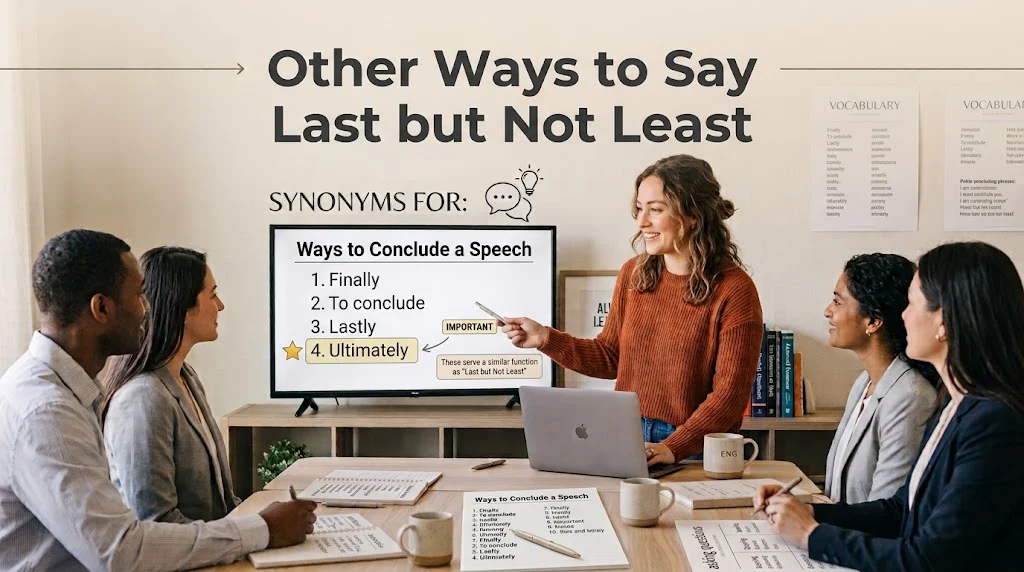
The best alternatives to last but not least include finally, most importantly, finally and importantly, another key point, and equally important. The best choice depends on whether you want to sound formal, casual, professional, or conversational.
Learning other ways to say last but not least can make your English sound smoother, more natural, and more confident. This phrase is often used before mentioning the final person or point in a list while showing that it is still important. You may hear it in speeches, presentations, articles, meetings, and everyday conversations. However, repeating the same expression can make your writing sound predictable.
Knowing alternatives to last but not least gives you more choices for different situations. Some expressions sound formal, while others work better in casual speech or professional communication. Just as you learn to express excitement in English, learning varied transition phrases can help you communicate ideas clearly, avoid repetition, and make your English more engaging.
Quick Categories
Formal alternatives to “last but not least”
- Finally
- Equally important
- Most importantly
- Of equal importance
Pro Tip: Use formal alternatives when writing reports, essays, presentations, or other professional documents.
Casual alternatives
- And finally
- One more thing
- Finally, we have
- And here is the last one
Pro Tip: Casual phrases work well in friendly conversations, informal presentations, and relaxed discussions.
Professional alternatives
- Finally, it is important to note
- Another key point
- As a final consideration
- One final point
Pro Tip: Professional English sounds stronger when your transitions clearly show the relationship between ideas.
Informal expressions
- And finally
- Last of all
- One last thing
- Before I finish
Pro Tip: Informal expressions in English are useful when speaking naturally, but choose more polished wording for formal documents.
“A strong transition does more than end a list. It tells your reader why the final point still matters.”
Common Mistakes
1. Using “last but not least” when the final item is actually unimportant
Mistake: “Last but not least, here is a small detail that does not matter.”
Better: “Finally, here is one additional detail.”
Why: The original expression emphasizes that the final item is still important.
2. Using it repeatedly in the same paragraph
Mistake: “Last but not least” appears several times in one short section.
Better: Use alternatives such as “finally,” “equally important,” or “one final point.”
Why: Repetition can make your writing sound mechanical.
3. Thinking “last” means least important
Mistake: “The last speaker is the least important.”
Better: “The final speaker is equally important.”
Why: The phrase specifically suggests that the final person or point deserves attention.
4. Using an overly casual alternative in formal writing
Mistake: “One last thing, the financial results were strong.”
Better: “Finally, the financial results were strong.”
Why: “One last thing” is conversational and may sound too informal for a formal report.
5. Using “finally” when there is no list or sequence
Mistake: “Finally, I like this restaurant.”
Better: “I really like this restaurant.”
Why: “Finally” normally signals the final point in a sequence or discussion.
What Does “Last but Not Least” Mean?
Last but not least means that something or someone is mentioned last but is still considered important.
It is commonly used to introduce the final item in a list, speech, presentation, or discussion.
The expression works as a transition phrase and is usually placed at the beginning of a sentence.
Example: “Last but not least, I would like to thank our volunteers.”
When to Use “Last but Not Least”
You can use the phrase in several common contexts:
- Presentations: When introducing the final point.
- Speeches: When thanking the final person or group.
- Articles: When presenting the last important idea.
- Meetings: When mentioning the final topic.
- Introductions: When introducing the last person in a group.
Spoken vs. Written: It works in both spoken and written English.
Formal vs. Informal: It is generally neutral and acceptable in professional communication, but alternatives can make writing more varied.
Is It Professional or Polite to Say “Last but Not Least”?
Polite? ✔️ Yes
Professional? ✔️ Yes
The phrase is polite and widely accepted in professional English. However, because it is common and sometimes overused, a more precise alternative may sound fresher in formal writing.
Business-style example: “Finally, I would like to recognize the team members who supported this project.”
In a professional presentation, finally, one final point, and equally important can provide a clean and confident transition.
Pros and Cons of Using “Last but Not Least”
Pros
- Simple and natural: Most English speakers understand it immediately.
- Friendly tone: It can make a list sound warm and inclusive.
- Common usage: It is widely recognized in spoken and written English.
- Easy to understand: It clearly signals the final point.
Cons
- Can sound repetitive: Frequent use may make your writing predictable.
- Sometimes overused: It appears often in speeches and presentations.
- Limited variety: It does not offer much stylistic flexibility.
- Less precise: Some situations need a clearer transition such as “finally” or “equally important.”
“Professional English becomes more effective when your transition words match the purpose of your message.”
Other Ways to Say “Last but Not Least” With Examples
These alternatives will help you sound more fluent, confident, and natural in different situations.
Use them according to tone, context, and audience to show that your final point is still important.
1. Phrase: Finally
Meaning: Used to introduce the final point or item.
Explanation: This is one of the simplest and most natural replacements.
Example Sentence: “Finally, we need to discuss the project deadline.”
Best Use: Formal presentations
Worst Use: No sequence
Tone: Clear, neutral, professional
Context Variability: Casual: “Finally, we reached the hotel.” Professional: “Finally, we need to review the budget.” Spoken: “Finally, let’s discuss the last issue.”
2. Phrase: Equally Important
Meaning: Shows that the final point has the same importance as earlier points.
Explanation: This phrase directly emphasizes the value of the next idea.
Example Sentence: “Equally important, we need to support our new employees.”
Best Use: Professional writing
Worst Use: Minor details
Tone: Formal, confident, precise
Context Variability: Casual: “This is important too.” Professional: “Equally important, we must consider customer needs.” Spoken: “Equally important is the team’s feedback.”
3. Phrase: Most Importantly
Meaning: Introduces something considered especially important.
Explanation: Use this when the final point deserves strong emphasis.
Example Sentence: “Most importantly, every customer should feel respected.”
Best Use: Strong emphasis
Worst Use: Equal points
Tone: Confident, direct, professional
Context Variability: Casual: “Most importantly, have fun.” Professional: “Most importantly, we must protect customer data.” Spoken: “Most importantly, remember the deadline.”
4. Phrase: One Final Point
Meaning: Introduces the last idea in a discussion.
Explanation: This is clear, professional, and useful in presentations.
Example Sentence: “One final point is worth discussing before we finish.”
Best Use: Business meetings
Worst Use: Casual greetings
Tone: Professional, clear, focused
Context Variability: Casual: “One last thing.” Professional: “One final point requires our attention.” Spoken: “One final point before we close.”
5. Phrase: Another Key Point
Meaning: Introduces another important idea.
Explanation: It emphasizes importance without necessarily making the idea the final point.
Example Sentence: “Another key point is the need for better communication.”
Best Use: Professional discussions
Worst Use: Final-only lists
Tone: Professional, clear, confident
Context Variability: Casual: “Another important thing is…” Professional: “Another key point is employee training.” Spoken: “Another key point is customer satisfaction.”
6. Phrase: Of Equal Importance
Meaning: Shows that the next point is just as important as previous points.
Explanation: This is a formal alternative suitable for academic and professional writing.
Example Sentence: “Of equal importance is the need to improve workplace safety.”
Best Use: Formal writing
Worst Use: Casual chat
Tone: Formal, academic, precise
Context Variability: Casual: “This is just as important.” Professional: “Of equal importance is staff development.” Spoken: “Of equal importance is the quality of service.”
7. Phrase: As a Final Consideration
Meaning: Introduces the last factor that should be considered.
Explanation: It works especially well when discussing decisions or plans.
Example Sentence: “As a final consideration, we should review the long-term costs.”
Best Use: Business writing
Worst Use: Friendly chat
Tone: Formal, thoughtful, professional
Context Variability: Casual: “One last thing to think about.” Professional: “As a final consideration, we should review the risks.” Spoken: “As a final consideration, let’s examine the cost.”
8. Phrase: One Last Thing
Meaning: Introduces one final point or request.
Explanation: This is a natural conversational alternative.
Example Sentence: “One last thing, please remember to submit your form.”
Best Use: Casual speech
Worst Use: Formal reports
Tone: Casual, friendly, conversational
Context Variability: Casual: “One last thing before you leave.” Professional: “One final point before we conclude.” Spoken: “One last thing I wanted to mention.”
9. Phrase: Last of All
Meaning: Introduces the final item in a sequence.
Explanation: This phrase is straightforward and slightly more traditional.
Example Sentence: “Last of all, we should thank everyone who helped.”
Best Use: Spoken lists
Worst Use: Technical reports
Tone: Neutral, simple, traditional
Context Variability: Casual: “Last of all, we visited the museum.” Professional: “Finally, we reviewed the recommendations.” Spoken: “Last of all, I want to thank the team.”
10. Phrase: Finally and Importantly
Meaning: Introduces the final point while emphasizing its importance.
Explanation: This combination closely matches the meaning of the original phrase.
Example Sentence: “Finally and importantly, we must consider the needs of our customers.”
Best Use: Formal presentations
Worst Use: Casual conversation
Tone: Formal, emphatic, professional
Context Variability: Casual: “Finally, remember the important part.” Professional: “Finally and importantly, we need to review compliance.” Spoken: “Finally and importantly, let’s discuss safety.”
11. Phrase: To Conclude
Meaning: Introduces the final part of a discussion.
Explanation: This phrase is especially common in speeches, essays, and presentations.
Example Sentence: “To conclude, the project has achieved its main goals.”
Best Use: Formal writing
Worst Use: Casual chat
Tone: Formal, polished, academic
Context Variability: Casual: “So, to finish…” Professional: “To conclude, the results support our strategy.” Spoken: “To conclude, I would like to thank everyone.”
12. Phrase: In Closing
Meaning: Introduces the final thoughts or remarks.
Explanation: It is commonly used at the end of speeches, letters, and presentations.
Example Sentence: “In closing, I would like to thank everyone for their hard work.”
Best Use: Formal speeches
Worst Use: Casual messages
Tone: Formal, respectful, polished
Context Variability: Casual: “Before we finish…” Professional: “In closing, I want to recognize the team.” Spoken: “In closing, thank you for your time.”
13. Phrase: Before We Finish
Meaning: Introduces something that should be mentioned before the discussion ends.
Explanation: This sounds natural and conversational.
Example Sentence: “Before we finish, I have one important announcement.”
Best Use: Spoken communication
Worst Use: Academic essays
Tone: Friendly, natural, conversational
Context Variability: Casual: “Before we finish, one more thing.” Professional: “Before we finish, I would like to address one concern.” Spoken: “Before we finish, let’s review the deadline.”
14. Phrase: Before I Finish
Meaning: Introduces a final personal point or message.
Explanation: It is particularly useful in speeches and presentations.
Example Sentence: “Before I finish, I want to thank everyone for being here.”
Best Use: Speeches
Worst Use: Formal reports
Tone: Warm, polite, conversational
Context Variability: Casual: “Before I go, one thing.” Professional: “Before I finish, I would like to acknowledge the team.” Spoken: “Before I finish, I have one final message.”
15. Phrase: To End With
Meaning: Introduces the final part of something.
Explanation: This phrase can be used when organizing a speech, presentation, or list.
Example Sentence: “To end with, I would like to share one final recommendation.”
Best Use: Presentations
Worst Use: Casual dialogue
Tone: Neutral, organized, professional
Context Variability: Casual: “To finish, here’s one more thing.” Professional: “To end with, I recommend reviewing the policy.” Spoken: “To end with, let’s discuss the final point.”
16. Phrase: As a Final Point
Meaning: Introduces the last important idea.
Explanation: This is a direct and professional replacement.
Example Sentence: “As a final point, we should consider the impact on employees.”
Best Use: Business meetings
Worst Use: Casual jokes
Tone: Formal, clear, professional
Context Variability: Casual: “One last point.” Professional: “As a final point, we need to review the contract.” Spoken: “As a final point, I’d like to discuss costs.”
17. Phrase: As a Final Note
Meaning: Introduces a final comment or reminder.
Explanation: This phrase sounds polished without being overly formal.
Example Sentence: “As a final note, please remember to update your contact details.”
Best Use: Professional messages
Worst Use: Technical data
Tone: Polite, professional, warm
Context Variability: Casual: “One final note.” Professional: “As a final note, please submit the report by Friday.” Spoken: “As a final note, thank you for your support.”
18. Phrase: As a Last Point
Meaning: Introduces the final point in a discussion.
Explanation: It clearly signals the end of a sequence.
Example Sentence: “As a last point, we need to discuss employee training.”
Best Use: Formal discussion
Worst Use: Casual chat
Tone: Neutral, formal, direct
Context Variability: Casual: “For the last point…” Professional: “As a last point, we should review the results.” Spoken: “As a last point, let’s consider the cost.”
19. Phrase: The Final Point
Meaning: Refers directly to the last idea in a list.
Explanation: This is concise and useful when clarity matters.
Example Sentence: “The final point concerns our customer service policy.”
Best Use: Formal writing
Worst Use: Friendly conversation
Tone: Formal, direct, precise
Context Variability: Casual: “The last thing is…” Professional: “The final point concerns compliance.” Spoken: “The final point is about our schedule.”
20. Phrase: One More Important Point
Meaning: Introduces an additional idea that deserves attention.
Explanation: It highlights importance without using the original expression.
Example Sentence: “One more important point is the need for regular feedback.”
Best Use: Presentations
Worst Use: Unimportant details
Tone: Clear, professional, emphatic
Context Variability: Casual: “One more important thing.” Professional: “One more important point concerns staff training.” Spoken: “One more important point before we move on.”
21. Phrase: An Important Final Thought
Meaning: Introduces a significant idea at the end.
Explanation: This works especially well when ending an article, speech, or presentation.
Example Sentence: “An important final thought is that success requires patience.”
Best Use: Closing remarks
Worst Use: Short lists
Tone: Thoughtful, polished, reflective
Context Variability: Casual: “One last thought.” Professional: “An important final thought is the need for planning.” Spoken: “An important final thought before we finish.”
22. Phrase: One Final Consideration
Meaning: Introduces one last factor that deserves attention.
Explanation: It is useful when evaluating choices, plans, or risks.
Example Sentence: “One final consideration is the cost of implementation.”
Best Use: Decision making
Worst Use: Casual chat
Tone: Formal, thoughtful, professional
Context Variability: Casual: “One last thing to think about.” Professional: “One final consideration is the budget.” Spoken: “One final consideration is timing.”
23. Phrase: Finally, We Should Note
Meaning: Introduces a final observation.
Explanation: This phrase is useful in reports and analytical writing.
Example Sentence: “Finally, we should note the positive response from customers.”
Best Use: Reports
Worst Use: Casual speech
Tone: Formal, analytical, professional
Context Variability: Casual: “Finally, remember this.” Professional: “Finally, we should note the improved results.” Spoken: “Finally, we should note one important change.”
24. Phrase: Another Important Consideration
Meaning: Introduces another factor that matters.
Explanation: It works well when several factors are being compared.
Example Sentence: “Another important consideration is employee satisfaction.”
Best Use: Professional writing
Worst Use: Final-only lists
Tone: Formal, thoughtful, clear
Context Variability: Casual: “Another important thing.” Professional: “Another important consideration is cost.” Spoken: “Another important consideration is timing.”
25. Phrase: To Finish
Meaning: Introduces the final part of a discussion.
Explanation: This is a simple and natural phrase for everyday communication.
Example Sentence: “To finish, let’s review the main recommendations.”
Best Use: Casual presentations
Worst Use: Formal essays
Tone: Simple, natural, conversational
Context Variability: Casual: “To finish, here’s the last point.” Professional: “To conclude, let’s review the recommendations.” Spoken: “To finish, I want to thank everyone.”
26. Phrase: To Wrap Up
Meaning: Introduces the final stage of a discussion.
Explanation: This is a common professional and conversational expression.
Example Sentence: “To wrap up, let’s review what we have learned.”
Best Use: Meetings
Worst Use: Academic papers
Tone: Friendly, professional, conversational
Context Variability: Casual: “Let’s wrap up.” Professional: “To wrap up, we need to confirm the next steps.” Spoken: “To wrap up, here are the key points.”
27. Phrase: In Summary
Meaning: Introduces a brief review of the main ideas.
Explanation: It is useful when bringing several points together at the end.
Example Sentence: “In summary, the proposal offers several clear benefits.”
Best Use: Formal writing
Worst Use: Introducing one detail
Tone: Formal, clear, academic
Context Variability: Casual: “So, basically…” Professional: “In summary, the proposal meets our goals.” Spoken: “In summary, we have three priorities.”
28. Phrase: As We Close
Meaning: Introduces the final part of a meeting, speech, or presentation.
Explanation: It provides a smooth transition toward the ending.
Example Sentence: “As we close, I would like to thank everyone for their contribution.”
Best Use: Meetings
Worst Use: Casual text
Tone: Polished, respectful, professional
Context Variability: Casual: “As we finish…” Professional: “As we close, let’s confirm the next steps.” Spoken: “As we close, thank you for your time.”
29. Phrase: To Bring This to a Close
Meaning: Introduces the final remarks of a discussion.
Explanation: This is a polished phrase for formal presentations and speeches.
Example Sentence: “To bring this to a close, I would like to highlight three key lessons.”
Best Use: Formal speeches
Worst Use: Casual chat
Tone: Formal, polished, confident
Context Variability: Casual: “To finish up…” Professional: “To bring this to a close, let’s review the results.” Spoken: “To bring this to a close, I want to thank everyone.”
30. Phrase: In Final Consideration
Meaning: Refers to the final factor being considered.
Explanation: This formal phrase can work in analytical or professional writing.
Example Sentence: “In final consideration, we must evaluate the long-term effects.”
Best Use: Formal analysis
Worst Use: Casual speech
Tone: Formal, analytical, precise
Context Variability: Casual: “Finally, think about the long-term effects.” Professional: “In final consideration, we should review the risks.” Spoken: “As a final consideration, we should examine the impact.”
“Choose ‘finally’ for simplicity, ‘equally important’ for emphasis, and ‘one final point’ for professional clarity.”
Mini Quiz / Self-Check
1. Which alternative is best for a formal business presentation?
A. One last thing
B. The runs
C. One final point
D. One little thing
Answer: C. One final point
2. Which phrase emphasizes that the final idea is just as important as the others?
A. Equally important
B. To finish
C. One last thing
D. Before I finish
Answer: A. Equally important
3. Which phrase is most conversational?
A. Of equal importance
B. As a final consideration
C. One last thing
D. In final consideration
Answer: C. One last thing
4. Which sentence uses “finally” correctly?
A. Finally, I enjoy reading books.
B. Finally, let’s review the final recommendation.
C. Finally, the blue car is beautiful.
D. Finally, my brother lives in London.
Answer: B. Finally, let’s review the final recommendation.
Comparison Table: Top Alternatives
| Phrase | Tone | Best Use |
|---|---|---|
| Finally | Neutral, professional | Presentations |
| Equally important | Formal, confident | Professional writing |
| Most importantly | Direct, emphatic | Strong emphasis |
| One final point | Professional, clear | Business meetings |
| Another key point | Professional, focused | Discussions |
| Of equal importance | Formal, academic | Formal writing |
| As a final consideration | Formal, thoughtful | Decision making |
| One last thing | Casual, friendly | Everyday speech |
| To conclude | Formal, polished | Essays and speeches |
| In closing | Formal, respectful | Closing remarks |
FAQs
What are the best other ways to say last but not least?
Some of the best alternatives are finally, equally important, most importantly, one final point, and another key point.
What is a professional way to say last but not least?
For professional communication, use phrases such as one final point, finally, equally important, or as a final consideration.
Is “last but not least” formal or informal?
“Last but not least” is neutral and can be used in both formal and informal situations. However, alternatives may sound more precise in professional writing.
Can I use “finally” instead of “last but not least”?
Yes. Finally is one of the simplest alternatives when you are introducing the final item in a sequence or list.
Is “one last thing” a good alternative to “last but not least”?
Yes, but it is more casual. It works well in conversations and informal presentations but may be too conversational for formal reports.
Conclusion
Learning other ways to say last but not least gives you more flexibility when speaking and writing English. Alternatives such as finally, equally important, and one final point can help you avoid repetition while keeping your message clear and effective.
The key is to match the phrase with your audience and purpose. Practice these alternatives in presentations, emails, essays, and everyday conversations. With regular use, your transitions will sound more natural, confident, and professional.
Read More Related Articles:
- Other Ways to Say I Appreciate | Warm Words That Leave an …
- Other Ways to Say Diarrhea | Polite, Professional & Clear …
- 30+ Other Ways to Say Ethical | Smarter Words That Reflect …

Emma Richardson is a professional content writer at Replynst.com. She creates clear, engaging and well-researched content designed to answer readers’ questions while following modern SEO best practices. Her focus is on helpful, reader-friendly articles that deliver genuine value.