Quick Answer:
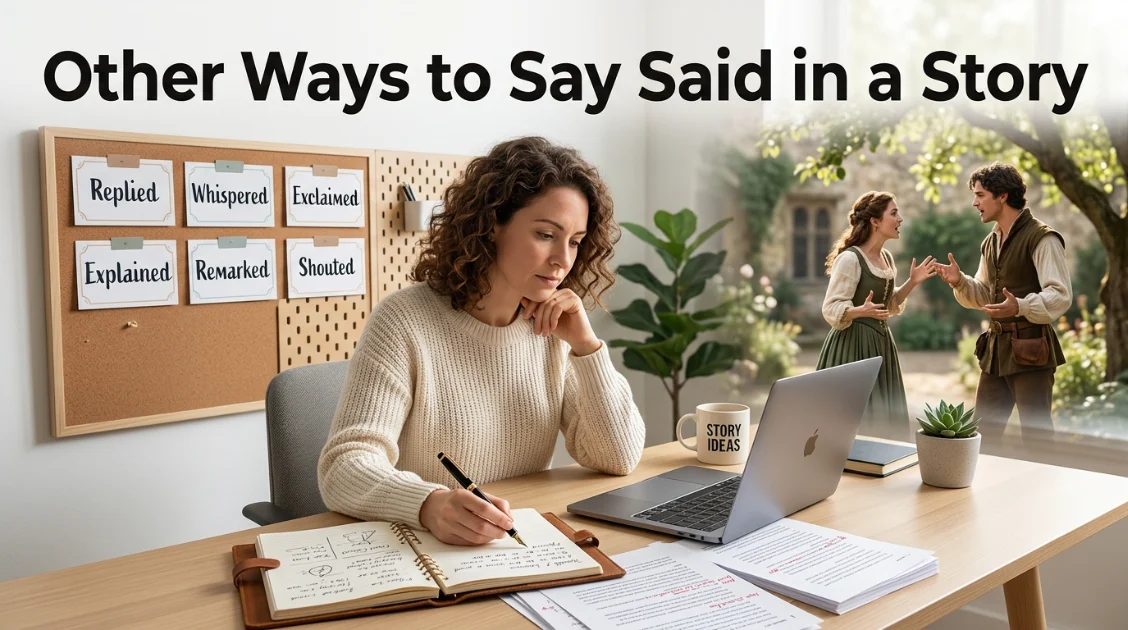
The best alternatives to said in a story include replied, exclaimed, whispered, shouted, muttered, remarked, explained, stated, responded, and added. Choosing the right dialogue tag can make storytelling more vivid, natural, and engaging without overcomplicating your writing.
Finding other ways to say said in a story can make your dialogue more engaging and descriptive. While “said” is completely correct and often useful, repeating it throughout a story can make dialogue feel predictable. Writers can choose alternatives that show emotion, volume, attitude, or the purpose of a character’s words.
Learning alternatives to said in a story is especially useful for students, novelists, bloggers, and anyone developing creative writing skills. Words such as “whispered,” “replied,” and “exclaimed” provide additional context without requiring long explanations. Just as learners practice how to express excitement in English, they can also learn how to communicate a character’s emotions through effective dialogue tags.
Quick Categories
Formal alternatives to “said in a story”
- Stated
- Remarked
- Declared
- Explained
Pro Tip: Use formal dialogue tags when the character is presenting information, making an announcement, or speaking seriously.
Casual alternatives
- Replied
- Answered
- Added
- Mentioned
Pro Tip: Simple alternatives often sound more natural than dramatic dialogue tags in everyday conversations.
Professional alternatives
- Explained
- Noted
- Observed
- Responded
Pro Tip: Choose precise words that describe what the character is doing with their speech rather than adding unnecessary drama.
Informal expressions
- Muttered
- Whispered
- Shouted
- Blurted
Pro Tip: Use informal expressions in English when the character’s emotion, volume, or reaction is important to the scene.
“The best dialogue tag does more than replace ‘said’. It helps readers understand how the words were delivered.”
Common Mistakes
1. Replacing “said” every time
Mistake: Using a different dramatic dialogue tag after every line.
Example: “I am tired,” she exclaimed.
Better: “I am tired,” she said.
Why: “Said” is often invisible to readers and does not need to be replaced constantly.
2. Using “exclaimed” for ordinary speech
Mistake: “I went to the store,” he exclaimed.
Better: “I went to the store,” he said.
Why: “Exclaimed” suggests strong emotion or excitement.
3. Confusing actions with dialogue tags
Mistake: “I agree,” she smiled.
Better: “I agree,” she said with a smile.
Why: A person can smile, but “smiled” does not describe the act of speaking.
4. Overusing “whispered”
Mistake: Every quiet conversation uses “whispered.”
Example: “Good morning,” she whispered.
Better: “Good morning,” she said quietly.
Why: Whispering has a specific meaning and should be used when the character actually speaks very softly.
5. Using unnecessarily dramatic words
Mistake: “I need some water,” he bellowed.
Better: “I need some water,” he said.
Why: “Bellowed” implies very loud or forceful speech and may not match the scene.
What Does “Said in a Story” Mean?
Said is a common dialogue tag used in fiction to identify the character who is speaking.
It usually appears after or before dialogue and helps readers understand who is talking.
Example: “I will meet you tomorrow,” Maria said.
The word “said” is a past-tense form of the verb say. In storytelling, it is commonly used with dialogue to identify the speaker.
When to Use “Said” in a Story
You can use “said” in several situations:
- Simple dialogue: When a character is speaking normally.
- Fast conversations: When clarity is more important than description.
- Emotional scenes: When the dialogue itself already shows emotion.
- Professional conversations: When characters are discussing information.
- Narrative writing: When you want the dialogue to flow naturally.
Spoken vs. Written: “Said” is especially common in written storytelling because it clearly identifies speakers.
Formal vs. Informal: It is neutral and can work in almost any type of story.
Is “Said” Professional or Polite?
Polite? ✔️ Yes
Professional? ✔️ Yes
“Said” is neutral rather than formal or informal. It is widely accepted in fiction, academic examples, scripts, journalism, and professional writing.
Story-style example: “I understand your concerns,” the manager said.
For creative writing, the main consideration is not whether “said” is professional, but whether another dialogue tag better communicates the character’s emotion or intention.
Pros and Cons of Using “Said”
Pros
- Simple and natural: Readers understand it immediately.
- Friendly tone: It does not make ordinary dialogue sound dramatic.
- Common usage: It is one of the most frequently used dialogue tags.
- Easy to understand: It clearly identifies the speaker.
Cons
- Can become repetitive: Frequent repetition may stand out in some passages.
- Limited emotional detail: It does not show how something was said.
- Less descriptive: It gives little information about volume or emotion.
- Not always suitable for dramatic moments: Strong scenes may benefit from more precise wording.
“Use ‘said’ when the dialogue speaks for itself, and choose a stronger tag when the delivery matters.”
Other Ways to Say “Said in a Story” With Examples
These alternatives will help you write dialogue that feels more fluent, confident, and natural.
Use them according to tone, context, emotion, and the character’s manner of speaking.
1. Phrase: Replied
Meaning: Responded to something another person said.
Explanation: “Replied” is one of the most natural replacements for “said” when a character answers someone.
Example Sentence: “I will be there at six,” she replied.
Best Use: Dialogue responses
Worst Use: First statements
Tone: Natural, neutral, clear
Context Variability: Casual: “Sure,” he replied. Professional: “That sounds reasonable,” she replied. Spoken: “Of course,” he replied.
2. Phrase: Answered
Meaning: Gave a response to a question.
Explanation: Use “answered” when the character is specifically responding to a question or request.
Example Sentence: “The library closes at five,” she answered.
Best Use: Direct questions
Worst Use: Emotional scenes
Tone: Clear, neutral, direct
Context Variability: Casual: “Yes,” he answered. Professional: “The report is ready,” she answered. Spoken: “I do not know,” he answered.
3. Phrase: Whispered
Meaning: Spoke very quietly.
Explanation: This dialogue tag shows that the character intentionally lowers their voice.
Example Sentence: “Be careful,” she whispered.
Best Use: Quiet scenes
Worst Use: Loud scenes
Tone: Quiet, gentle, secretive
Context Variability: Casual: “Come here,” she whispered. Professional: Rarely appropriate. Spoken: “Do not tell anyone,” he whispered.
4. Phrase: Shouted
Meaning: Spoke very loudly.
Explanation: “Shouted” is useful when a character needs to make their voice heard over distance or noise.
Example Sentence: “Wait for me!” he shouted.
Best Use: Loud dialogue
Worst Use: Quiet scenes
Tone: Loud, urgent, forceful
Context Variability: Casual: “Come back!” she shouted. Professional: Rarely appropriate. Spoken: “Look out!” he shouted.
5. Phrase: Exclaimed
Meaning: Spoke with strong emotion or excitement.
Explanation: Use “exclaimed” when the character’s words express surprise, excitement, anger, or another strong reaction.
Example Sentence: “We actually won!” she exclaimed.
Best Use: Strong reactions
Worst Use: Routine statements
Tone: Emotional, energetic, expressive
Context Variability: Casual: “That is amazing!” he exclaimed. Professional: Limited use. Spoken: “I cannot believe it!” she exclaimed.
6. Phrase: Muttered
Meaning: Spoke in a low, unclear voice.
Explanation: “Muttered” often suggests annoyance, embarrassment, uncertainty, or speaking quietly to oneself.
Example Sentence: “This is not going well,” he muttered.
Best Use: Private reactions
Worst Use: Clear announcements
Tone: Quiet, annoyed, uncertain
Context Variability: Casual: “Whatever,” she muttered. Professional: Rarely used. Spoken: “I forgot,” he muttered.
7. Phrase: Remarked
Meaning: Made a comment or observation.
Explanation: This word works well when a character makes a noticeable observation.
Example Sentence: “That is an interesting idea,” she remarked.
Best Use: Observations
Worst Use: Urgent dialogue
Tone: Neutral, thoughtful, formal
Context Variability: Casual: “It is cold today,” he remarked. Professional: “The results are unusual,” she remarked. Spoken: “That was unexpected,” he remarked.
8. Phrase: Explained
Meaning: Made something easier to understand.
Explanation: Use “explained” when a character provides information, clarification, or reasoning.
Example Sentence: “The meeting was postponed because the manager was away,” she explained.
Best Use: Giving information
Worst Use: Short reactions
Tone: Informative, clear, professional
Context Variability: Casual: “That is why I left,” he explained. Professional: “The process takes three days,” she explained. Spoken: “Let me explain,” he said.
9. Phrase: Stated
Meaning: Expressed something clearly and directly.
Explanation: “Stated” has a more formal feel and works well when a character makes a firm statement.
Example Sentence: “I will not change my decision,” he stated.
Best Use: Firm statements
Worst Use: Casual chatter
Tone: Formal, direct, confident
Context Variability: Casual: “That is my opinion,” she stated. Professional: “The policy applies to everyone,” he stated. Spoken: “I disagree,” she stated.
10. Phrase: Declared
Meaning: Announced something firmly or confidently.
Explanation: This word adds strength and importance to a character’s statement.
Example Sentence: “We will finish this project today,” the leader declared.
Best Use: Strong statements
Worst Use: Ordinary dialogue
Tone: Strong, confident, dramatic
Context Variability: Casual: “I am ready!” he declared. Professional: “The company will continue,” she declared. Spoken: “This is my final decision,” he declared.
11. Phrase: Added
Meaning: Gave additional information.
Explanation: “Added” is useful when a character contributes another thought after making a previous statement.
Example Sentence: “I will call you tomorrow,” she added.
Best Use: Additional information
Worst Use: First statement
Tone: Natural, neutral, conversational
Context Variability: Casual: “Bring some snacks too,” he added. Professional: “We should also review the budget,” she added. Spoken: “I almost forgot,” he added.
12. Phrase: Mentioned
Meaning: Referred to something briefly.
Explanation: Use “mentioned” when a character brings up information without making it the main focus.
Example Sentence: “John will join us later,” she mentioned.
Best Use: Brief information
Worst Use: Dramatic announcements
Tone: Casual, neutral, understated
Context Variability: Casual: “She mentioned your name,” he said. Professional: “The client mentioned the deadline,” she noted. Spoken: “I mentioned that earlier,” he said.
13. Phrase: Noted
Meaning: Pointed out or observed something.
Explanation: “Noted” gives dialogue a thoughtful or professional quality.
Example Sentence: “The numbers have improved,” the analyst noted.
Best Use: Observations
Worst Use: Emotional outbursts
Tone: Formal, thoughtful, professional
Context Variability: Casual: “That is strange,” he noted. Professional: “The figures have changed,” she noted. Spoken: “That is worth considering,” he noted.
14. Phrase: Observed
Meaning: Made a comment based on something noticed.
Explanation: This is useful for characters who carefully notice or analyze situations.
Example Sentence: “Someone has been here recently,” she observed.
Best Use: Character observations
Worst Use: Excited reactions
Tone: Formal, thoughtful, analytical
Context Variability: Casual: “It looks like rain,” he observed. Professional: “The trend is changing,” she observed. Spoken: “That seems unusual,” he observed.
15. Phrase: Responded
Meaning: Gave a reaction or answer.
Explanation: “Responded” works well when a character reacts directly to another person’s statement.
Example Sentence: “I understand what you mean,” he responded.
Best Use: Direct reactions
Worst Use: First statements
Tone: Neutral, professional, clear
Context Variability: Casual: “Maybe you are right,” she responded. Professional: “We will review the proposal,” he responded. Spoken: “I understand,” she responded.
16. Phrase: Murmured
Meaning: Spoke in a soft and quiet voice.
Explanation: “Murmured” can make a character’s speech sound gentle, intimate, or subdued.
Example Sentence: “Everything will be fine,” she murmured.
Best Use: Soft dialogue
Worst Use: Public announcements
Tone: Soft, gentle, intimate
Context Variability: Casual: “I missed you,” he murmured. Professional: Rarely used. Spoken: “It is okay,” she murmured.
17. Phrase: Called
Meaning: Spoke loudly to someone who is farther away.
Explanation: “Called” is useful when a character addresses another person across a room or distance.
Example Sentence: “Are you coming?” she called.
Best Use: Distant speech
Worst Use: Private conversations
Tone: Clear, loud, casual
Context Variability: Casual: “Wait for me!” he called. Professional: Rarely used. Spoken: “Come inside!” she called.
18. Phrase: Cried
Meaning: Spoke loudly or emotionally.
Explanation: In storytelling, “cried” can indicate a strong emotional or urgent statement.
Example Sentence: “Help me!” she cried.
Best Use: Emotional moments
Worst Use: Calm dialogue
Tone: Emotional, urgent, dramatic
Context Variability: Casual: “Look at this!” he cried. Professional: Rarely suitable. Spoken: “Please stop!” she cried.
19. Phrase: Yelled
Meaning: Spoke very loudly, usually because of anger or urgency.
Explanation: “Yelled” is common in informal storytelling when a character raises their voice.
Example Sentence: “Get out!” he yelled.
Best Use: Angry dialogue
Worst Use: Formal scenes
Tone: Loud, angry, forceful
Context Variability: Casual: “Come here!” she yelled. Professional: Limited use. Spoken: “Stop!” he yelled.
20. Phrase: Blurted
Meaning: Said something suddenly without thinking.
Explanation: “Blurted” shows that the words came out quickly or unexpectedly.
Example Sentence: “I broke the vase,” he blurted.
Best Use: Sudden confessions
Worst Use: Calm speeches
Tone: Sudden, nervous, spontaneous
Context Variability: Casual: “I forgot!” she blurted. Professional: Limited use. Spoken: “I know the answer,” he blurted.
21. Phrase: Complained
Meaning: Expressed dissatisfaction or annoyance.
Explanation: Use “complained” when the character is unhappy about something.
Example Sentence: “This room is too cold,” she complained.
Best Use: Negative reactions
Worst Use: Positive statements
Tone: Negative, annoyed, direct
Context Variability: Casual: “This is taking forever,” he complained. Professional: “The deadline is too short,” she complained. Spoken: “I am tired,” he complained.
22. Phrase: Argued
Meaning: Gave reasons to support a position during disagreement.
Explanation: “Argued” is useful when a character is defending an opinion or challenging another person.
Example Sentence: “We need more time to finish the project,” he argued.
Best Use: Disagreements
Worst Use: Friendly greetings
Tone: Assertive, serious, confrontational
Context Variability: Casual: “That is not fair,” she argued. Professional: “The proposal needs revision,” he argued. Spoken: “You are wrong,” she argued.
23. Phrase: Suggested
Meaning: Presented an idea for consideration.
Explanation: Use “suggested” when a character proposes an idea without ordering someone to accept it.
Example Sentence: “Why do not we leave early?” she suggested.
Best Use: Ideas and plans
Worst Use: Firm commands
Tone: Helpful, neutral, thoughtful
Context Variability: Casual: “Let us watch a movie,” he suggested. Professional: “We could revise the schedule,” she suggested. Spoken: “Maybe we should wait,” he suggested.
24. Phrase: Admitted
Meaning: Acknowledged something that may be difficult or embarrassing to say.
Explanation: This dialogue tag can reveal honesty, guilt, or vulnerability.
Example Sentence: “I was wrong,” he admitted.
Best Use: Honest confessions
Worst Use: Routine facts
Tone: Honest, serious, vulnerable
Context Variability: Casual: “I ate the last cookie,” she admitted. Professional: “We made an error,” he admitted. Spoken: “I was nervous,” she admitted.
25. Phrase: Agreed
Meaning: Showed that the character shares another person’s opinion.
Explanation: “Agreed” works when a character accepts or supports what another person has said.
Example Sentence: “You are right,” she agreed.
Best Use: Agreement
Worst Use: Questions
Tone: Positive, neutral, cooperative
Context Variability: Casual: “That sounds good,” he agreed. Professional: “We should proceed,” she agreed. Spoken: “Exactly,” he agreed.
26. Phrase: Promised
Meaning: Gave assurance that something would happen.
Explanation: Use “promised” when a character makes a commitment about a future action.
Example Sentence: “I will never leave you,” he promised.
Best Use: Commitments
Worst Use: Ordinary comments
Tone: Sincere, serious, reassuring
Context Variability: Casual: “I will call tonight,” she promised. Professional: “We will deliver on time,” he promised. Spoken: “I promise,” she said.
27. Phrase: Warned
Meaning: Told someone about possible danger or trouble.
Explanation: “Warned” makes it clear that the character is trying to prevent a problem.
Example Sentence: “Do not go near the river,” he warned.
Best Use: Danger scenes
Worst Use: Friendly greetings
Tone: Serious, cautious, urgent
Context Variability: Casual: “Be careful,” she warned. Professional: “The deadline is approaching,” he warned. Spoken: “Do not touch that,” she warned.
28. Phrase: Encouraged
Meaning: Gave someone confidence or motivation.
Explanation: Use “encouraged” when a character tries to inspire another person to continue or take action.
Example Sentence: “You can do this,” she encouraged.
Best Use: Supportive dialogue
Worst Use: Angry scenes
Tone: Positive, supportive, motivating
Context Variability: Casual: “Keep going,” he encouraged. Professional: “You are ready for this,” she encouraged. Spoken: “Do not give up,” he encouraged.
29. Phrase: Insisted
Meaning: Said something firmly despite disagreement.
Explanation: “Insisted” shows that a character strongly maintains a position or demand.
Example Sentence: “I know what I saw,” she insisted.
Best Use: Strong disagreement
Worst Use: Casual greetings
Tone: Firm, determined, forceful
Context Variability: Casual: “I am coming with you,” he insisted. Professional: “The report must be corrected,” she insisted. Spoken: “I am certain,” he insisted.
30. Phrase: Explained
Meaning: Clarified an idea, reason, or situation.
Explanation: “Explained” is especially useful when dialogue provides important information that readers need to understand.
Example Sentence: “The door opens only after you enter the code,” she explained.
Best Use: Clear information
Worst Use: Emotional reactions
Tone: Clear, informative, professional
Context Variability: Casual: “That is why I left,” he explained. Professional: “The procedure has changed,” she explained. Spoken: “Let me explain what happened,” she said.
“Strong storytelling does not mean replacing every ‘said’. It means choosing dialogue tags with purpose.”
Mini Quiz / Self-Check
1. Which alternative is best when a character speaks very quietly?
A. Shouted
B. Whispered
C. Declared
D. Yelled
Answer: B. Whispered
2. Which dialogue tag best fits a sudden confession?
A. Blurted
B. Observed
C. Stated
D. Mentioned
Answer: A. Blurted
3. Which word is best when a character gives additional information?
A. Added
B. Shouted
C. Warned
D. Cried
Answer: A. Added
4. Which sentence uses a dialogue tag naturally?
A. “I agree,” she smiled.
B. “I agree,” she whispered loudly.
C. “I agree,” she replied.
D. “I agree,” she laughed.
Answer: C. “I agree,” she replied.
Comparison Table: Top Alternatives
| Phrase | Tone | Best Use |
|---|---|---|
| Replied | Neutral, natural | Direct responses |
| Answered | Clear, direct | Questions |
| Whispered | Quiet, gentle | Secret conversations |
| Shouted | Loud, urgent | Distant speech |
| Exclaimed | Emotional, energetic | Strong reactions |
| Muttered | Quiet, annoyed | Private reactions |
| Remarked | Thoughtful, formal | Observations |
| Explained | Informative, clear | Giving information |
| Declared | Strong, confident | Firm statements |
| Responded | Neutral, professional | Direct reactions |
FAQs
What are the best other ways to say said in a story?
Useful alternatives include replied, answered, whispered, exclaimed, remarked, explained, stated, added, muttered, and responded.
What can I use instead of “said” in creative writing?
Choose a dialogue tag based on the character’s action or emotion. For example, use whispered for quiet speech, shouted for loud speech, and replied for an answer.
Is it bad to use “said” repeatedly in a story?
Not necessarily. “Said” is a natural and useful dialogue tag. The key is to avoid distracting repetition while keeping dialogue clear.
What is a professional alternative to “said”?
Words such as stated, noted, explained, remarked, and responded can work in professional or formal storytelling contexts, depending on the meaning.
How can I make dialogue more interesting without using “said”?
Combine natural dialogue tags with character actions, facial expressions, and context. You do not need a dramatic synonym after every line.
Conclusion
Learning other ways to say said in a story gives writers more control over dialogue, tone, and character development. Words such as replied, whispered, exclaimed, explained, and insisted can show how a character communicates and what their words mean within the scene.
However, variety should always have a purpose. “Said” remains one of the most useful dialogue tags because it is simple and unobtrusive. Practice choosing dialogue tags according to emotion, context, and character behavior, and your storytelling will become clearer and more engaging.
Discover More Post:
- 30+ Other Ways to Say Leave Me Alone | Set Boundaries with …
- Other Ways to Say It Means a Lot | Meaningful Expressions …
- 30+ What Are Other Ways to Say According to? Smart …

Logan Hayes is a content writer at Replynst.com. He specializes in turning complex topics into simple, engaging and useful articles. His work combines careful research, clear writing to create content readers can trust.