Quick Answer:
The best alternatives to sustainable include eco-friendly, environmentally friendly, long-lasting, renewable, responsible, viable, and resource-efficient. The right phrase depends on whether you are discussing the environment, business, products, development, or long-term success.
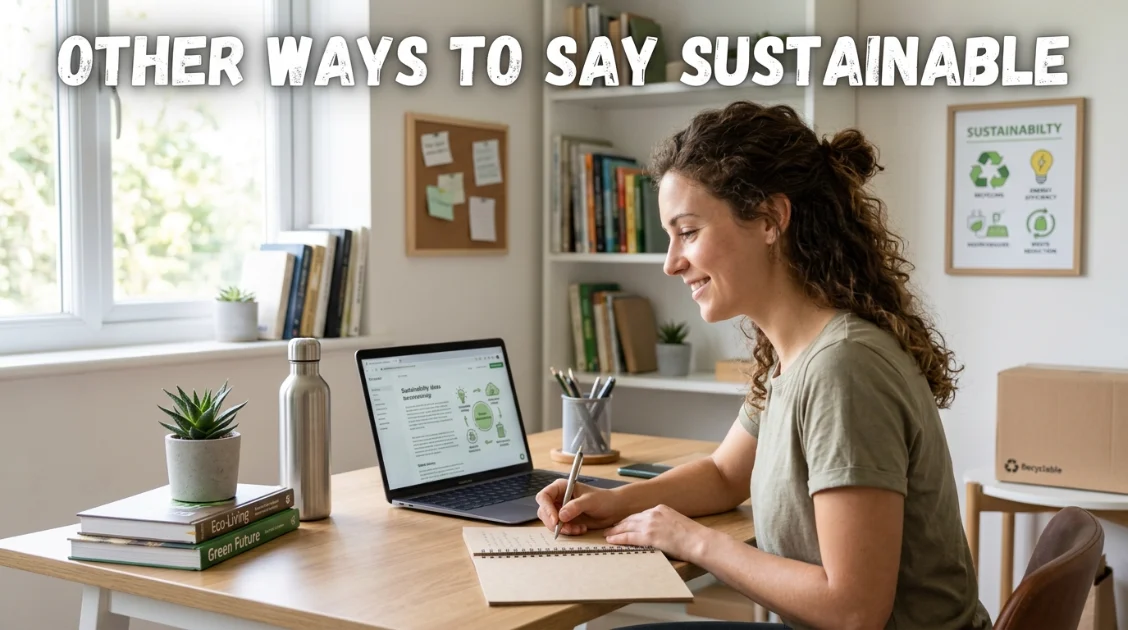
Knowing other ways to say sustainable can help you communicate environmental, business, and long-term ideas with greater precision. The word sustainable is widely used in everyday English, professional writing, marketing, academic discussions, and environmental conversations.
Learning alternatives to sustainable allows you to avoid repetition and choose language that fits your exact meaning. For example, eco-friendly works well for products, while viable may describe a practical business plan. Similarly, long-lasting focuses on durability rather than environmental impact. Understanding these distinctions makes your English more natural and professional. Whether you are writing about climate action, describing a responsible company, or learning how to express excitement in English, choosing precise vocabulary can make your communication clearer, stronger, and more confident.
Quick Categories
Formal alternatives to “sustainable”
- Environmentally responsible
- Resource-efficient
- Ecologically viable
- Long-term viable
Pro Tip: Use formal alternatives in academic papers, reports, policy documents, and professional presentations when precision matters.
Casual alternatives
- Eco-friendly
- Green
- Good for the planet
- Earth-friendly
Pro Tip: Casual alternatives are useful in everyday conversations, social media, and simple explanations.
Professional alternatives
- Long-term viable
- Responsible
- Resource-efficient
- Future-proof
Pro Tip: In business communication, select a phrase that explains whether you mean environmental responsibility, financial viability, or long-term performance.
Informal expressions
- Good for the planet
- Better for the environment
- Built to last
- Made to last
Pro Tip: Informal expressions in English can sound natural in conversation, but professional documents usually need more precise terminology.
“The best alternative to sustainable depends on exactly what you want to describe.”
Common Mistakes
1. Using “eco-friendly” for every meaning of sustainable
Mistake: “This business model is eco-friendly.”
Better: “This business model is financially viable.”
Why: Sustainable can refer to long-term financial or practical success, not only environmental impact.
2. Treating “renewable” and “sustainable” as exact synonyms
Mistake: “Wood is always renewable and sustainable.”
Better: “Wood can be renewable when responsibly managed.”
Why: Renewable refers to replenishment, while sustainable considers broader long-term effects.
3. Using “green” in formal academic writing
Mistake: “The company adopted a green development strategy.”
Better: “The company adopted an environmentally responsible development strategy.”
Why: “Green” is common but can sound less precise in formal writing.
4. Using “long-lasting” to describe environmental practices
Mistake: “Solar energy is long-lasting.”
Better: “Solar energy is a renewable energy source.”
Why: Long-lasting mainly describes durability or duration, not environmental sustainability.
5. Using “sustainable” without explaining what is sustainable
Mistake: “We need a sustainable solution.”
Better: “We need a financially sustainable and environmentally responsible solution.”
Why: Adding detail makes the intended meaning clearer.
What Does “Sustainable” Mean?
Sustainable describes something that can continue over a long period without causing unacceptable environmental, economic, or social harm.
It is an adjective commonly used before nouns, such as sustainable development, sustainable business, and sustainable practices.
Example: “The company is investing in sustainable energy solutions.”
When to Use “Sustainable”
You can use sustainable in several common contexts:
- Environmental discussions: When talking about practices that reduce environmental harm.
- Business communication: When discussing long-term business models or operations.
- Product descriptions: When discussing responsible materials, production, or consumption.
- Academic writing: When analyzing development, resources, or environmental policy.
- Everyday conversations: When discussing choices that can continue over time.
Spoken vs. Written: The word works naturally in both spoken and written English.
Formal vs. Informal: It is neutral and professional, making it suitable for many contexts.
Is It Professional or Polite to Say “Sustainable”?
Polite? ✔️ Yes
Professional? ✔️ Yes
“Sustainable” is a standard professional word. It is widely used in business, environmental science, education, government, and corporate communication.
Business-style example: “We are developing a sustainable strategy that supports long-term growth.”
Pros and Cons of Using “Sustainable”
Pros
- Simple and natural: It is easy to understand in most contexts.
- Professional tone: It works well in business and academic English.
- Common usage: It is widely recognized internationally.
- Broad meaning: It can describe environmental, financial, and practical ideas.
Cons
- Can be vague: The exact meaning may depend on context.
- Overused: Businesses and organizations use the word frequently.
- Limited specificity: It may not explain exactly what makes something sustainable.
- Can create confusion: Readers may interpret it as environmental only.
“Precise vocabulary makes your professional English more informative and credible.”
Other Ways to Say “Sustainable” With Examples
These alternatives will help you sound more fluent, confident, and natural in different situations.
Use them according to tone, context, and audience to describe environmental responsibility, durability, or long-term viability.
1. Phrase: Eco-Friendly
Meaning: Causing little or less environmental harm.
Explanation: This is one of the most common alternatives when discussing environmentally responsible products or practices.
Example Sentence: “The company introduced eco-friendly packaging.”
Best Use: Green products
Worst Use: Financial planning
Tone: Casual, positive, modern
Context Variability: Casual: “This product is eco-friendly.” Professional: “We offer eco-friendly packaging.” Spoken: “It is an eco-friendly option.”
2. Phrase: Environmentally Friendly
Meaning: Having a relatively low negative impact on the environment.
Explanation: This is a clear and widely understood alternative for environmental contexts.
Example Sentence: “We are looking for environmentally friendly transportation options.”
Best Use: Environmental writing
Worst Use: Financial strategy
Tone: Clear, formal, neutral
Context Variability: Casual: “It is environmentally friendly.” Professional: “We use environmentally friendly materials.” Spoken: “This option is environmentally friendly.”
3. Phrase: Renewable
Meaning: Able to be naturally replaced or replenished.
Explanation: This word is especially useful when discussing energy or natural resources.
Example Sentence: “The facility uses renewable energy.”
Best Use: Energy resources
Worst Use: Business plans
Tone: Technical, precise, professional
Context Variability: Casual: “Solar power is renewable.” Professional: “The company invests in renewable energy.” Spoken: “We use renewable energy sources.”
4. Phrase: Long-Lasting
Meaning: Continuing to exist or work for a long time.
Explanation: This alternative focuses on durability rather than environmental responsibility.
Example Sentence: “We designed a long-lasting product that does not need frequent replacement.”
Best Use: Product durability
Worst Use: Climate policy
Tone: Simple, positive, practical
Context Variability: Casual: “It is long-lasting.” Professional: “The product has a long-lasting design.” Spoken: “This material is long-lasting.”
5. Phrase: Responsible
Meaning: Designed or managed with appropriate consideration for consequences.
Explanation: This broad alternative can describe environmentally or socially responsible practices.
Example Sentence: “The company is committed to responsible sourcing.”
Best Use: Business practices
Worst Use: Technical definitions
Tone: Professional, positive, broad
Context Variability: Casual: “It is a responsible choice.” Professional: “We use responsible sourcing practices.” Spoken: “That is a responsible approach.”
6. Phrase: Resource-Efficient
Meaning: Using resources carefully while minimizing waste.
Explanation: This phrase is useful when discussing energy, water, materials, or production.
Example Sentence: “The factory has introduced resource-efficient production methods.”
Best Use: Business operations
Worst Use: Casual chat
Tone: Formal, technical, precise
Context Variability: Casual: “It uses fewer resources.” Professional: “We use resource-efficient technology.” Spoken: “The process is resource-efficient.”
7. Phrase: Environmentally Responsible
Meaning: Designed or carried out with consideration for environmental effects.
Explanation: This phrase provides a more formal alternative to eco-friendly.
Example Sentence: “The company is adopting environmentally responsible manufacturing practices.”
Best Use: Professional writing
Worst Use: Casual conversation
Tone: Formal, professional, responsible
Context Variability: Casual: “It is better for the environment.” Professional: “We use environmentally responsible practices.” Spoken: “The company is environmentally responsible.”
8. Phrase: Green
Meaning: Environmentally conscious or designed to reduce environmental harm.
Explanation: “Green” is a popular and concise alternative in everyday and business communication.
Example Sentence: “The city is investing in green transportation.”
Best Use: Public communication
Worst Use: Technical reports
Tone: Modern, concise, informal
Context Variability: Casual: “We want a greener lifestyle.” Professional: “The company launched a green initiative.” Spoken: “It is a green solution.”
9. Phrase: Viable
Meaning: Capable of working successfully over time.
Explanation: This word is useful when sustainable means practical, workable, or capable of continuing successfully.
Example Sentence: “The proposal offers a viable long-term solution.”
Best Use: Business planning
Worst Use: Environmental labeling
Tone: Professional, precise, practical
Context Variability: Casual: “That plan could work.” Professional: “The strategy is financially viable.” Spoken: “This is a viable option.”
10. Phrase: Long-Term Viable
Meaning: Capable of continuing successfully over a long period.
Explanation: This phrase directly communicates the long-term aspect of sustainability.
Example Sentence: “We need a long-term viable business model.”
Best Use: Business strategy
Worst Use: Casual speech
Tone: Formal, professional, analytical
Context Variability: Casual: “We need a plan that can last.” Professional: “We need a long-term viable model.” Spoken: “The strategy must be viable long term.”
11. Phrase: Future-Proof
Meaning: Designed to remain useful or effective as conditions change.
Explanation: This modern business term focuses on preparation for future needs and challenges.
Example Sentence: “The company is investing in future-proof infrastructure.”
Best Use: Business strategy
Worst Use: Scientific definitions
Tone: Modern, professional, confident
Context Variability: Casual: “We need something that will last.” Professional: “We are developing future-proof systems.” Spoken: “This solution is designed to be future-proof.”
12. Phrase: Durable
Meaning: Able to remain useful despite continued use.
Explanation: This alternative is best when sustainable refers to product lifespan and physical quality.
Example Sentence: “The company uses durable materials to reduce replacement needs.”
Best Use: Product quality
Worst Use: Climate strategy
Tone: Practical, clear, positive
Context Variability: Casual: “It is very durable.” Professional: “We use durable materials.” Spoken: “The product is durable.”
13. Phrase: Low-Impact
Meaning: Causing relatively little harm or disruption.
Explanation: This phrase is useful for environmental practices, products, and development methods.
Example Sentence: “The project uses low-impact construction methods.”
Best Use: Environmental projects
Worst Use: Financial plans
Tone: Professional, neutral, technical
Context Variability: Casual: “It has a low environmental impact.” Professional: “We use low-impact materials.” Spoken: “The process is low-impact.”
14. Phrase: Conservation-Minded
Meaning: Focused on protecting and preserving natural resources.
Explanation: This phrase describes an approach that values resource conservation.
Example Sentence: “The organization promotes conservation-minded farming practices.”
Best Use: Environmental contexts
Worst Use: Corporate finance
Tone: Formal, thoughtful, environmental
Context Variability: Casual: “They care about conservation.” Professional: “The company follows conservation-minded practices.” Spoken: “It is a conservation-minded approach.”
15. Phrase: Earth-Friendly
Meaning: Designed to reduce harm to the natural environment.
Explanation: This is a friendly alternative often used in consumer-focused communication.
Example Sentence: “The brand sells earth-friendly household products.”
Best Use: Product marketing
Worst Use: Academic papers
Tone: Friendly, positive, informal
Context Variability: Casual: “These products are earth-friendly.” Professional: “The brand offers earth-friendly alternatives.” Spoken: “It is an earth-friendly choice.”
16. Phrase: Planet-Friendly
Meaning: Designed to have a lower environmental impact.
Explanation: This phrase is accessible and common in consumer and lifestyle communication.
Example Sentence: “The company is developing planet-friendly packaging.”
Best Use: Consumer writing
Worst Use: Technical reports
Tone: Friendly, modern, positive
Context Variability: Casual: “It is planet-friendly.” Professional: “We are developing planet-friendly products.” Spoken: “That is a planet-friendly option.”
17. Phrase: Socially Responsible
Meaning: Considering the effects of actions on people and communities.
Explanation: This phrase is useful when sustainability includes social responsibility.
Example Sentence: “The company aims to become a more socially responsible employer.”
Best Use: Corporate policies
Worst Use: Energy definitions
Tone: Professional, ethical, formal
Context Variability: Casual: “They care about people.” Professional: “The company follows socially responsible policies.” Spoken: “It is a socially responsible decision.”
18. Phrase: Economically Viable
Meaning: Financially capable of continuing successfully.
Explanation: This phrase is useful when discussing the economic side of sustainability.
Example Sentence: “The project must be economically viable before construction begins.”
Best Use: Business planning
Worst Use: Product marketing
Tone: Formal, analytical, professional
Context Variability: Casual: “The project needs to make financial sense.” Professional: “The proposal must be economically viable.” Spoken: “The plan is economically viable.”
19. Phrase: Practicable
Meaning: Capable of being successfully put into practice.
Explanation: This word works when sustainable means realistic and workable.
Example Sentence: “We need a practicable solution to reduce waste.”
Best Use: Formal writing
Worst Use: Casual speech
Tone: Formal, precise, academic
Context Variability: Casual: “We need a practical solution.” Professional: “The proposal must be practicable.” Spoken: “That approach is practicable.”
20. Phrase: Self-Sustaining
Meaning: Able to continue without ongoing external support.
Explanation: This phrase emphasizes independence and the ability to maintain itself.
Example Sentence: “The community is working toward a self-sustaining energy system.”
Best Use: Development projects
Worst Use: Simple product descriptions
Tone: Professional, positive, descriptive
Context Variability: Casual: “The system can run on its own.” Professional: “The project aims to become self-sustaining.” Spoken: “The system is self-sustaining.”
21. Phrase: Regenerative
Meaning: Designed to restore or improve natural systems or resources.
Explanation: This is a more specific environmental term that can go beyond simply reducing harm.
Example Sentence: “The farm uses regenerative agricultural practices.”
Best Use: Environmental writing
Worst Use: General conversation
Tone: Technical, modern, environmental
Context Variability: Casual: “The farm helps restore the soil.” Professional: “The company supports regenerative agriculture.” Spoken: “They use regenerative practices.”
22. Phrase: Resource-Conserving
Meaning: Designed to reduce unnecessary use of resources.
Explanation: This phrase emphasizes preservation of materials, energy, water, or other resources.
Example Sentence: “The building uses resource-conserving technologies.”
Best Use: Technical writing
Worst Use: Casual chat
Tone: Formal, technical, precise
Context Variability: Casual: “It saves resources.” Professional: “The facility uses resource-conserving systems.” Spoken: “The process is resource-conserving.”
23. Phrase: Waste-Reducing
Meaning: Designed to produce or use less waste.
Explanation: This phrase is useful when sustainability specifically involves waste management.
Example Sentence: “The company introduced waste-reducing packaging.”
Best Use: Environmental projects
Worst Use: Financial strategy
Tone: Clear, practical, professional
Context Variability: Casual: “It creates less waste.” Professional: “We use waste-reducing production methods.” Spoken: “This approach is waste-reducing.”
24. Phrase: Energy-Efficient
Meaning: Using less energy to perform a task or provide a service.
Explanation: This is a precise alternative when sustainability specifically concerns energy consumption.
Example Sentence: “The new building uses energy-efficient lighting.”
Best Use: Energy discussions
Worst Use: Social policy
Tone: Technical, practical, professional
Context Variability: Casual: “These lights save energy.” Professional: “We installed energy-efficient lighting.” Spoken: “The system is energy-efficient.”
25. Phrase: Environmentally Conscious
Meaning: Aware of and concerned about environmental effects.
Explanation: This phrase describes people, organizations, products, or choices that prioritize environmental considerations.
Example Sentence: “Consumers are becoming more environmentally conscious.”
Best Use: Lifestyle writing
Worst Use: Financial analysis
Tone: Positive, professional, thoughtful
Context Variability: Casual: “She is environmentally conscious.” Professional: “The company is environmentally conscious.” Spoken: “We try to be environmentally conscious.”
26. Phrase: Built to Last
Meaning: Designed to remain useful for a long time.
Explanation: This informal expression emphasizes durability and product lifespan.
Example Sentence: “These furniture pieces are built to last.”
Best Use: Product descriptions
Worst Use: Academic writing
Tone: Friendly, confident, informal
Context Variability: Casual: “It is built to last.” Professional: “The product is designed for long-term use.” Spoken: “It is built to last.”
27. Phrase: Made to Last
Meaning: Designed to remain useful for a long time.
Explanation: This phrase is a simple alternative when discussing durable products or materials.
Example Sentence: “Our bags are made to last for years.”
Best Use: Product marketing
Worst Use: Environmental policy
Tone: Friendly, positive, simple
Context Variability: Casual: “It is made to last.” Professional: “The product is designed for long-term durability.” Spoken: “These products are made to last.”
28. Phrase: Better for the Environment
Meaning: Having a lower environmental impact than another option.
Explanation: This conversational phrase is useful when comparing products or practices.
Example Sentence: “Reusable containers are often better for the environment than disposable ones.”
Best Use: Everyday comparisons
Worst Use: Academic definitions
Tone: Casual, clear, conversational
Context Variability: Casual: “This option is better for the environment.” Professional: “This option has a lower environmental impact.” Spoken: “It is better for the environment.”
29. Phrase: Long-Term
Meaning: Continuing or relevant over an extended period.
Explanation: This phrase can replace sustainable when the focus is on continued success rather than environmental impact.
Example Sentence: “We need a long-term strategy for business growth.”
Best Use: Business strategy
Worst Use: Environmental labeling
Tone: Professional, neutral, practical
Context Variability: Casual: “We need a plan for the future.” Professional: “We need a long-term strategy.” Spoken: “This is a long-term solution.”
30. Phrase: Sustainable in the Long Run
Meaning: Able to continue successfully over an extended period.
Explanation: This expression emphasizes durability, practicality, and future viability.
Example Sentence: “We need to determine whether this business model is sustainable in the long run.”
Best Use: Strategic discussions
Worst Use: Technical definitions
Tone: Professional, conversational, practical
Context Variability: Casual: “Can this work in the long run?” Professional: “The model must be sustainable in the long run.” Spoken: “We need something that works in the long run.”
“Choose eco-friendly for environmental impact, durable for product life, and viable for long-term practicality.”
Mini Quiz / Self-Check
1. Which phrase is best for a product with a low environmental impact?
A. Economically viable
B. Eco-friendly
C. Long-term viable
D. Practicable
Answer: B. Eco-friendly
2. Which alternative best describes a financially workable business model?
A. Planet-friendly
B. Renewable
C. Economically viable
D. Earth-friendly
Answer: C. Economically viable
3. Which phrase is most appropriate for energy that can naturally be replenished?
A. Durable
B. Renewable
C. Long-lasting
D. Future-proof
Answer: B. Renewable
4. Which phrase best describes a product designed to remain useful for many years?
A. Built to last
B. Socially responsible
C. Environmentally conscious
D. Resource-conserving
Answer: A. Built to last
Comparison Table: Top Alternatives
| Phrase | Tone | Best Use |
|---|---|---|
| Eco-friendly | Casual, positive | Green products |
| Environmentally friendly | Formal, clear | Environmental writing |
| Renewable | Technical, precise | Energy and resources |
| Long-lasting | Simple, practical | Product durability |
| Responsible | Professional, broad | Business practices |
| Resource-efficient | Formal, technical | Business operations |
| Environmentally responsible | Professional, formal | Corporate writing |
| Viable | Professional, analytical | Business strategies |
| Future-proof | Modern, confident | Long-term planning |
| Energy-efficient | Technical, practical | Energy usage |
FAQs
What are the best other ways to say sustainable?
Common alternatives include eco-friendly, environmentally friendly, renewable, responsible, resource-efficient, viable, durable, and long-lasting.
What is a professional way to say sustainable?
Professional alternatives include environmentally responsible, resource-efficient, economically viable, long-term viable, and socially responsible, depending on the intended meaning.
Is eco-friendly the same as sustainable?
Not exactly. Eco-friendly usually focuses on environmental impact, while sustainable can also include economic, social, and long-term considerations.
What is another way to say sustainable in business?
Depending on context, you can use viable, economically viable, long-term viable, future-proof, or responsible.
What is another way to say sustainable in academic writing?
Academic alternatives include environmentally responsible, resource-efficient, ecologically viable, regenerative, and long-term viable, depending on the subject.
Conclusion
Learning other ways to say sustainable helps you communicate more precisely across environmental, academic, business, and everyday contexts. Words such as eco-friendly, renewable, viable, and durable may look similar, but each highlights a different aspect of sustainability.
Practice choosing alternatives based on meaning rather than simply replacing one word with another. Paying attention to audience, tone, and context will make your English more natural, professional, and confident.
Read More Related Articles:
- 30+ Other Ways to Say One-Stop Shop | Better Words for …
- How to Say Yes in Other Ways | 30+ Fresh Replies That …
- 30+ Other Ways to Say Leave Me Alone | Set Boundaries with …

Emma Richardson is a professional content writer at Replynst.com. She creates clear, engaging and well-researched content designed to answer readers’ questions while following modern SEO best practices. Her focus is on helpful, reader-friendly articles that deliver genuine value.