Quick Answer:
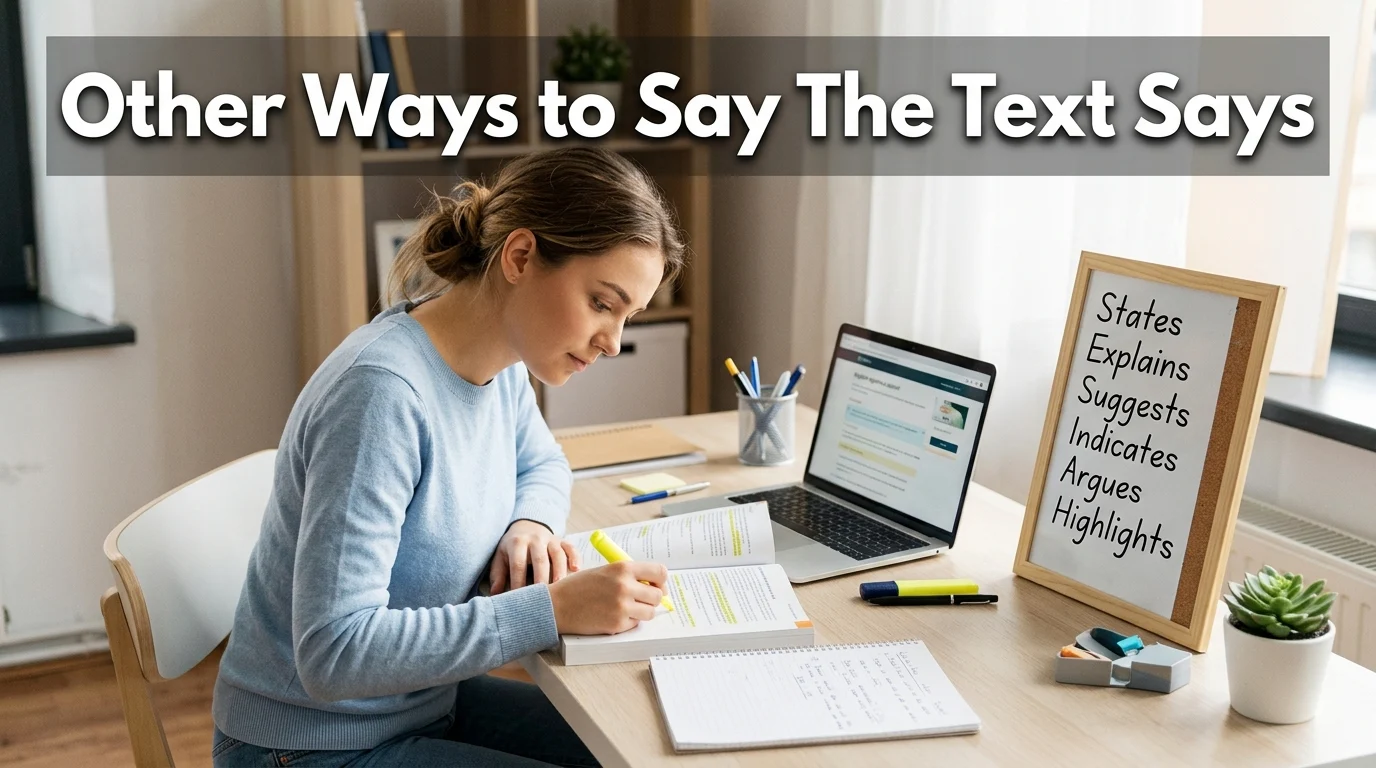
The best alternatives to the text says include the author states, the passage explains, the writer notes, the text suggests, and the passage indicates. These phrases help you avoid repetition and make essays, analysis, and professional writing sound clearer and more polished.
Learning other ways to say the text says can make your writing more precise, engaging, and academically confident. The phrase is useful when discussing information from an article, book, passage, study, or other written source, but repeating it too often can make your analysis sound mechanical. Choosing the right alternative helps you explain evidence while showing a stronger command of English.
This guide presents 30 alternatives to the text says, from formal academic expressions to natural options for everyday writing. You will learn how each phrase changes the tone and meaning of your sentence. Just as learners practice ways to express excitement in English, learning professional reaction phrases and source based expressions can improve fluency and writing variety.
Quick Categories
Formal alternatives to “the text says”
- The author states
- The passage explains
- The writer asserts
- The text indicates
Pro Tip: Use precise reporting verbs when analyzing academic sources or formal written material.
Casual alternatives
- The text mentions
- The writer points out
- The passage talks about
- The author notes
Pro Tip: Casual options work best when your writing is conversational rather than highly academic.
Professional alternatives
- The report indicates
- The source explains
- The document states
- The study suggests
Pro Tip: Match your reporting verb to the type of source you are discussing.
Informal expressions
- The text says
- The writer talks about
- The author brings up
- The passage points out
Pro Tip: Informal expressions in English are useful in conversations, but formal assignments usually need more precise reporting verbs.
“Strong writing does not simply repeat what a source says. It shows exactly how the source communicates its idea.”
Common Mistakes
1. Repeating “the text says” too often
Mistake: “The text says climate change is serious. The text says people should act. The text says governments must respond.”
Better: “The text states that climate change is serious. It also argues that governments must respond.”
Why: Repetition can make your analysis sound basic and mechanical.
2. Using “says” for every type of source
Mistake: “The research says the treatment was effective.”
Better: “The study indicates that the treatment was effective.”
Why: Academic writing benefits from reporting verbs that describe the source more precisely.
3. Using “claims” when there is strong evidence
Mistake: “The study claims that the method works.”
Better: “The study demonstrates that the method works.”
Why: “Claims” can sometimes suggest that the statement is uncertain or disputed.
4. Using “proves” too easily
Mistake: “The article proves that social media causes stress.”
Better: “The article suggests that social media may contribute to stress.”
Why: “Proves” is a strong word and should only be used when the evidence genuinely establishes something conclusively.
5. Choosing a reporting verb that does not match the meaning
Mistake: “The author admits that education is important.”
Better: “The author emphasizes that education is important.”
Why: “Admits” suggests acknowledging something reluctantly, while “emphasizes” simply highlights importance.
What Does “The Text Says” Mean?
The text says means that a written source communicates, presents, or expresses a particular idea or piece of information.
It is commonly used when discussing books, articles, essays, reports, passages, research papers, and other written sources.
The phrase contains the subject the text and the reporting verb says.
Example: “The text says that effective communication requires careful listening.”
When to Use “The Text Says”
You can use the text says in several situations:
- Essay writing: When introducing information from a passage.
- Literary analysis: When explaining what a written work communicates.
- Reading comprehension: When referring directly to information in a passage.
- Academic discussion: When summarizing a source.
- Everyday conversation: When discussing something you have read.
- Professional writing: When referring to information in a document.
Spoken vs. Written: “The text says” is natural in both spoken and written English.
Formal vs. Informal: The phrase is neutral, but more precise alternatives often sound stronger in academic writing.
Is It Professional or Polite to Say “The Text Says”?
Polite? ✔️ Yes
Professional? ✔️ Yes
The phrase is grammatically correct and perfectly acceptable in professional communication. However, repeating it several times can make formal writing less sophisticated.
Business-style example: “The report states that the company will review its current policy next quarter.”
“A precise reporting verb can turn a simple summary into polished, professional analysis.”
Pros and Cons of Using “The Text Says”
Pros
- Simple and natural: Easy for readers to understand.
- Friendly tone: Sounds straightforward and accessible.
- Common usage: Frequently used in everyday and academic English.
- Easy to understand: Clearly introduces information from a source.
Cons
- Can become repetitive: Frequent use may weaken your writing style.
- Limited precision: “Says” does not explain how the author communicates an idea.
- Less academic variety: Essays often benefit from stronger reporting verbs.
- Not always context specific: It may not distinguish between stating, suggesting, arguing, or emphasizing.
Other Ways to Say “The Text Says” With Examples
These alternatives will help you sound more fluent, confident, and natural in different situations.
Use them according to tone, context, and audience to describe information from written sources accurately.
1. Phrase: The Author States
Meaning: The author directly presents an idea or fact.
Explanation: This is a clear and formal alternative for academic writing.
Example Sentence: “The author states that effective leadership requires empathy.”
Best Use: Academic writing
Worst Use: Casual conversation
Tone: Formal, clear, precise
Context Variability: Casual: “The writer says.” Professional: “The author states.” Spoken: “The author states that the policy needs revision.”
2. Phrase: The Passage Explains
Meaning: The passage gives information that helps the reader understand something.
Explanation: Use this when the source provides an explanation rather than simply making a statement.
Example Sentence: “The passage explains why communication skills are essential.”
Best Use: Essay analysis
Worst Use: Simple quotation
Tone: Formal, informative, academic
Context Variability: Casual: “The passage explains it.” Professional: “The passage explains the process.” Spoken: “The passage explains why this happens.”
3. Phrase: The Writer Notes
Meaning: The writer points out or mentions information.
Explanation: This is useful when highlighting a specific observation made by the writer.
Example Sentence: “The writer notes that employees value flexible working arrangements.”
Best Use: Academic essays
Worst Use: Casual storytelling
Tone: Professional, neutral, polished
Context Variability: Casual: “The writer mentions.” Professional: “The writer notes.” Spoken: “The writer notes an important difference.”
4. Phrase: The Text Indicates
Meaning: The text gives evidence of or points toward an idea.
Explanation: This phrase is useful when the meaning is supported by information in the source.
Example Sentence: “The text indicates that customer expectations have changed.”
Best Use: Formal analysis
Worst Use: Direct quotation
Tone: Formal, analytical, precise
Context Variability: Casual: “The text suggests.” Professional: “The text indicates.” Spoken: “The text indicates a change in attitude.”
5. Phrase: The Writer Asserts
Meaning: The writer confidently presents a particular position.
Explanation: Use this when the author makes a strong statement or argument.
Example Sentence: “The writer asserts that education should be accessible to everyone.”
Best Use: Argument analysis
Worst Use: Casual discussion
Tone: Formal, strong, academic
Context Variability: Casual: “The writer argues.” Professional: “The writer asserts.” Spoken: “The writer strongly asserts this position.”
6. Phrase: The Text Suggests
Meaning: The text gives the impression or possibility of an idea.
Explanation: This is useful when the source implies something rather than directly stating it.
Example Sentence: “The text suggests that technology has changed workplace communication.”
Best Use: Literary analysis
Worst Use: Direct factual statement
Tone: Analytical, neutral, cautious
Context Variability: Casual: “The text seems to suggest.” Professional: “The text suggests.” Spoken: “The text suggests a different explanation.”
7. Phrase: The Passage Reveals
Meaning: The passage makes previously hidden information clear.
Explanation: This phrase works especially well in literary and analytical writing.
Example Sentence: “The passage reveals the character’s growing uncertainty.”
Best Use: Literary analysis
Worst Use: Simple statistics
Tone: Analytical, expressive, formal
Context Variability: Casual: “The passage shows.” Professional: “The passage reveals.” Spoken: “The passage reveals an important detail.”
8. Phrase: The Author Argues
Meaning: The author presents and supports a particular viewpoint.
Explanation: Use this when the source contains reasoning intended to persuade the reader.
Example Sentence: “The author argues that public education requires greater investment.”
Best Use: Argumentative essays
Worst Use: Neutral facts
Tone: Formal, analytical, confident
Context Variability: Casual: “The author thinks.” Professional: “The author argues.” Spoken: “The author argues that change is necessary.”
9. Phrase: The Article Explains
Meaning: The article provides information or clarification about a topic.
Explanation: This is particularly useful when discussing online articles, reports, or informational pieces.
Example Sentence: “The article explains how effective communication improves teamwork.”
Best Use: Source summaries
Worst Use: Literary analysis
Tone: Clear, professional, informative
Context Variability: Casual: “The article talks about.” Professional: “The article explains.” Spoken: “The article explains the process clearly.”
10. Phrase: The Source States
Meaning: The source directly provides a statement.
Explanation: This is useful when you want to refer to a source without repeatedly naming its author.
Example Sentence: “The source states that the policy was introduced in 2024.”
Best Use: Research writing
Worst Use: Personal conversation
Tone: Formal, neutral, precise
Context Variability: Casual: “The source says.” Professional: “The source states.” Spoken: “The source states that the change was necessary.”
11. Phrase: The Report Indicates
Meaning: The report provides information pointing toward a particular conclusion.
Explanation: This is a strong professional expression for business and research contexts.
Example Sentence: “The report indicates that customer satisfaction has improved.”
Best Use: Business writing
Worst Use: Casual chat
Tone: Professional, analytical, formal
Context Variability: Casual: “The report shows.” Professional: “The report indicates.” Spoken: “The report indicates positive results.”
12. Phrase: The Study Suggests
Meaning: Research findings point toward a possible conclusion.
Explanation: This phrase appropriately avoids claiming more certainty than the research supports.
Example Sentence: “The study suggests that regular exercise may improve concentration.”
Best Use: Academic writing
Worst Use: Personal opinion
Tone: Academic, cautious, precise
Context Variability: Casual: “The study says.” Professional: “The study suggests.” Spoken: “The study suggests a possible connection.”
13. Phrase: The Document States
Meaning: A document directly presents information.
Explanation: This works well for policies, contracts, official documents, and workplace materials.
Example Sentence: “The document states that employees must complete the training.”
Best Use: Professional communication
Worst Use: Literary analysis
Tone: Formal, direct, professional
Context Variability: Casual: “The document says.” Professional: “The document states.” Spoken: “The document states the requirements clearly.”
14. Phrase: The Passage Points Out
Meaning: The passage draws attention to a particular fact or idea.
Explanation: This phrase is useful when the source highlights something important.
Example Sentence: “The passage points out the importance of clear communication.”
Best Use: Essay writing
Worst Use: Formal reports
Tone: Neutral, clear, conversational
Context Variability: Casual: “The passage points out.” Professional: “The passage highlights.” Spoken: “The passage points out an important issue.”
15. Phrase: The Author Highlights
Meaning: The author gives special attention to an important idea.
Explanation: Use this when the writer emphasizes a particular point.
Example Sentence: “The author highlights the importance of employee well-being.”
Best Use: Academic analysis
Worst Use: Minor details
Tone: Formal, analytical, confident
Context Variability: Casual: “The writer points out.” Professional: “The author highlights.” Spoken: “The author highlights a major concern.”
16. Phrase: The Text Emphasizes
Meaning: The text gives particular importance to an idea.
Explanation: This is an effective alternative when an idea appears especially important in the source.
Example Sentence: “The text emphasizes the need for responsible communication.”
Best Use: Academic writing
Worst Use: Simple facts
Tone: Formal, analytical, precise
Context Variability: Casual: “The text focuses on.” Professional: “The text emphasizes.” Spoken: “The text emphasizes this issue.”
17. Phrase: The Writer Observes
Meaning: The writer makes an observation about a topic.
Explanation: This phrase is useful when the source presents an insight or observation.
Example Sentence: “The writer observes that workplace expectations are changing.”
Best Use: Analytical writing
Worst Use: Direct instructions
Tone: Formal, thoughtful, neutral
Context Variability: Casual: “The writer notices.” Professional: “The writer observes.” Spoken: “The writer observes an interesting pattern.”
18. Phrase: The Author Mentions
Meaning: The author briefly refers to something.
Explanation: Use this when the information is mentioned but not necessarily developed in detail.
Example Sentence: “The author mentions several benefits of remote work.”
Best Use: Source summaries
Worst Use: Major arguments
Tone: Neutral, simple, professional
Context Variability: Casual: “The writer mentions.” Professional: “The author mentions.” Spoken: “The author briefly mentions this point.”
19. Phrase: The Text Describes
Meaning: The text gives details about something.
Explanation: This is appropriate when a source provides characteristics, events, situations, or processes.
Example Sentence: “The text describes the challenges faced by new employees.”
Best Use: Descriptive analysis
Worst Use: Strong arguments
Tone: Clear, neutral, academic
Context Variability: Casual: “The text talks about.” Professional: “The text describes.” Spoken: “The text describes the situation.”
20. Phrase: The Passage Demonstrates
Meaning: The passage provides evidence that makes an idea clear.
Explanation: Use this when the information strongly illustrates a point.
Example Sentence: “The passage demonstrates the consequences of poor communication.”
Best Use: Academic analysis
Worst Use: Weak evidence
Tone: Formal, confident, analytical
Context Variability: Casual: “The passage shows.” Professional: “The passage demonstrates.” Spoken: “The passage demonstrates this clearly.”
21. Phrase: The Source Highlights
Meaning: The source draws attention to an important point.
Explanation: This phrase is useful across academic and professional writing.
Example Sentence: “The source highlights the importance of employee training.”
Best Use: Research writing
Worst Use: Casual conversation
Tone: Professional, analytical, clear
Context Variability: Casual: “The source points out.” Professional: “The source highlights.” Spoken: “The source highlights an important concern.”
22. Phrase: The Article Points Out
Meaning: The article draws attention to a particular fact or idea.
Explanation: This expression sounds natural in both formal and semi formal writing.
Example Sentence: “The article points out several weaknesses in the current system.”
Best Use: Article analysis
Worst Use: Legal documents
Tone: Neutral, clear, conversational
Context Variability: Casual: “The article points out.” Professional: “The article identifies.” Spoken: “The article points out a useful detail.”
23. Phrase: The Writer Explains
Meaning: The writer provides information that makes something easier to understand.
Explanation: This phrase is useful when discussing an explanation or clarification.
Example Sentence: “The writer explains why active listening improves workplace relationships.”
Best Use: Essay writing
Worst Use: Simple statistics
Tone: Clear, informative, professional
Context Variability: Casual: “The writer explains.” Professional: “The writer explains the process.” Spoken: “The writer explains why this happens.”
24. Phrase: The Text Presents
Meaning: The text introduces or communicates an idea, argument, or information.
Explanation: This is a flexible academic phrase that works with many types of sources.
Example Sentence: “The text presents a different perspective on leadership.”
Best Use: Academic analysis
Worst Use: Casual speech
Tone: Formal, analytical, polished
Context Variability: Casual: “The text gives.” Professional: “The text presents.” Spoken: “The text presents another viewpoint.”
25. Phrase: The Author Claims
Meaning: The author states that something is true or valid.
Explanation: This phrase is useful when discussing a claim, especially when the evidence needs evaluation.
Example Sentence: “The author claims that the policy will improve productivity.”
Best Use: Argument analysis
Worst Use: Established facts
Tone: Formal, analytical, cautious
Context Variability: Casual: “The writer says.” Professional: “The author claims.” Spoken: “The author claims that the policy will help.”
26. Phrase: The Passage Shows
Meaning: The passage makes an idea or situation clear.
Explanation: This is a simple and natural alternative that works well in general writing.
Example Sentence: “The passage shows how quickly the situation changed.”
Best Use: General analysis
Worst Use: Highly technical writing
Tone: Simple, clear, neutral
Context Variability: Casual: “The passage shows.” Professional: “The passage demonstrates.” Spoken: “The passage shows the difference.”
27. Phrase: The Source Suggests
Meaning: Information from the source points toward an idea without stating it with complete certainty.
Explanation: This is useful when interpreting evidence or drawing a reasonable conclusion.
Example Sentence: “The source suggests that consumer behavior has changed.”
Best Use: Research analysis
Worst Use: Direct factual statements
Tone: Cautious, formal, analytical
Context Variability: Casual: “The source seems to suggest.” Professional: “The source suggests.” Spoken: “The source suggests a possible explanation.”
28. Phrase: The Report Shows
Meaning: The report presents information that makes a result or trend visible.
Explanation: This is common in business, research, and data focused writing.
Example Sentence: “The report shows a significant increase in customer satisfaction.”
Best Use: Business writing
Worst Use: Literary analysis
Tone: Professional, direct, clear
Context Variability: Casual: “The report shows.” Professional: “The report demonstrates.” Spoken: “The report shows a clear trend.”
29. Phrase: The Author Points Out
Meaning: The author draws attention to a specific idea or detail.
Explanation: This is a natural alternative when the writer intentionally highlights something.
Example Sentence: “The author points out the importance of adapting to change.”
Best Use: Essay analysis
Worst Use: Highly formal reports
Tone: Natural, neutral, conversational
Context Variability: Casual: “The author points out.” Professional: “The author highlights.” Spoken: “The author points out an important issue.”
30. Phrase: The Text Communicates
Meaning: The text conveys an idea, message, or feeling to the reader.
Explanation: This phrase is especially useful when analyzing the overall message of a written work.
Example Sentence: “The text communicates a strong message about personal responsibility.”
Best Use: Literary analysis
Worst Use: Simple facts
Tone: Formal, analytical, expressive
Context Variability: Casual: “The text gets across.” Professional: “The text communicates.” Spoken: “The text communicates an important message.”
“Do not simply replace ‘says’ with a bigger word. Choose a reporting verb that accurately describes what the source is doing.”
Mini Quiz / Self Check
1. Which phrase is best for a formal academic essay?
- A. The writer talks about
- B. The text states
- C. The author brings up
- D. The writer says
Answer: B. The text states
2. Which phrase is best when a study provides evidence for a possible conclusion?
- A. The study suggests
- B. The study admits
- C. The study chats
- D. The study talks
Answer: A. The study suggests
3. Which phrase best describes a source that gives special attention to an idea?
- A. The author highlights
- B. The author asks
- C. The author tells
- D. The author speaks
Answer: A. The author highlights
4. Which sentence sounds most professional?
A. The report says sales went up.
B. The report talks about sales.
C. The report indicates that sales increased.
D. The report brings up sales.
Answer: C. The report indicates that sales increased.
Comparison Table: Top Alternatives
| Phrase | Tone | Best Use |
|---|---|---|
| The author states | Formal, precise | Academic writing |
| The passage explains | Formal, informative | Essay analysis |
| The writer notes | Professional, neutral | Academic essays |
| The text indicates | Formal, analytical | Formal analysis |
| The author argues | Analytical, confident | Argumentative essays |
| The text suggests | Cautious, analytical | Literary analysis |
| The report indicates | Professional, precise | Business writing |
| The study suggests | Academic, cautious | Research writing |
| The author highlights | Formal, analytical | Source analysis |
| The source states | Formal, neutral | Research writing |
FAQs
What are the best other ways to say the text says?
Some of the most useful alternatives are the author states, the passage explains, the writer notes, the text indicates, and the author argues.
What is a professional way to say “the text says”?
In professional or academic writing, you can use the source states, the report indicates, the document explains, or the text suggests, depending on the meaning.
How can I avoid repeating “the text says” in an essay?
Use different reporting verbs such as states, argues, explains, suggests, emphasizes, highlights, demonstrates, and indicates according to the source’s purpose.
Is “the author claims” the same as “the author says”?
Not exactly. Claims suggests that the author presents something as true, while says is more neutral.
What is the difference between “the text states” and “the text suggests”?
States usually introduces a direct or explicit idea. Suggests indicates that the source points toward an idea without necessarily stating it directly.
Conclusion
Learning other ways to say the text says gives you more control over tone, precision, and sentence variety. Instead of relying on one reporting verb, you can choose expressions such as states, explains, suggests, argues, highlights, indicates, or demonstrates based on what your source actually communicates.
Practice these alternatives when writing essays, reports, summaries, and professional messages. Over time, you will develop stronger source analysis skills and sound more confident in English. The key is not simply to use advanced vocabulary, but to select the reporting verb that accurately matches your meaning and context.
Read More Related Articles:
- 30+ Other Ways to Say Demonstrate | Smart Alternatives for Clear …
- Other Ways to Say Especially | 30+ Fresh Alternatives for …
- Other Ways to Say Fuck |30+ Powerful Alternatives for Every …

Emma Richardson is a professional content writer at Replynst.com. She creates clear, engaging and well-researched content designed to answer readers’ questions while following modern SEO best practices. Her focus is on helpful, reader-friendly articles that deliver genuine value.