Quick Answer:
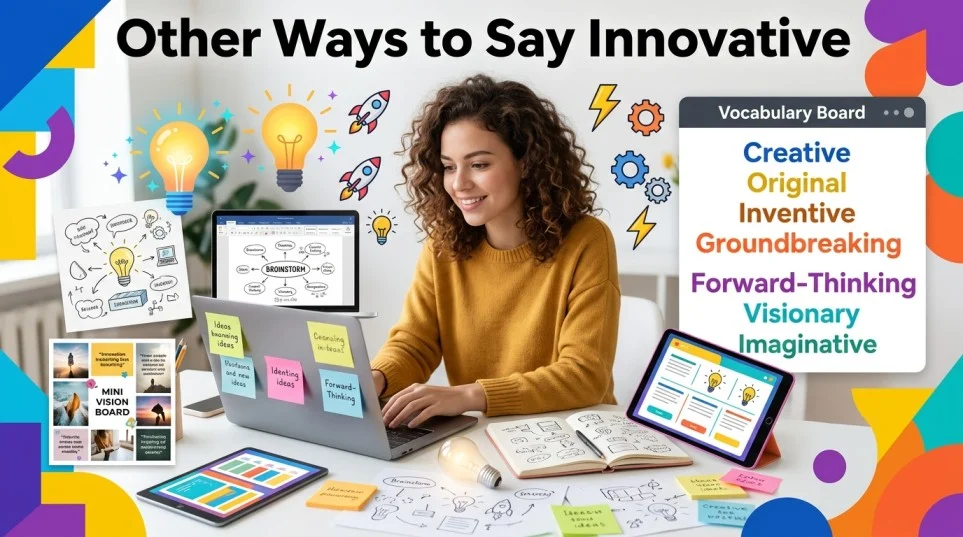
The best alternatives to innovative include creative, groundbreaking, inventive, pioneering, forward-thinking, original, and revolutionary. These expressions help you describe fresh ideas, modern approaches, and unique solutions in professional writing, academic discussions, and everyday English.
The word innovative describes something new, creative, or original that introduces fresh ideas and improves existing methods. It is commonly used in business, education, technology, marketing, and everyday conversations to highlight creativity and progress. However, repeating the same word can make your writing sound less engaging and limit your vocabulary.
Learning other ways to say innovative helps you communicate ideas more effectively while choosing expressions that match your audience and purpose. Whether you are describing a creative business strategy, an advanced technology, or an original solution, the right alternative can make your message more precise and memorable. In this guide, you will discover 30 useful alternatives, their meanings, practical examples, and appropriate contexts to improve your English fluency and professional communication skills.
Quick Categories
Formal alternatives to “Innovative”
- Groundbreaking
- Pioneering
- Revolutionary
- Transformative
Pro Tip: Use these expressions in academic papers, business reports, and professional presentations when describing significant developments.
Casual alternatives
- Creative
- Original
- Fresh
- Imaginative
Pro Tip: Choose simple and familiar words when discussing new ideas with friends, colleagues, or general audiences.
Professional alternatives
- Forward-thinking
- Visionary
- Progressive
- Cutting-edge
Pro Tip: Use professional vocabulary to highlight strategic thinking, technological advancement, and creative problem-solving.
Informal expressions
- Outside-the-box
- Ahead of its time
- Next-level
- Something new
Pro Tip: Informal expressions in English work well in conversations and creative discussions, but formal alternatives are more suitable for business documents.
“Strong vocabulary does more than describe an idea. It helps people understand its originality and impact.”
Common Mistakes
1. Using “Innovative” When You Mean “Creative”
Mistake: “She is innovative because she paints beautiful pictures.”
Better: “She is creative because she paints beautiful pictures.”
Why: Creative describes artistic imagination, while innovative often involves introducing new methods or ideas.
2. Using “Revolutionary” for Every New Idea
Mistake: “This new notebook design is revolutionary.”
Better: “This new notebook design is original.”
Why: Revolutionary suggests a major or significant change, not simply something different.
3. Confusing “Modern” With “Innovative”
Mistake: “The company uses innovative furniture because it is modern.”
Better: “The company uses modern furniture with innovative features.”
Why: Modern refers to something contemporary, while innovative highlights originality or improvement.
4. Using “Pioneering” Without Context
Mistake: “She created a pioneering presentation.”
Better: “She developed a pioneering approach to online education.”
Why: Pioneering usually describes introducing something new within a particular field.
5. Using “Cutting-Edge” in Every Situation
Mistake: “He has a cutting-edge way of organizing his desk.”
Better: “He has an efficient way of organizing his desk.”
Why: Cutting-edge is generally associated with advanced technology, methods, or developments.
What Does “Innovative” Mean?
Innovative is an adjective that describes something involving new ideas, original thinking, or improved methods.
It is commonly used to describe products, strategies, technologies, solutions, and people who introduce creative approaches.
Grammar Explanation: Innovative is an adjective. It commonly appears before nouns or after linking verbs such as is, seems, and becomes.
Example: “The company introduced an innovative approach to customer service.”
When to Use “Innovative”
Use innovative when discussing:
- Business: Describing new strategies, products, or services.
- Education: Highlighting creative teaching methods.
- Technology: Discussing advanced tools and developments.
- Marketing: Explaining original campaigns and ideas.
- Problem-solving: Describing effective and creative solutions.
- Academic writing: Discussing original research or approaches.
Spoken vs. Written: Innovative works naturally in both spoken and written English.
Formal vs. Informal: It is appropriate in professional communication, academic writing, presentations, and everyday conversations.
Is It Professional or Polite to Say “Innovative”?
Polite? ✔️ Yes
Professional? ✔️ Yes
Innovative is a professional and positive adjective. It communicates creativity, originality, and progress without sounding overly casual.
However, choosing a more specific alternative can make your message more meaningful.
Business-style example: “Our team developed an innovative strategy to improve customer engagement and streamline operations.”
Pros and Cons of Using “Innovative”
Pros
- Simple and natural: Easy to understand and use in different situations.
- Positive impression: Highlights creativity and originality.
- Common usage: Widely recognized in professional and everyday English.
- Easy to understand: Clearly communicates the introduction of new ideas.
Cons
- Too general: Does not always explain what makes something new.
- Overused: Frequent repetition can make writing less engaging.
- Limited emotional range: May not fully communicate excitement or uniqueness.
- Not always precise: Some situations require more specific vocabulary.
“Instead of calling every new idea innovative, choose a word that explains exactly what makes it different.”
Other Ways to Say “Innovative” With Examples
These alternatives will help you sound more fluent, confident, and natural in different situations.
Use them according to tone, context, and audience to describe originality, creativity, and forward-thinking ideas.
1. Phrase: Creative
Meaning: Involving imagination and original thinking.
Explanation: Creative describes someone or something that produces fresh and interesting ideas.
Example Sentence: “Our creative team developed a unique marketing campaign.”
Best Use: Everyday communication
Worst Use: Technical descriptions
Tone: Positive, friendly, natural
Context Variability: Casual: “That is a creative idea.” Professional: “We developed a creative marketing strategy.” Spoken: “She is very creative.”
2. Phrase: Groundbreaking
Meaning: Introducing something completely new or significantly important.
Explanation: This word highlights developments that create meaningful changes in a particular field.
Example Sentence: “The researchers introduced a groundbreaking solution to the problem.”
Best Use: Major achievements
Worst Use: Minor changes
Tone: Impressive, formal, impactful
Context Variability: Casual: “That is a groundbreaking idea.” Professional: “The company introduced groundbreaking technology.” Spoken: “Their research is groundbreaking.”
3. Phrase: Pioneering
Meaning: Being among the first to develop or introduce something new.
Explanation: Pioneering describes original efforts that establish new directions in a field.
Example Sentence: “Her pioneering work transformed the way educators approach online learning.”
Best Use: Professional achievements
Worst Use: Routine activities
Tone: Formal, inspiring, authoritative
Context Variability: Casual: “That was pioneering work.” Professional: “The organization introduced a pioneering business model.” Spoken: “She is known for her pioneering research.”
4. Phrase: Inventive
Meaning: Showing the ability to create original ideas or solutions.
Explanation: Inventive emphasizes imagination and the ability to develop something different.
Example Sentence: “The designer created an inventive solution for limited storage space.”
Best Use: Creative solutions
Worst Use: Traditional procedures
Tone: Positive, intelligent, creative
Context Variability: Casual: “That is an inventive idea.” Professional: “We need an inventive approach to this challenge.” Spoken: “He is incredibly inventive.”
5. Phrase: Forward-Thinking
Meaning: Considering future opportunities and possibilities.
Explanation: This phrase describes people or organizations that plan ahead and embrace new developments.
Example Sentence: “The company adopted a forward-thinking approach to digital transformation.”
Best Use: Business strategies
Worst Use: Historical descriptions
Tone: Professional, progressive, strategic
Context Variability: Casual: “She has a forward-thinking mindset.” Professional: “We support forward-thinking business practices.” Spoken: “He is a forward-thinking leader.”
6. Phrase: Revolutionary
Meaning: Introducing a major change that transforms an existing system or approach.
Explanation: Revolutionary is appropriate when an idea significantly changes how something works.
Example Sentence: “The new technology introduced a revolutionary way to process information.”
Best Use: Major developments
Worst Use: Small improvements
Tone: Powerful, formal, dramatic
Context Variability: Casual: “That is a revolutionary idea.” Professional: “The product offers a revolutionary approach to automation.” Spoken: “This technology could be revolutionary.”
7. Phrase: Original
Meaning: New, unique, and not copied from another source.
Explanation: Original emphasizes uniqueness and independent thinking.
Example Sentence: “Her original approach helped the team solve a difficult problem.”
Best Use: Unique ideas
Worst Use: Routine methods
Tone: Simple, positive, natural
Context Variability: Casual: “That is an original idea.” Professional: “We developed an original business concept.” Spoken: “I like your original approach.”
8. Phrase: Cutting-Edge
Meaning: Representing the latest developments in a particular field.
Explanation: This expression is frequently used for advanced technology, research, and modern methods.
Example Sentence: “The company uses cutting-edge technology to improve productivity.”
Best Use: Technology discussions
Worst Use: Ordinary objects
Tone: Modern, professional, impressive
Context Variability: Casual: “That gadget is cutting-edge.” Professional: “Our facility uses cutting-edge equipment.” Spoken: “They are working with cutting-edge technology.”
9. Phrase: Visionary
Meaning: Showing the ability to imagine future possibilities.
Explanation: Visionary describes people, ideas, or plans that demonstrate original long-term thinking.
Example Sentence: “The visionary founder introduced a new approach to sustainable business.”
Best Use: Leadership qualities
Worst Use: Basic tasks
Tone: Inspiring, ambitious, professional
Context Variability: Casual: “He has a visionary mindset.” Professional: “She is a visionary business leader.” Spoken: “That was a visionary decision.”
10. Phrase: Progressive
Meaning: Supporting development, improvement, and positive change.
Explanation: Progressive is useful for describing modern approaches that encourage advancement.
Example Sentence: “The organization introduced progressive policies to support employee development.”
Best Use: Organizational development
Worst Use: Unchanging traditions
Tone: Formal, modern, constructive
Context Variability: Casual: “That is a progressive idea.” Professional: “We encourage progressive workplace practices.” Spoken: “The company takes a progressive approach.”
11. Phrase: Imaginative
Meaning: Showing creativity and the ability to think beyond ordinary ideas.
Explanation: Imaginative highlights the use of imagination to create interesting possibilities.
Example Sentence: “The teacher developed an imaginative method to engage students.”
Best Use: Creative projects
Worst Use: Technical accuracy
Tone: Creative, expressive, positive
Context Variability: Casual: “That is an imaginative idea.” Professional: “The team proposed an imaginative solution.” Spoken: “She has an imaginative approach.”
12. Phrase: Transformative
Meaning: Causing significant improvements or changes.
Explanation: Transformative emphasizes the impact of an idea rather than simply its originality.
Example Sentence: “Digital learning has had a transformative effect on education.”
Best Use: Significant improvements
Worst Use: Minor updates
Tone: Formal, powerful, impactful
Context Variability: Casual: “That was a transformative experience.” Professional: “The initiative created transformative business opportunities.” Spoken: “It was a transformative project.”
13. Phrase: Novel
Meaning: New, unusual, or previously unfamiliar.
Explanation: Novel is a concise formal alternative when describing an original idea or approach.
Example Sentence: “The researchers proposed a novel method for improving energy efficiency.”
Best Use: Academic writing
Worst Use: Casual conversations
Tone: Formal, intellectual, precise
Context Variability: Casual: “That is a new idea.” Professional: “The team developed a novel solution.” Spoken: “They suggested a novel approach.”
14. Phrase: Fresh
Meaning: New, interesting, or different from what is commonly used.
Explanation: Fresh is a simple alternative that makes ideas sound appealing and original.
Example Sentence: “We need a fresh perspective to improve our marketing strategy.”
Best Use: Creative discussions
Worst Use: Technical reports
Tone: Friendly, positive, natural
Context Variability: Casual: “That is a fresh idea.” Professional: “We need a fresh approach to customer engagement.” Spoken: “She brought fresh ideas to the meeting.”
15. Phrase: Trailblazing
Meaning: Introducing new ideas or methods that others may follow.
Explanation: Trailblazing highlights pioneering achievements and the creation of new opportunities.
Example Sentence: “The organization is recognized for its trailblazing work in renewable energy.”
Best Use: Major achievements
Worst Use: Ordinary tasks
Tone: Inspiring, powerful, professional
Context Variability: Casual: “That was trailblazing work.” Professional: “The company introduced a trailblazing business model.” Spoken: “She is a trailblazing entrepreneur.”
16. Phrase: Unconventional
Meaning: Different from traditional or commonly accepted methods.
Explanation: Unconventional emphasizes unusual thinking, although it does not necessarily mean the idea is effective.
Example Sentence: “The team adopted an unconventional approach to solve the challenge.”
Best Use: Alternative methods
Worst Use: Traditional procedures
Tone: Creative, distinctive, neutral
Context Variability: Casual: “That is an unconventional idea.” Professional: “We explored unconventional problem-solving methods.” Spoken: “He has an unconventional way of thinking.”
17. Phrase: Resourceful
Meaning: Able to find clever ways to solve problems using available resources.
Explanation: Resourceful focuses on practical creativity and effective problem-solving.
Example Sentence: “The resourceful team developed a solution despite limited resources.”
Best Use: Problem-solving
Worst Use: Product descriptions
Tone: Practical, positive, capable
Context Variability: Casual: “She is really resourceful.” Professional: “Our resourceful employees find effective solutions.” Spoken: “He handled the challenge resourcefully.”
18. Phrase: Advanced
Meaning: Developed beyond basic or traditional levels.
Explanation: Advanced is useful when describing improved technology, methods, or systems.
Example Sentence: “The company introduced an advanced system for managing customer data.”
Best Use: Technology descriptions
Worst Use: Artistic originality
Tone: Professional, technical, neutral
Context Variability: Casual: “That is an advanced tool.” Professional: “We implemented advanced software solutions.” Spoken: “They use advanced technology.”
19. Phrase: State-of-the-Art
Meaning: Using the most recent and advanced technology or methods available.
Explanation: This phrase is especially useful for describing modern facilities, equipment, and systems.
Example Sentence: “The laboratory is equipped with state-of-the-art research facilities.”
Best Use: Modern technology
Worst Use: Simple ideas
Tone: Professional, impressive, technical
Context Variability: Casual: “That machine is state-of-the-art.” Professional: “Our facility offers state-of-the-art equipment.” Spoken: “They have a state-of-the-art laboratory.”
20. Phrase: Ingenious
Meaning: Showing exceptional cleverness and originality.
Explanation: Ingenious describes solutions or ideas that are both clever and practical.
Example Sentence: “The engineer designed an ingenious device to reduce energy consumption.”
Best Use: Clever solutions
Worst Use: Ordinary changes
Tone: Intelligent, positive, impressive
Context Variability: Casual: “That is an ingenious idea.” Professional: “The team developed an ingenious solution.” Spoken: “Her design is absolutely ingenious.”
21. Phrase: Unprecedented
Meaning: Never having happened or existed before.
Explanation: Unprecedented highlights something entirely new or without an earlier example.
Example Sentence: “The project introduced an unprecedented approach to community engagement.”
Best Use: Unique developments
Worst Use: Common improvements
Tone: Formal, strong, authoritative
Context Variability: Casual: “That is something unprecedented.” Professional: “The initiative achieved unprecedented results.” Spoken: “This is an unprecedented development.”
22. Phrase: Futuristic
Meaning: Suggesting advanced ideas, designs, or technologies associated with the future.
Explanation: Futuristic is commonly used to describe modern designs and imaginative concepts.
Example Sentence: “The company introduced a futuristic design for its latest electric vehicle.”
Best Use: Design concepts
Worst Use: Traditional approaches
Tone: Modern, imaginative, distinctive
Context Variability: Casual: “That looks futuristic.” Professional: “The product features a futuristic design.” Spoken: “I love its futuristic appearance.”
23. Phrase: Enterprising
Meaning: Showing initiative and willingness to develop new opportunities.
Explanation: Enterprising describes people who use creativity and initiative to achieve practical goals.
Example Sentence: “The enterprising entrepreneur developed a successful online business.”
Best Use: Business initiatives
Worst Use: Technical products
Tone: Ambitious, positive, professional
Context Variability: Casual: “She is very enterprising.” Professional: “We value enterprising employees.” Spoken: “He is an enterprising business owner.”
24. Phrase: Outside-the-Box
Meaning: Thinking in ways that go beyond conventional approaches.
Explanation: This informal expression describes creative thinking that challenges familiar methods.
Example Sentence: “We need to think outside the box to attract more customers.”
Best Use: Team discussions
Worst Use: Formal academic writing
Tone: Casual, creative, conversational
Context Variability: Casual: “Think outside the box.” Professional: “We encourage creative problem-solving.” Spoken: “Let’s try thinking outside the box.”
25. Phrase: Next-Level
Meaning: Significantly improved or more advanced than something ordinary.
Explanation: Next-level is an informal expression used to highlight exceptional creativity or quality.
Example Sentence: “Her next-level design completely changed our presentation.”
Best Use: Casual praise
Worst Use: Formal reports
Tone: Informal, enthusiastic, expressive
Context Variability: Casual: “That idea is next-level.” Professional: “The new design represents a significant improvement.” Spoken: “Your presentation is next-level.”
26. Phrase: Ahead of Its Time
Meaning: More advanced or original than what was commonly accepted during its period.
Explanation: This expression describes ideas or products that introduce concepts before they become widely accepted.
Example Sentence: “The original design was ahead of its time.”
Best Use: Historical innovations
Worst Use: Routine improvements
Tone: Reflective, positive, descriptive
Context Variability: Casual: “That idea was ahead of its time.” Professional: “The product introduced concepts ahead of its time.” Spoken: “His thinking was ahead of its time.”
27. Phrase: Breakthrough
Meaning: An important discovery or development that creates progress.
Explanation: Breakthrough is a noun or adjective that highlights a significant achievement.
Example Sentence: “The research team achieved a breakthrough in medical technology.”
Best Use: Major discoveries
Worst Use: Small updates
Tone: Powerful, positive, professional
Context Variability: Casual: “That is a major breakthrough.” Professional: “The project represents a breakthrough in research.” Spoken: “We finally made a breakthrough.”
28. Phrase: Progressive-Minded
Meaning: Open to new ideas, improvements, and future developments.
Explanation: This expression describes people or organizations that welcome change and creative thinking.
Example Sentence: “The progressive-minded manager encouraged employees to share original ideas.”
Best Use: Leadership discussions
Worst Use: Product descriptions
Tone: Professional, positive, forward-looking
Context Variability: Casual: “She is progressive-minded.” Professional: “We need progressive-minded leaders.” Spoken: “He is open-minded and progressive-minded.”
29. Phrase: Original-Thinker
Meaning: A person who develops independent and unusual ideas.
Explanation: This expression focuses on a person’s ability to think creatively rather than follow conventional patterns.
Example Sentence: “Our team needs an original thinker who can approach challenges differently.”
Best Use: Employee descriptions
Worst Use: Technical documents
Tone: Positive, descriptive, professional
Context Variability: Casual: “She is an original thinker.” Professional: “We value original thinkers in our organization.” Spoken: “He is a real original thinker.”
30. Phrase: Game-Changing
Meaning: Having the potential to significantly change how something is done.
Explanation: Game-changing describes developments that introduce important improvements or new possibilities.
Example Sentence: “The company launched a game-changing product that simplified online payments.”
Best Use: Product launches
Worst Use: Minor adjustments
Tone: Enthusiastic, powerful, modern
Context Variability: Casual: “That is a game-changing idea.” Professional: “The product offers a game-changing solution.” Spoken: “This could be a game-changing development.”
“A creative idea becomes more powerful when you describe its purpose, originality, and impact with precise words.”
Mini Quiz / Self-Check
Test your understanding of these alternatives with the following questions.
1. Which phrase best describes an idea that introduces a major change?
A. Fresh B. Revolutionary C. Ordinary D. Traditional
Correct Answer: B. Revolutionary
2. Which alternative is most suitable for describing advanced technology?
A. Cutting-edge B. Friendly C. Unconventional D. Imaginative
Correct Answer: A. Cutting-edge
3. Which expression describes someone who develops clever and practical solutions?
A. Modern B. Futuristic C. Ingenious D. Common
Correct Answer: C. Ingenious
4. Which phrase is most appropriate for casual conversations about creative thinking?
A. Unprecedented B. Outside-the-box C. Gastrointestinal D. State-of-the-art
Correct Answer: B. Outside-the-box
Comparison Table: Top Alternatives
| Phrase | Tone | Best Use |
|---|---|---|
| Creative | Friendly, natural | Everyday conversations |
| Groundbreaking | Formal, impactful | Major achievements |
| Pioneering | Professional, inspiring | New developments |
| Inventive | Positive, intelligent | Creative solutions |
| Forward-thinking | Strategic, professional | Business planning |
| Revolutionary | Powerful, formal | Major transformations |
| Original | Simple, positive | Unique ideas |
| Cutting-edge | Modern, technical | Advanced technology |
| Visionary | Inspiring, ambitious | Leadership |
| Transformative | Formal, impactful | Significant improvements |
FAQs
What are the best other ways to say innovative?
Some useful alternatives include creative, groundbreaking, inventive, pioneering, forward-thinking, original, and transformative. The best choice depends on the context and intended meaning.
What is a professional way to say innovative?
Professional alternatives include forward-thinking, pioneering, transformative, cutting-edge, and groundbreaking. These expressions work well in business writing, presentations, and professional discussions.
What is another word for innovative in academic writing?
Novel, pioneering, groundbreaking, and original are useful academic alternatives. They help describe new research methods, theories, discoveries, and approaches.
How can I describe an innovative person?
You can describe an innovative person as creative, inventive, visionary, resourceful, or forward-thinking. These words highlight different aspects of originality and problem-solving.
What is the difference between innovative and groundbreaking?
Innovative describes something involving new ideas or methods, while groundbreaking emphasizes a significant development that introduces important change. Not every innovative idea is necessarily groundbreaking.
See Also
- Other Ways to Say Creative: Discover fresh vocabulary for describing imagination, originality, and unique ideas.
- Professional English Guide: Improve your workplace vocabulary with practical expressions for meetings, presentations, and professional communication.
Conclusion
Learning other ways to say innovative can make your English more expressive, professional, and engaging. Alternatives such as groundbreaking, inventive, forward-thinking, and transformative help you describe different types of creativity with greater accuracy. Each expression communicates a slightly different meaning, making vocabulary selection an important part of effective communication.
Practice using these alternatives in conversations, emails, presentations, and academic writing. Pay attention to context, audience, and tone before choosing a phrase. With regular practice, you can develop a stronger vocabulary and describe original ideas with confidence.
Read More Related Articles:
- Other Ways to Say Especially | 30+ Fresh Alternatives for …
- Other Ways to Say Problem Solver | Smart, Professional …
- Ways to Say Bye in Other Languages | Global Goodbye Guide …

Ethan Parker is a professional content writer at Replynst.com. He creates clear, engaging and well-researched articles focused on providing useful information, answering readers’ questions.